

Editor’s Note: This article was submitted on behalf of Shen Milsom & Wilke (SM&W), acoustic, audiovisual and technology design consultants. The product reviews and comparisons presented reflect the sole opinions of the author.
Corporate meeting rooms place competing demands on AV System Designers to specify high-fidelity, front-of-room loudspeakers that provide high-performance sound while keeping loudspeakers as unobtrusive as possible. Since audio systems are now network-based, loudspeaker and amplifier choices must also consider the AV network architecture, interoperability and long-term support model.
Mark Peterson, principal at Shen Milsom & Wilke (SM&W), compares two contrasting approaches to program audio: a visually discreet audio solution from K-Array and a robust system from L-Acoustics. The goal is to clarify the trade-offs between architectural minimalism, acoustic performance, network strategy and system complexity in a typical corporate meeting room application.
At a Glance
Courtesy / Shen Milsom & Wilke
Integrated Convenience vs. Modular Power
The fundamental difference between the two systems lies in their core architecture.

The K-Array system is built around the KA02 amplifier, an integrated, all-in-one device that combines amplification, DSP and a host of user-friendly connectivity options. It features built-in streaming, Bluetooth connectivity and multiple consumer-grade inputs alongside professional balanced analog and USB inputs. The design favors convenience, putting amplification, processing, streaming and connections into one compact box for quick deployment.
By contrast, the L-Acoustics system uses separate, professional-grade components that work together as a complete package. The signal chain involves an audio processor, an amplified controller and a network switch, all of which include distinct rack-mounted units.
SM&W Detailed Product Evaluations
K-Array: The Invisible Solution
K-Array Solution System Components
KA02 amplifier, Vyper KV25 II loudspeakers and Rumble KU26 subwoofer.
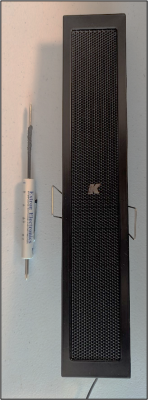
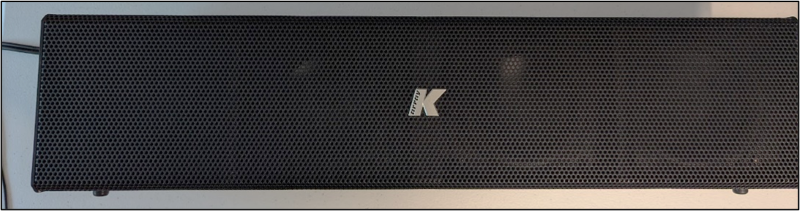
The K-Array Vyper KV25 II is an ultra-flat passive line-array loudspeaker designed for high-quality audio reproduction in design-sensitive environments. It houses four one-inch neodymium full-range transducers in an anodized aluminum enclosure measuring 1.56-inch W x 10.24-inch H x 0.85-inch D and weighing 0.88 lbs. The frequency response extends from 150 Hz to 18 kHz (-6 dB) with a maximum SPL of 108 dB. The 140-degree horizontal 25 vertical dispersion provides broad lateral coverage while maintaining vertical directivity.
Courtesy / Shen Milsom & Wilke
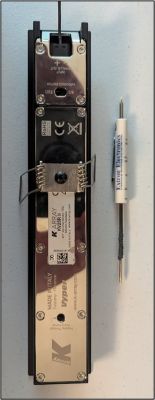
K-Array’s Vyper KV25 speaker is barely thicker than a pencil, allowing it to disappear completely into architectural millwork. Courtesy / Shen Milsom & Wilke
The KV25 II features a selectable 8- or 32-Ohm impedance switch, allowing multiple speakers to be paralleled on a single amplifier channel without excessive load. This system integrates cleanly into millwork using tool-less side clips that hold the speaker flush to the surface.
Courtesy / Shen Milsom & Wilke
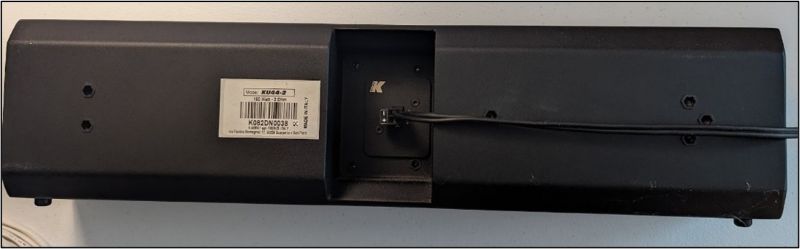
K-Array’s Rumble KU26, is a passive subwoofer with integrated amplifier. Courtesy / Shen Milsom & Wilke
The K Array Rumble KU26 is a compact passive subwoofer designed to deliver low-frequency extension in space-constrained and architecturally sensitive environments. Measuring 13.8-inches W x 7.1-inches H x 4.6-inches D and weighing approximately 12 pounds, the Rumble houses two 6-inch long-excursion woofers in a steel and aluminum enclosure. The KU26 provides bass down to 45 Hz with minimal distortion, intended for reinforcing low-end content in distributed music, retail, hospitality and corporate installations.
K-Array Solution Performance
The system delivers even coverage with notable output for its size, displaying engineering precision and balanced tonality for general program and speech playback. The trade off in form factor is less nuance and texture for critical listening applications, particularly in the low-midrange band.
L-Acoustics: The Performance Powerhouse
L-Acoustics System Components
5XT loudspeakers, SB10i subwoofer, LA2Xi amplifier and P1 processor with LS10 switch
The L‑Acoustics 5XT is a compact, full-range coaxial loudspeaker designed for high-quality audio reproduction in short-throw applications. It features a 5-inch low-frequency driver and a 1-inch high-frequency compression driver in a coaxial configuration, housed in an enclosure measuring 6.5-inhces W × 6.5-inches H × 6.9-inches D and weighing 7.7 pounds. The frequency response is 90 Hz to 20 kHz, with a maximum SPL of 121 dB. With a coverage pattern of 110 degree conical, the 5XT delivers uniform response across the listening area, suitable for fill, delay or foreground music in hospitality, corporate and performance environments.
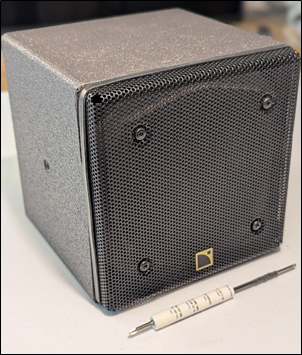
The L-Acoustics 5XT’s coaxial driver design, which places the high-frequency tweeter inside the woofer, ensures a consistent and natural sound quality. Courtesy / Shen Milsom & Wilke
The SB10i is a compact installation subwoofer designed to deliver low-frequency extension in architecturally sensitive environments by housing a single 10-inch 8 ohm down-firing driver in a 21-inches W x 21-inches H x 6.7-inches D enclosure that weighs 33 pounds. L-VENTS ensure that air passes smoothly through the bass-reflex vent, and by maintaining laminar flow through the port, this subwoofer produces clear, deep bass from 100 down to 27 Hz, at a maximum SPL of 124 dB. The vent technology is a key reason why the SB10i performs so well for its size.
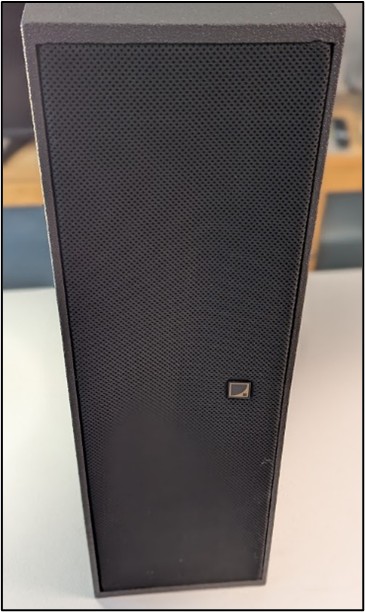
Courtesy / Shen Milsom & Wilke
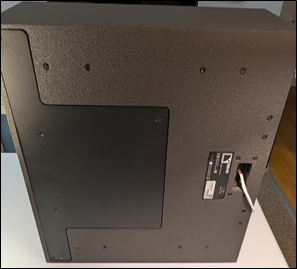
Courtesy / Shen Milsom & Wilke
L-Acoustics System Performance
The L-Acoustics system delivers a full, powerful sound that comfortably supports speech and music at higher output levels. It produces clear mid-range articulation, while the SB10i extends bass smoothly down toward 30 Hz without losing clarity.
Setup involves AVB and AES routing, and a more complex yet versatile interface. The result is clearer midrange, smooth low end from the SB10i, and even coverage across the listening area. The system suits foreground music and environments where performance is paramount.
Feature Comparison
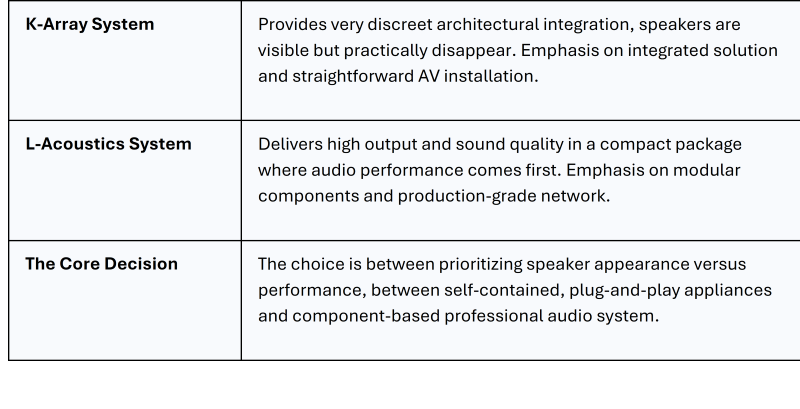
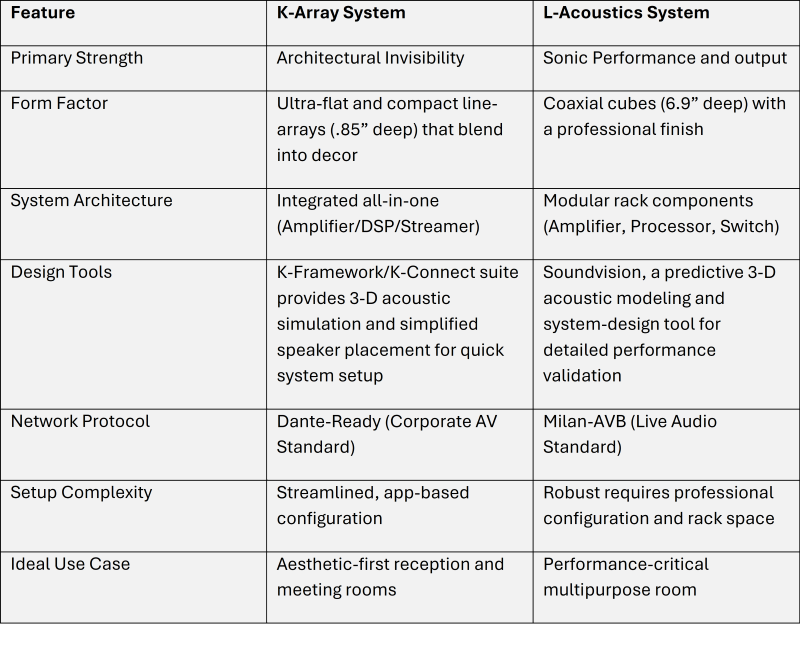
The following table summarizes the key difference between the two systems:
Courtesy / Shen Milsom & Wilke
The K-Array system excels in applications where architectural integration is the highest priority. Its small size and visually unobtrusive design make it ideal for hospitality, retail and design-sensitive corporate spaces, but prioritizing aesthetic invisibility makes this system less suitable for critical listening.
The L-Acoustics system delivers a fuller sound that comfortably supports speech and music at higher output levels but requires more architectural footprint and an equipment rack. This system’s strength lies in installations where listening experience is the primary concern, even if the hardware is more challenging to accommodate architecturally.
Network Philosophy
These two systems approach audio networking very differently. The K-Array package supports Dante, which is the protocol most corporate AV teams already use for audio-over-IP. In contrast, the L-Acoustics system relies on Milan AVB, which provides better performance characteristics required for live sound but less common for corporate networks. To realize the performance benefits of L-Acoustics in meeting rooms, organizations typically need a production-grade audio network with AVB-capable switches, often on a dedicated segment.
Conclusion
In this evaluation, the two systems end up serving different priorities. K-Array focuses on minimizing visual presence while achieving acceptable sonic performance, whereas L-Acoustics accepts slightly larger components to deliver superior audio quality.
The choice depends on whether the project prioritizes aesthetics or performance and the types of program material that will be played back. The decision also depends on the network design, and the system will connect to DSPs, codecs and other devices over the network.
Challenges of Remote Testing
Conducting speaker system evaluations remotely can be challenging. Shipping demo units introduces risk of damage or incomplete cabling, mislabeled and poorly terminated connections. Networked audio systems often require firmware updates, specialized control software and effective remote technical support. Setup complexity can consume valuable evaluation time. Differences in supported audio protocols: Dante is supported in the K-Array and the only version of AES supported by L-Acoustics system is through Q-SYS. These limits in formats and source options underline the need to define networked audio requirements before any equipment is shipped.
Lessons Learned
- Ensure demo units ship fully tested and that cabling is provided, correctly terminated and labeled.
- Confirm network requirements and supported audio protocols in advance (Dante, AVB, AES) and required software downloads.
- Plan for remote technical support sessions to navigate the software interfaces.
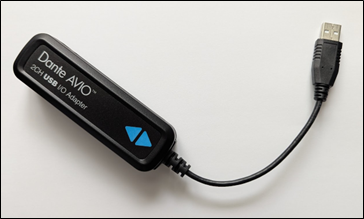
- Use reliable network devices, such as Dante AVIO, to streamline inserting digital audio into the test setups.
- Document the received equipment to avoid disputes about prior damage.
When the demo systems arrive fully prepared, remote testing runs more smoothly and allows a direct comparison of the two packages. With some planning, the systems can be set up next to each other so that differences in sound and behavior are easier to hear than they would be at a trade show or manufacturer demo.
Pro Tip: Dante AVIO
Dante AVIO adapters provide a simple way to feed digital audio into a networked system. They connect via USB and only require free Dante Controller software to configure audio routing. Its low cost and flexibility make it a valuable tool to stream test material directly from a laptop or phone into a Dante-enabled amplifier or DSP.
Courtesy / Shen Milsom & Wilke
Mark Peterson is senior principal and global audiovisual discipline leader at Shen Milsom & Wilke.