
After a challenging 2025 — a year marked by tariff concerns and cautious spending — the pro AV industry forecast indicates we may well be poised for a rebound.
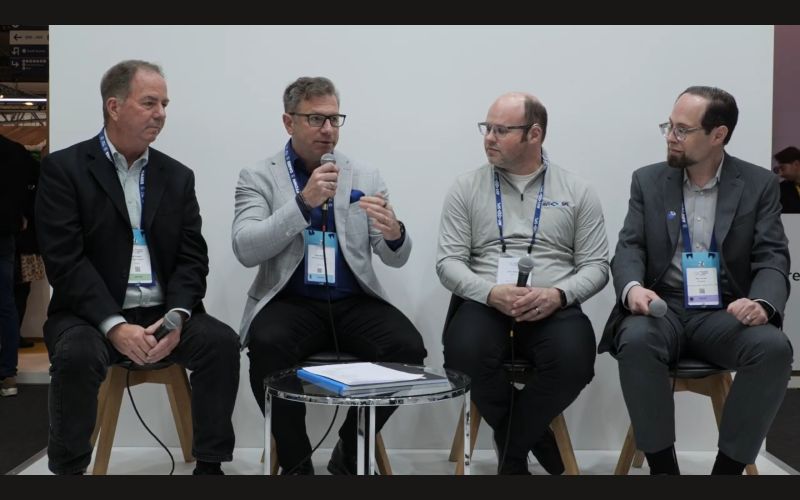
That’s the topline takeaway from a panel I moderated last week at Integrated Systems Europe (ISE) 2026, conducted at the HDBaseT Alliance booth. Our group of panelists included Sean Wargo, principal, Apogee Insight, LLC; John Richards, vice president of engineering, systems integration, AVI-SPL; and Lee Dodson, principal, Apogee Insight, LLC.
I left the conversation expecting modest but better top-line growth of 4% to 5% for pro AV. However, it seems likely that success for integrators and consultants will depend on their ability to strategically target high-value opportunities in specific markets and solution areas.
Pro AV Forecast: Growth Drivers, Ripe Opportunities
These analysts and integration leaders identified several key growth drivers, and we’ll summarize and recap those ripe opportunities here. They include the experience economy, AV’s ongoing convergence with both broadcast and security, and the critical role of managed services.

Although commoditization certainly remains a concern in some sectors, a focus on enhancing user experience and deploying intelligent technologies presents an unencumbered path to integrator profitability.
Navigating a Landscape of Uneven Growth
Wargo characterized 2025 as being a “hedge year” during which end users were cautious, leading to some of the lowest growth rates since the pandemic. He forecasts a better outlook for 2026, but he stressed the importance of identifying specific opportunities rather than expecting uniform growth across the board.
“What’s really important, Dan, is where do you find that growth?” Wargo asked rhetorically. “Some project types, some solution areas, some vertical markets [are] doing better than others. Others are kind of flat and maybe even declining, [and they] may have some more challenges.” He added, “So, I think it’s all about, and has always been about, finding your opportunities.”
Dodson pointed to two areas that continue to show promise: the experience economy and broadcast AV.
Pro AV Forecast: Experience Economy ‘Where Value Is’
“The experience economy is where value is for the whole community, and that is a segment that pulls in the whole pro AV ecosystem,” Dodson explained. He also noted that, as content distribution evolves, segmentation of technology trades is diminishing. That creates new roles and new opportunities for integrators.
“There’s more and more security being utilized in pro AV systems,” he explained. “There’s more broadcast and streaming. We see those lines blurring as the use case evolves, and it’s expanding, which is great for everybody.”
Offsetting Commoditization with Services and Simplicity
Although opportunities are abundant, our panelists also addressed persistent challenges, particularly as regards hardware commoditization in corporate conferencing and higher education. These markets, which benefited from lots of adaptive expenditure during the pandemic, are now experiencing lower growth rates. Wargo made this point, identifying corporate conferencing and collaboration as sitting at the “lower end of growth” due to falling price points and market saturation.
The strategic play for integrators, he argued, is managed services. “What’s happened in our industry is we’ve migrated more and more toward a service offering,” Wargo observed. “The reality of a managed-service offering is becoming more pressing — more real, actually — than we’ve seen in the past.”
Pro AV Forecast: AI and Smart Systems
Wargo continued, “That’s where we’re starting to get into some of the innovations that we’re hearing from the integration community around AI [and] smart systems that help you accomplish the task efficiently of deploying a managed-service offering.”
Richards agreed and added that profitability in commoditized spaces now hinges on speed, volume and simplicity. By standardizing and streamlining deployments, integrators can achieve scale and enhance reliability, while still delivering excellent user experiences.
As Richards put it, “Simplicity is a core item that we have to embrace so that we can do mass room deployments with scalability, reliability and user experience in mind.” He noted that software and simplified hardware, such as multi-camera systems that don’t require complex switchers, are key to creating these efficient, high-quality outcomes in both corporate settings and education environments.
The Year Ahead: AI, Experiences and Multi-Camera Rooms
Looking ahead, the panelists predicted this will be a pivotal year for the industry. Dodson forecasts a “rebound effect” in which clients who opted for cookie-cutter systems begin reinvesting to improve the quality of user experiences, such as with better audio and voice recognition.
For Wargo, the defining trend will be the practical application of artificial intelligence. “For me, 2026 is the year that we see [a] true AI use case,” he predicted. “I’m talking about deployed AI to make networks smarter.” Wargo continued, “For me, this is the year AI really becomes real for pro AV in terms of a use-case deployment.”
Pro AV Forecast: Multi-Camera Meeting Rooms
Richards concluded with a prediction for the modern meeting space that underscores the shift toward more sophisticated, yet simplified, collaboration experiences. “If you don’t have a multi-camera meeting room, you’re going to have one this year — many of them, probably,” he declared. “I would say, that is a standard.” Whether rooms are larger or smaller, he said it is becoming common for there to be two, three or four cameras present. “I mean, it just builds on all the things that we’re so used to,” he added. “Being seen, being heard, intelligent decision-making coming out of those meetings and bringing people together closer in the environment we work in every day.”
To see more Commercial Integrator State of the Industry coverage, check out our recent webinar, produced in partnership with NSCA.