
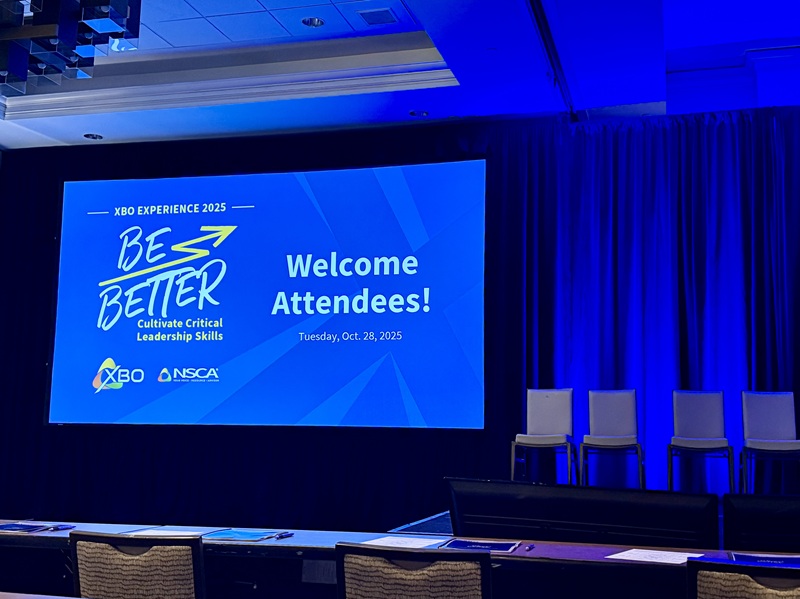
With the pace of technological and organizational change accelerating faster than ever before, how can leaders in the integration industry ensure they are not just keeping up, but actively thriving? The opening keynote session at XBO Experience 2025, titled “Thrive Through Change, Leading with Confidence in Uncertain Times,” tackled this very question.
XBO Experience, a two-day interactive session held on Oct. 28 to 29, 2025 by NSCA, also focused ongoing and emerging trends, as well as education for newer professionals about the industry’s best practices and most proven methods.
With a core theme of “Be Better,” the opening keynote session thus focused on cultivating critical leadership skills necessary for navigating the volatile landscape of modern AV business.
Understanding the Pace of Change
One of the central topics of the opening keynote at XBO Experience 2025 was the exponential nature of change. The session highlighted that we are no longer operating in a linear world. Technology, particularly AI, is reshaping industries at a rate that can feel overwhelming.

Courtesy / CI Staff
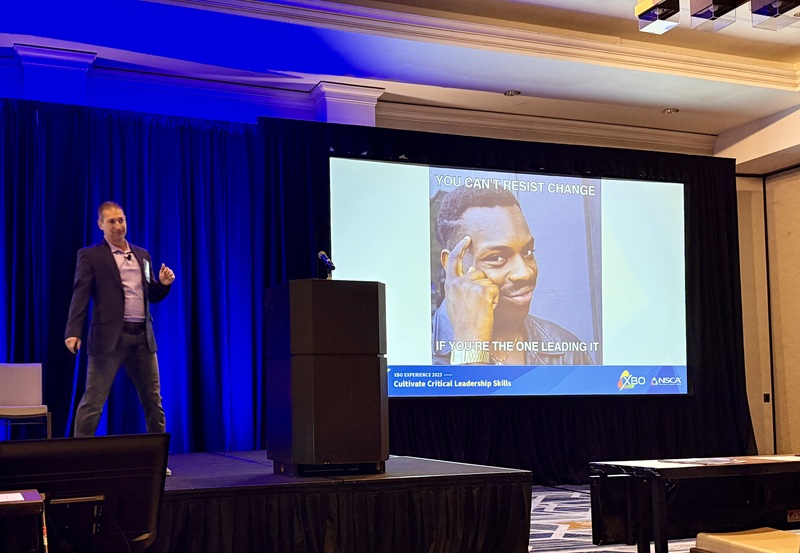
Brandon Conick, chief operating officer at CTI, emphasized that understanding this acceleration is the first step toward leadership resilience.
He pointed to Moore’s Law as a framework for understanding this growth, noting that the capabilities of our tools are doubling while costs decrease, creating a landscape where adaptability is the most valuable currency.
Changing Individual Behavior
Conick dedicated a significant portion of the discussion on the psychology of individual change. Here, he observed that leaders often struggle to implement new strategies because they focus solely on changing thoughts rather than behaviors.
Conick then provided insight into this dynamic. “To create change in the individual, you have to change behaviors and not just thoughts,” he noted. He used the relatable anecdote of “Harold,” a character who fails to wash his hands after cooking despite knowing better, to illustrate how difficult it can be to break established routines.
To overcome this, Conick suggested a philosophy of incremental improvement and positive reinforcement where Harold’s family would verbally acknowledge any time he did wash his hands.
By striving to get 1% better every day, individuals can overcome the inertia of old habits without becoming overwhelmed by the magnitude of the transformation.
Leading Organizational Transformation
Moving from the individual to the collective presents a different set of hurdles. Conick discussed how organizational change is fundamentally different from individual change because of the complex social dynamics at play.
Focusing on the human side of business transformation, Conick proclaimed that while an individual may be smart, groups can be irrational, panicked and unpredictable. “Crowds can be vulnerable to manipulation and easily swayed,” he remarked. “And once the crowd moves in one direction or another, you see those other psychological tendencies factor in [the decision-making process].”
To combat this, Conick suggested that the right play is to focus on strengths as a company or organization, and lean into those when facilitating change. He then highlighted organizational leadership as a key method for uniting groups to drive change.
According to Conick, key strategies for organizational leadership include:
- Identifying Future Leaders: Preparing the next generation of leadership is essential for member companies to evolve and remain relevant.
- Focusing on Strengths: Rather than trying to be everything to everyone, successful companies focus on their core competencies.
- Embracing Reality: Leaders must acknowledge difficult truths to move forward. As Conick stated, “You can’t resist change if you’re the one leading it.”
XBO Experience Opening Keynote: A Call to Action for Leaders
The session concluded with a practical framework for application. Conick urged the audience not to leave the insights in the conference hall but to apply them immediately. He then proposed a simple yet effective roadmap for action:
- Try to change one of your own behaviors first.
- Attempt to change a direct report’s behaviors if you manage others.
- Work toward changing your organization’s behavior.
According to Conick, by following this stepped approach, leaders can build momentum and foster a culture that views change not as a threat, but as an opportunity for growth.
For more resources on leadership development and to stay updated on future events, visit the NSCA website today.