What is the “Oculus”?
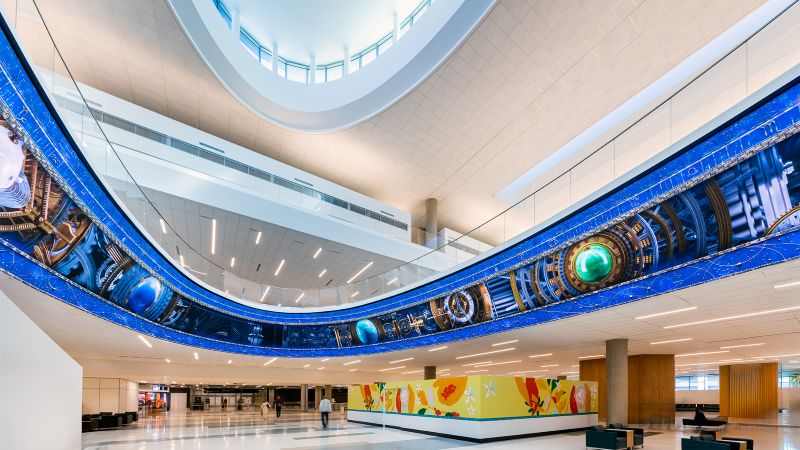
The “Oculus” is a 220-foot curved LED display at George Bush Intercontinental Airport’s Terminal E, designed to welcome travelers to Houston with a blend of art, technology, and storytelling. Suspended at a 60-degree angle between the Arrivals and Departures levels, the display serves as both a media canvas and an architectural centerpiece.
Why is it unique?
Unlike traditional flat LED walls, the Oculus forms a truncated elliptical cone with smooth, connected arcs. Over 2,000 custom-fabricated Nanolumens Nixel Series LED modules were engineered to achieve its precise curvature. The display spans 93 feet in length, 16 feet in height, and covers nearly 1,955 square feet of LED surface.
How was it built?
Ford AV led the system integration, working with Nanolumens, HOK, and Burns Engineering to bring the vision to life. Nanolumens’ Special Projects Group developed 3D models, structural concepts, and custom componentry. The design was divided into eight arc sections, each built from 36 custom polygonal LED modules, ensuring seamless assembly and maintainability.
What are its technical features?
The Oculus boasts a resolution of 34,584 by 1,416 pixels, totaling nearly 49 million pixels, with pixel pitches ranging from 2.0 to 1.4 millimeters for close viewing. Brightness is calibrated to 800 nits for clarity in the well-lit terminal, and thermal management systems ensure reliable operation in Houston’s humid climate.
What does Oculus do?
Beyond its striking form, the Oculus is an interactive storytelling platform. Immersive studio Gentilhomme designed 27 content sequences that interpret Houston’s identity through motion graphics and environmental imagery. Occupancy sensors capture passenger movement, allowing content to respond dynamically in real time.
Why does it matter?
“The Oculus is 100% meant to share the sense of place for Houston,” said Darryl Daniel, chief technology officer at Houston Airports. “For many, this is their first experience of Houston, and for others, it’s the last thing they see before they leave.”
How is it managed?
The system operates with Pixera media servers and is controlled through Smart Monkeys’ ISSAC platform and Nanolumens’ NanoSuite, which provides centralized monitoring, scheduling, and diagnostics for long-term performance.
What’s next?
The Oculus sets a new standard for airport digital signage, blending technology with Houston’s cultural identity. It’s a testament to the city’s innovation and creativity, leaving a lasting impression on millions of travelers each year.