
Every day, integrators are challenged to make decisions that consider a wide array of needs when selecting new hardware, software and systems. Whether your integration project is starting at the drawing board or is in the process of evolution to the ideal state, the path that you take can seem dizzying and filled with so many products, features and solutions that it’s easy to become stuck from the many decisions required.
AV-over-IP systems have become mission-critical in enterprise, education, healthcare and live-event environments; platform decisions can affect performance, security and total cost of ownership. At the core of this decision is a fundamental choice: select an open AV-over-IP platform that prioritizes interoperability and hardware freedom or commit to a closed ecosystem that trades some of the flexibility for an experience controlled entirely by a single manufacturer.
What is the Benefit of Open AV-over-IP Platforms?
Open AV-over-IP platforms transport high-quality multi-channel digital audio and video over standard Ethernet infrastructure. These platforms have achieved broad adoption across the professional AV industry, with compatibility spanning thousands of products from hundreds of manufacturers globally.
At their core, open AV-over-IP platforms begin with the protocols integrated by manufacturers into hardware and software products.

What are Closed AV-over-IP Ecosystems?
Closed ecosystems are platforms where hardware, firmware and software are developed and controlled by a single vendor. All components are engineered by the same manufacturer as a system, ideally working together and eliminating compatibility challenges that can arise in multi-vendor environments.
Closed ecosystems typically combine all devices and management layers under a single system. This provides a consistent approach in exchange for hardware exclusivity and vendor dependency.
Understanding the two approaches is critical to meet the varying ongoing needs of your clients’ AV and IT teams.
Understanding AV-over-IP: Open Platforms vs. Closed Ecosystems
Courtesy / Audinate
Interoperability
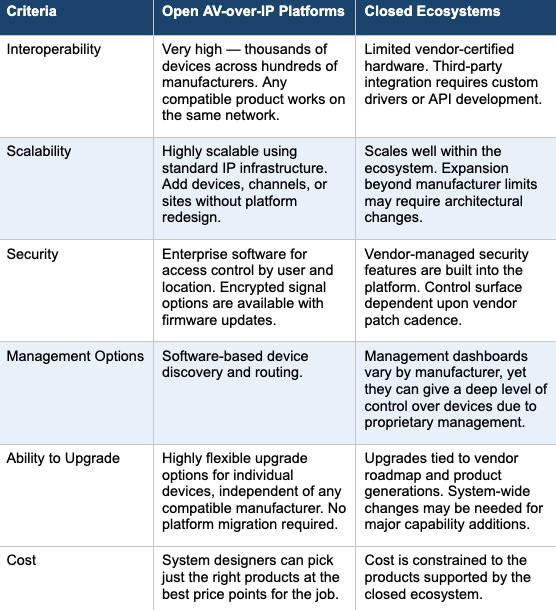
Interoperability is the defining strength of open AV-over-IP systems. Because open platforms have a broad license across the industry, integrators can design systems using the best available product for each application. Selecting a microphone from one manufacturer, a DSP from another and amplifiers from a third is easy, and it can be done with the confidence that all devices will communicate on the same network without custom integration work.
This multi-vendor freedom has practical benefits beyond initial system design. When a specific product is discontinued, a superior alternative becomes available, or a client’s needs evolve, components can be swapped without disrupting the rest of the system. Additionally, the protocol layer remains constant even as the hardware around it changes.
For large installations like convention centers, universities, broadcast facilities, or multi-building corporate campuses, this level of interoperability allows integrators to specify best-in-class products for every application rather than compromising on any single vendor’s full catalog.
Interoperability within a closed ecosystem comes with the expectations seamless compatibility with all components engineered and tested together. However, interoperability beyond the ecosystem’s boundaries has its limits. Hardware must come from the vendor’s own product line, or in some cases, a curated list of certified third-party devices.
Scalability
Open AV-over-IP networking scales across devices, channels and sites using the same Ethernet infrastructure that already supports IT operations. Adding capacity is straightforward: connect additional compatible devices to the network, and they appear automatically in the management software. There is no proprietary hardware bottleneck limiting how many endpoints can be added.
At the enterprise level, management software enables organization of multi-site deployments into logical domains, each with its own access controls and routing configurations. This architecture supports growth from a single room to hundreds of locations without requiring a platform redesign.
Meanwhile, closed ecosystems scale effectively within their defined architecture. Adding rooms, endpoints or functionality is straightforward as long as the expansion stays within the platform’s certified hardware and processing capacity. Organizations planning for rapid or unpredictable growth should carefully evaluate a platform’s documented scaling limits and the cost model associated with expanding beyond them.
Security
Security for open AV-over-IP systems has implementation with both with standard IT systems and management software, enabling administrators to define which users and systems can access specific devices, apply role-based permissions and audit routing changes. This approach integrates naturally with existing IT governance frameworks and gives security teams visibility into AV systems using familiar tools.
On the other hand, closed ecosystems typically offer a vendor-managed security surface. Because all hardware and software originate from a single vendor, the platform can enforce consistent security configurations across all components. The vendor’s security team is responsible for monitoring vulnerabilities and issuing patches.
Upgradability
The upgrade story for open AV-over-IP platforms is one of its most compelling long-term advantages. Because the open platforms are hardware-agnostic, users can upgrade individual components independently and on their own timeline. An organization can replace aging amplifiers with newer models from any compatible manufacturer without touching the rest of the system. This means organizations are not forced into system-wide refresh cycles driven by a vendor’s product lifecycle decisions.
Upgrade paths within closed ecosystems are well-defined but constrained. Vendors typically provide documented upgrade trajectories for their hardware and software, yet may lag more innovative manufacturers in the industry. For organizations that have standardized on a single platform, upgrades within the ecosystem can be straightforward. The challenge arises when upgrade needs exceed what the current platform generation supports. End-of-life announcements for specific hardware can force upgrades on vendor-determined timelines rather than based on organizational needs.
Organizations evaluating closed ecosystems should closely examine the vendor’s product lifecycle policies, typical hardware refresh intervals and the cost model for major version upgrades. Understanding these factors upfront is essential for accurate long-term total cost of ownership projections.
How Should Integrators Choose Open or Closed AV-over-IP Platforms?
Choosing between an open AV-over-IP platform and a closed ecosystem requires an honest assessment of five dimensions: how important hardware flexibility is to the organization’s long-term strategy, how the system needs to scale, what security posture is required, how much operational complexity the end user’s AV team can manage and how the system will evolve over its lifetime.
Open audio networking excels in interoperability, scalability and upgrade agility — making it the right foundation for complex, multi-vendor environments where long-term hardware freedom is a strategic priority. Meanwhile, closed ecosystems excel in a unified approach to device management, making them suitable for organizations that value operational simplicity and single-vendor accountability.
When integrators who understand the strengths and limits of each approach design the systems, the appropriate choice is one that serves clients well — not just during installation but also for the years and upgrades that follow.
Jim Kidwell is principal product marketing manager at Audinate.