
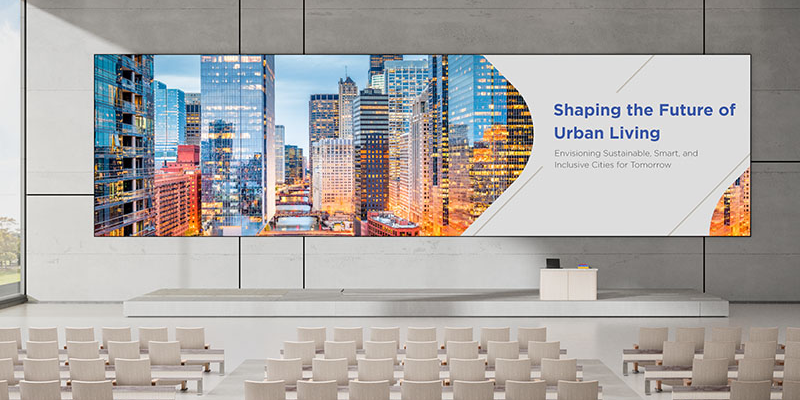
If you’re considering a large video wall, you’re likely weighing two major options. You can choose a traditional LCD video wall or a modern Direct View LED (dvLED) video wall.
Video walls are expanding across corporate offices, schools, and retail stores. Because of this, the choice between LCD and dvLED is more important than ever. Both technologies have their strengths. However, dvLED offers better visual quality, easier maintenance, and simpler installation.
The shift toward dvLED is happening because it offers a cleaner look, a seamless design, and incredible ease of deployment. This is especially true with today’s All-in-One dvLED solutions. Below, we break down the core differences so you can confidently choose the right display for your environment.
Why were LCD video walls popular in the past?
LCD video walls used to be the default choice because the panels were easy to find and had a lower upfront cost. The technology is reliable and familiar. It also provides good image quality when you are standing very close to the screen.

Where LCD still works well:
- It offers sharp visuals.
- It requires a lower initial investment.
- It is a mature technology that many people know how to use.
However, modern environments demand more. You need seamless design and easier integration. This is where LCD struggles.
Where LCD falls short today:
- Bezels break up the content: Every panel has a border. This creates a visible grid when you tile them together.
- It looks bulky: Thick panel stacks can be heavy on the wall.
- Color is inconsistent: When you have multiple panels, the same color can look off on some of the screens, making it difficult to achieve a uniform image.
- Maintenance is complex: LCD panels age at different rates. They require frequent adjustments. Plus, replacement panels rarely match perfectly.
- Installation is hard: Dealing with multiple heavy panels increases the time and complexity of the install.
Why has dvLED become the new standard?
dvLED video walls are built from modular panels. Each LED acts as its own light source. This makes dvLED displays much thinner, brighter, and more vibrant. Most importantly, they are completely seamless.
As the technology has matured, it has become more affordable, providing a more accessible price point alongside improved durability and ease of maintenance. As a result, dvLED is now the preferred choice across nearly every industry.
What makes dvLED the superior choice?
Here are five reasons why integrators and businesses are switching to dvLED.
1. It offers a cleaner, bezel-less visual experience
dvLED panels lock together without visible borders. This creates one continuous canvas with no distracting grid lines. It creates a sleek, modern surface that elevates any room. From lobby signage to control rooms, dvLED delivers a premium look that LCD just can’t match.
2. It has a slimmer profile
Most dvLED systems feature an ultra-slim chassis with minimal framing. Compared to bulky LCD stacks, dvLED are lighter and fit better with modern architecture.
3. It delivers higher brightness and better color
Because LEDs emit their own light, you get much higher brightness. You also get deep color uniformity across the entire wall. Colors remain consistent even when you replace a single module, provided it is a properly calibrated spare. This is something LCD struggles to maintain.
4. Installation and maintenance are easier
The lightweight tiles allow for fast setup. You also get front-service access for quick repairs. The system configures automatically, so you don’t need to calibrate multiple panels manually.
5. All-in-One solutions make integration effortless
The newest dvLED solutions have removed the complexity of large installations. ViewSonic All-in-One dvLED displays integrate power, image stitching, and control systems into one unit.
This turns a multi-component project into a simple plug-and-play experience because it offers:
- Fewer cables and no external controllers.
- Software-free integration with pre-calibrated tiles and image mapping.
- A single power button to start everything up easily.
LCD vs. dvLED: A Quick Comparison
| Feature | LCD Video Wall | Direct View LED Video Wall |
| Bezels | Visible seams between panels | Seamless and bezel-less |
| Aesthetics | Bulkier, grid-like appearance | Clean, modern, uninterrupted |
| Brightness | Limited; struggles in bright rooms | High brightness; fully adjustable |
| Color Uniformity | Replacements disrupt color matching | Uniform color; calibrated spare tiles |
| Installation | Heavy, complex multi-panel setup | All-in-One simplifies installation |
| Maintenance | Frequent replacement of displays | Front-serviceable with hot swappable tiles minimizes downtime |
Final Thoughts
If you are designing a high-impact space, whether it’s a meeting room, a lobby, or a control center, dvLED offers a superior experience. It brings natural advantages that maximize your investment, including seamless zero-bezel designs, superior brightness for well-lit rooms, and wide viewing angles that ensure everyone sees clearly.
While LCD video walls and projectors are still common due to lower initial costs, dvLED is often the better choice for the long term. With easier front-service maintenance and greater reliability, it delivers a better total cost of ownership. For any environment where design, longevity, and performance matter, dvLED is the clear winner.