

Editor’s Note: This article originally launched on Nov. 20, 2025 and now includes an exclusive Q&A updated on Feb. 17, 2026.
As the Official Projector Partner of Cirque du Soleil Entertainment Group, Epson announced its high-performance laser projectors officially debuted in Cirque du Soleil ALIZÉ, opening at Berlin’s Theater am Potsdamer Platz. Helping bring the magic of Cirque du Soleil’s first-ever European residency to life, Epson says it worked with Cirque du Soleil’s technical experts to implement the projection system.
“As its first show incorporating “Acromagic” and its first European residency, Cirque du Soleil ALIZÉ crystallizes a milestone moment for Cirque du Soleil, both from a creativity and a business growth perspective,” says Matthew Nickel, chief show creation and production officer, Cirque du Soleil. “This bold new production allows us to push creative boundaries yet again and we’re thrilled to count on Epson’s technology as we open the door to an entirely original world.”
A New Era of Artistic Innovation for Cirque du Soleil
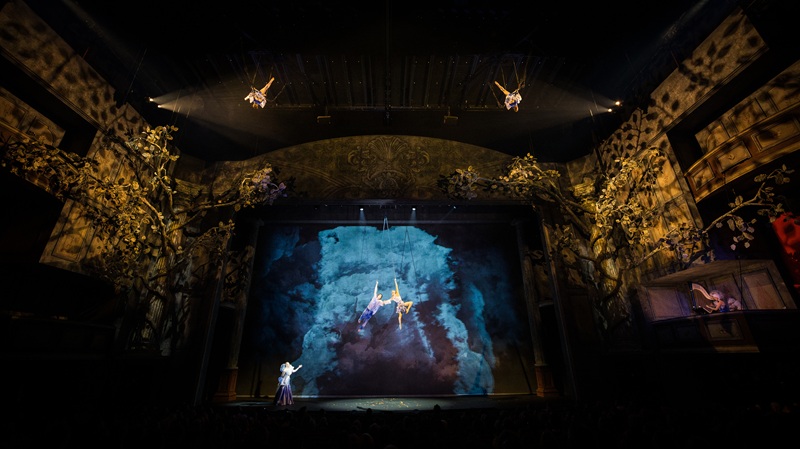
Courtesy / Epson. Credit: Anne-Marie Forker
Per the company, “Acromagic” represents the culmination of more than 20 years of artistic innovation by pioneers of the Magie Nouvelle (new magic) movement, Valentine Losseau and Raphaël Navarro, Directors, Authors, Magic Designers and Invisibility System Designers for Cirque du Soleil ALIZÉ. Magie Nouvelle is reinventing magic, transforming it into a language of artistic exploration and a means of creative expression. ALIZÉ takes Magie Nouvelle and integrates it for the first time with Cirque du Soleil’s signature acrobatics to deliver “Acromagic.”

At the heart of Cirque du Soleil ALIZÉ lies the dedicated work of over 100 technicians and creation team members who collaborated to transform Berlin’s Theater am Potsdamer Platz to meet the unique demands of this complex resident production, says the company. ALIZÉ extends beyond the stage into the auditorium, drawing spectators into a completely immersive experience. Epson notes that its cutting-edge projection technology played a key role in turning this into reality.
“Above and beyond delivering images, the projections in this brand-new production interact with the performance,” says Emilie Emiroglou, director of creation, Cirque du Soleil ALIZÉ. “During early planning, many of us were wondering how we would make the special effects work. With the incredible help of our creative and technical team, as well as the cutting-edge technology behind their talent, we were able to make what seemed unachievable, something real.”
Projection Technology: When Innovation Meets Artistry

Courtesy / Epson. Credit: Anne-Marie Forker
The creative and technical teams behind Cirque du Soleil ALIZÉ proclaim that they are redefining what’s possible in live acrobatic entertainment. For ALIZÉ, the team says it designed a stage in a 3D environment that mirrored the real stage, allowing them to simulate realistic lighting and effects. The team aimed to blend projection so seamlessly into the performance that it feels like light is transforming the set, slowly building intensity and motion until everything comes alive.
“Projection is a powerful tool that helps bring our stories and characters to life; it can transform a set, replace textures and even change the very nature of an object,” remarks Félix Fradet-Faguy, projection designer of Cirque du Soleil ALIZÉ.
According to Epson, projection transforms every part of the theater — from the floor to the set pieces to the performers — creating both a visual spectacle and narrative focus. Large-scale canvases, like the one in Cirque du Soleil ALIZÉ, often require multiple projectors working together. Eight overlaying Epson EB-PU2220B 20,000-lumen large venue laser projectors, paired with a selection of lenses, created the theater’s dynamic canvas, blurring the lines between reality and illusion as each illumination pulls the audience deeper into a world of shifting perception.
How Epson and Cirque du Soleil Addressed the Challenge
Per the company, a major challenge in live entertainment is maintaining projection alignment, especially when the projectors need to move during scenes. While the team can calibrate static projectors in advance, the moving ones require real-time calibration using tracking cameras and infrared trackers embedded in scenic elements. Epson adds that its precise real-time calibration capabilities allow dynamic realignment as projectors are manually moved onstage and effortless adaptation to the diverse installation and placement demands, enabling seamless integration of visual into every corner of the theater.
“Projection technology can create a feeling that time is slowing down or even that actions become deeper and richer,” adds Fradet-Faguy. “It helps us create an experience where we can tell a story and amaze the audience all the while concentrating the attention on human performance.”
Epson and Cirque du Soleil Deliver Another Successful Experience
“To see the end result of Cirque du Soleil ALIZÉ is nothing short of remarkable,” says Jason Meyer, director of product management, Epson America, Inc. “Partnering with Cirque du Soleil on this groundbreaking residency is an honor. This team is crafting unique experiences, unlike anything before seen, that fuse together innovation and illusion while preserving mystery and amplifying wonder. We look forward to the many opportunities that this creative alliance will unlock in the future.”
As the first of many projects together, ALIZÉ demonstrates how Epson’s projection technology can bring new dimensions to Cirque du Soleil’s visionary storytelling, the company states.
Looking ahead, the company further acknowledges that the partnership will continue to evolve as Epson and Cirque du Soleil work together on technology integration into shows that will amplify experiences and captivate audiences.
Exclusive Q&A With Cirque du Soleil ALIZÉ
Commercial Integrator also had a chance to sit down with Simon L. Lachance, production technical director, Cirque du Soleil ALIZÉ, who dives into the exciting aspects of ALIZÉ.
Read on to learn more!
Commercial Integrator: What was the most exciting aspect of incorporating production technology with the creative narration?
Simon L. Lachance: The most exciting shift was treating technology as a language rather than as a spectacle.
With ALIZÉ, we align closely with the philosophy of Magie Nouvelle and Nouveau Cirque. Instead of using technology to demonstrate what is technically possible, we focused on how it could serve the narrative as we are used to doing with acrobatics since Cirque du Soleil started. Projection, automation and media systems are not there to draw attention to themselves; they exist to support emotion in storytelling.
From the outset, the question was not “What can this technology do?” but rather “How can it participate in the story?”
When that balance is achieved, the technology blends and becomes part of the audience’s journey. We ensure that hardware and systems served the artistic intent, and not the other way around.
CI: Apart from the projection alignment, did you face any other challenges during the project? How did Epson help overcome them?
Lachance: Beyond alignment, the main challenges in creation was seamless efficiency.
ALIZÉ is built on multiple interconnected layers — automation, tracking, media and live performance — that must remain perfectly synchronized night after night. In that context, the best technology is the one that does not demand attention. If the team is constantly managing equipment, it takes time and focus away from creation.
What worked particularly well with the Epson projectors is that once the system was set up and calibrated, it became stable and predictable. That allowed the creative and technical teams to focus on refining the experience rather than managing the tools.
The Epson team supported this by investing time early in the process. Through workshops, demonstrations, and technical discussions, they ensured our teams fully understood the product before it entered production. That preparation reduced long-term operational overhead and gave us confidence in the system throughout creation and operation.
CI: How would you describe your partnership with Epson and how you plan to continue to push the boundaries of creativity together?
Lachance: Cirque du Soleil brings the creative vision, narrative ambition, and system-design thinking. Epson provides the technological foundation that allows those ideas to be realized in a reliable and repeatable way.
For us, meaningful collaboration starts early. We value partners who engage in dialogue, understand the broader system, and help us explore how technology can support complex creative goals rather than simply responding to a specification.
Looking ahead, pushing boundaries will be less about adding more equipment and more about integration. As projection, lighting, tracking and automation increasingly converge into a single visual language, partnerships like this allow us to explore new forms of expression while maintaining the stability required for permanent productions.
CI: Is there anything else you would like to add?
Lachance: A project like ALIZÉ is never the result of a single discipline or organization. While Cirque du Soleil is known for what happens on stage, there is a significant depth of technical design, research and experimentation behind the scenes.
We have developed a culture that encourages questioning existing approaches and exploring new ones, while remaining open to input from the wider industry. With ALIZÉ now having a permanent home in Berlin and Cirque expanding its presence in Europe, we see strong opportunities for long-term collaboration and shared development.
Our goal is not only to create ambitious work, but also to participate in a broader conversation about how live entertainment can evolve — together with partners who share that curiosity and commitment.