Key Takeaways:
- DVLED adoption is driven by standardization, scalability and complex designs like curved and outdoor installations.
- Site readiness and trade coordination are key challenges for successful DVLED projects.
- Early collaboration with mounting manufacturers ensures precision and seamless installations.
- Configurable mounting systems enable creative designs while maintaining stability and alignment.
- Long-term reliability depends on micro-adjustable mounts and accounting for thermal expansion and structural movement.
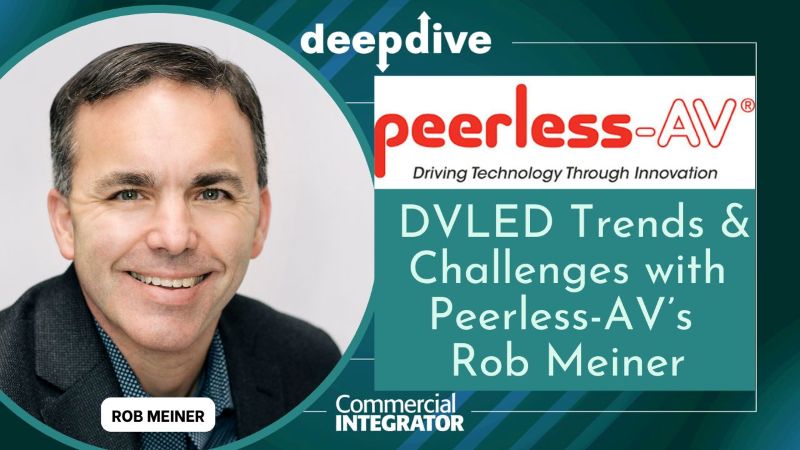
Direct View LED (DVLED) technology continues to transform the AV industry, offering exciting opportunities for creative and impactful installations. In a recent Q&A, Dan Ferrisi, group director of content and editorial at Emerald, sat down with Rob Meiner, technical sales engineer at Peerless-AV, to explore the latest trends, challenges and solutions shaping the DVLED landscape.
Watch the full video Q&A below:
What Are the Key Trends in DVLED Design and Deployment?
As DVLED adoption grows across diverse applications, Meiner highlighted a significant industry shift toward standardization and scalability. Integrators are seeking solutions that streamline deployment, reduce downtime and ensure consistent results. “It all boils down to how quickly you can get that mount system up on the wall and the displays up and running,” Meiner explained.

At the same time, more complex installations — such as outdoor, curved and architecturally integrated designs — are becoming increasingly common. These projects demand precise engineering and mounting solutions to meet the unique challenges they present.
What Challenges Do Integrators Face in DVLED Installations?
Meiner identified two key challenges integrators face when executing successful DVLED installations: site readiness and trade coordination.
Site readiness often involves unresolved issues with wall conditions, structural support or power and data planning before installation begins. Dust and dirt-free environments are also critical, particularly when mounting displays back-to-back. Meiner emphasized the importance of completing the entire installation process in one seamless effort to minimize downtime.
Trade coordination is another hurdle, especially for large-scale projects involving multiple stakeholders including AV integrators, electrical contractors and structural teams. Meiner stressed the need for strong project management to keep all parties aligned and ensure a smooth installation process.
Why Is Mounting Important in DVLED System Design?
According to Meiner, mounting considerations should be integrated into the design phase of any DVLED project. Early collaboration with mounting manufacturers such as Peerless-AV can help identify potential issues with wall conditions, tolerances and serviceability before they become problems in the field.
Meiner shared an example of a collaborative effort involving a systems integrator, display OEM, architect and construction company. By aligning on design specifications early, the team ensured a seamless installation for a concave wall system.
How Can the Right Mounting Partner Unlock Creative DVLED Applications?
DVLED technology offers endless possibilities for creative and nontraditional applications from mosaics to curved displays. Meiner emphasized that having the right mounting partner is essential to translating creative visions into structurally sound and buildable solutions.
“Flexibility comes from having a strong modular foundation,” Meiner noted. Configurable mounting systems allow for a wide range of designs without compromising alignment or stability.
What Should Integrators Prioritize for Long-Term DVLED Reliability?
When choosing a mounting manufacturer, Meiner advised integrators to prioritize systems with micro-level XY and Z-axis adjustments to ensure visual uniformity. He also highlighted the importance of accounting for thermal expansion and structural movement, particularly in environments with extreme temperatures or seismic activity.
“Even a fraction of an inch can throw off the visual uniformity,” Meiner explained, underscoring the need for precision and adaptability in mounting solutions.
What’s Next for DVLED Technology and Installations?
As DVLED technology continues to evolve, Peerless-AV offers integrators the tools and expertise needed to succeed. Meiner’s insights underscore the critical role of mounting systems in achieving outcome assurance and unlocking the full potential of DVLED installations.
For more on DVLED trends and best practices, visit Peerless-AV at InfoComm booth C8725 in Las Vegas and stay tuned for Commercial Integrator’s DVLED deep dive in the May/June CI+SSI print issue and online.