
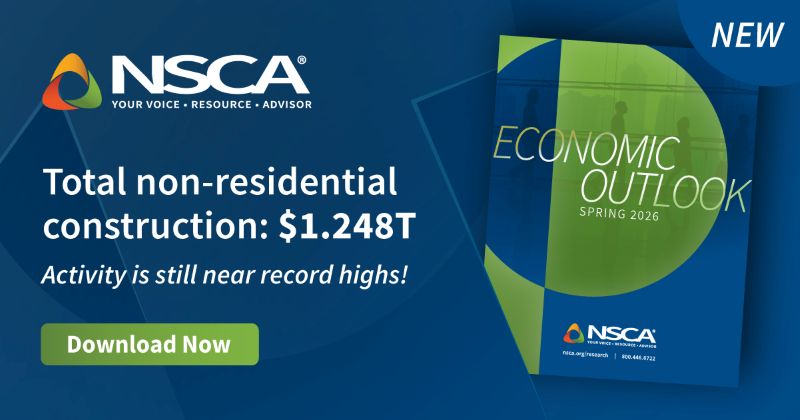
This economy feels like a tangle of mixed signals: Backlogs are solid in some markets but are starting to thin out in others. Bid lists are crowded in some verticals but quiet in markets that used to see lots of activity.
Every week brings a new headline about interest rates, tariffs, AI or labor. The challenge is figuring out which of these signals matter for your business.
That’s where NSCA’s new Economic Outlook Report comes in. It helps integrators wade through the noise to focus on what will affect their pipelines and margins. Developed alongside NSCA Chief Economist Dr. Chris Kuehl and his firm, Armada Corporate Intelligence, the report gives a clear view of what the next few years will look like in terms of construction activity, key verticals and the forces that move projects forward.
A Comprehensive Planning Tool
For many integrators, NSCA’s long-running Electronic Systems Outlook has been a familiar planning tool. This new report keeps construction front and center — just as that report did — while digging into non-residential and residential trends, sector forecasts and regional outlooks.

Instead of listing economic statistics, this report links project pipelines, customer confidence and tech spending to macroeconomic forces such as:
- GDP growth
- Business investment patterns
- Labor market dynamics
- Trade policy shifts
- Regulation and pricing trends
This will provide firm leaders a clear sense of how today’s headlines could change tomorrow’s project list.
Construction Is Strong but Changing Shape
The Spring 2026 Economic Outlook Report puts total non-residential spending at roughly $1.25 trillion on an annualized basis, which suggests that the overall level of work remains high, even with a modest year‑over‑year dip.
Within that, the report points to continued strength in areas like data centers, power, manufacturing and healthcare, alongside softer conditions in other categories and regions.
For integrators that reach across multiple verticals, the implication is clear: Opportunities are real but constantly shifting underfoot.
Unpacking Economic Uncertainty
The report also spends time on what Dr. Kuehl describes as “sneaky” economic issues that rarely dominate industry conversations but have major influence over margins and risk. One example is the loss of legacy technical skills as experienced workers retire.
Many young technicians and engineers are comfortable with modern platforms but have limited exposure to older systems that still run large portions of critical infrastructure. When those systems need to be integrated, upgraded or migrated, firms can find themselves short on people who understand them.
This gap can slow projects, increase rework and make it harder to scope jobs accurately.
Turning Economic Data into Decisions
The Economic Outlook Report becomes especially useful for integration leaders when it connects the dots. For example:
- A chart on business investment is paired with commentary about how corporate spending plans translate into demand for automation, training and equipment.
- A discussion of inventory‑to‑sales ratios is tied to supply chain tightness, product availability and the risk of projects sitting on the shelf because a critical component is on backorder.
- Healthcare, education, manufacturing and data center market discussions are framed in terms of how technology investment trends intersect with construction activity and long-term growth.
So, you can hold your three‑year plan up against the report’s scenarios and stress test assumptions about volume and mix. Or you can use the sector and regional outlooks to prioritize segments and territories. You can even treat the macro commentary as a prompt to revisit hiring plans.
Final Thoughts
The report gives you a common reference point when talking to customers about scope, lenders about risk or internal stakeholders about where to focus their investments.
In short, consider the Economic Outlook Report as a way to see a few moves ahead in a business that rarely stands still.
Visit NSCA.org/research to download your copy today!
Tom LeBlanc is NSCA’s executive director. Learn more about becoming an NSCA member by visiting NSCA.org.