When a commercial shading system requires additional power supplies, gateways, injectors, converters or proprietary control hardware, those extra components rarely attract much attention during specification.
However, during installation, they usually become highly noticeable when telecom closets fill up faster than expected, commissioning takes longer, labor costs increase and each additional device becomes another potential point of failure.
As Power over Ethernet (PoE) shading becomes increasingly common in commercial buildings, systems integrators and specifiers are discovering that products marketed as “PoE shades” can carry dramatically different infrastructure requirements.
Some are designed from the ground up to operate natively on PoE infrastructure; others incorporate PoE into a broader architecture that still depends on additional power conversion equipment or proprietary hardware.

Both approaches can deliver automated shading. But they differ in complexity, scalability and long-term maintenance requirements.
For integrators, consultants, architects and building owners, understanding these architectural differences has become increasingly important; not because one approach is universally right or wrong, but because each carries different implications for installation, commissioning, IT management and future expansion.
What PoE Was Designed to Do
Power over Ethernet was developed around a straightforward objective: eliminate unnecessary infrastructure by delivering both power and communications over a single Ethernet cable.
Instead of requiring separate electrical wiring and network cabling, PoE allows connected devices to operate using standard network infrastructure.
The benefits are well established. Fewer cables reduce installation complexity and labor costs while simultaneously simplifying maintenance.
What’s more, devices can be managed through existing IP networks, meaning IT departments can monitor and administer them alongside other connected building systems.
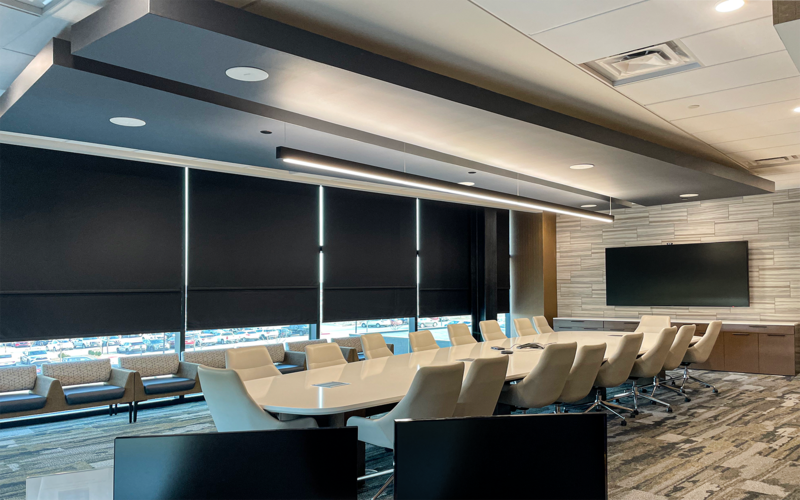
With motorized shades becoming more prevalent in commercial applications, it’s critical to understand what Power over Ethernet (PoE) really means. (Photo courtesy: PowerShades)
PoE technology is governed by standards established by the Institute of Electrical and Electronics Engineers (IEEE), including IEEE 802.3af, IEEE 802.3at and IEEE 802.3bt (Types 3 and 4).
Different shading manufacturers have adopted varying standards depending on their design philosophy. Some leverage the higher power available through IEEE 802.3bt, while others operate efficiently within the lower power limits of IEEE 802.3af, allowing compatibility with lower-cost switches and potentially reducing overall energy consumption.
PoE offers the same potential advantages when applied to automated shading. However, manufacturers have taken different approaches to incorporating the technology.
Some have engineered motors specifically to operate directly from PoE infrastructure; others have adapted existing low-voltage or DC-powered motor platforms by incorporating converters, power-management devices, gateways or intermediary hardware that allow them to function within a PoE environment.
While both approaches use PoE in some fashion, their infrastructure requirements — and the experience they create for installers and building owners — are considerably different. Think of the difference between software designed to run natively on an operating system versus software that requires multiple compatibility layers.
Both may ultimately perform the same function, but the underlying architecture affects deployment, maintenance and long-term support.
Evaluating Native PoE Architecture
While no industry-wide certification currently distinguishes different types of PoE shading systems, there are several objective characteristics that specifiers can evaluate when comparing solutions.
1. Direct Power from an IEEE-Compliant PoE Switch
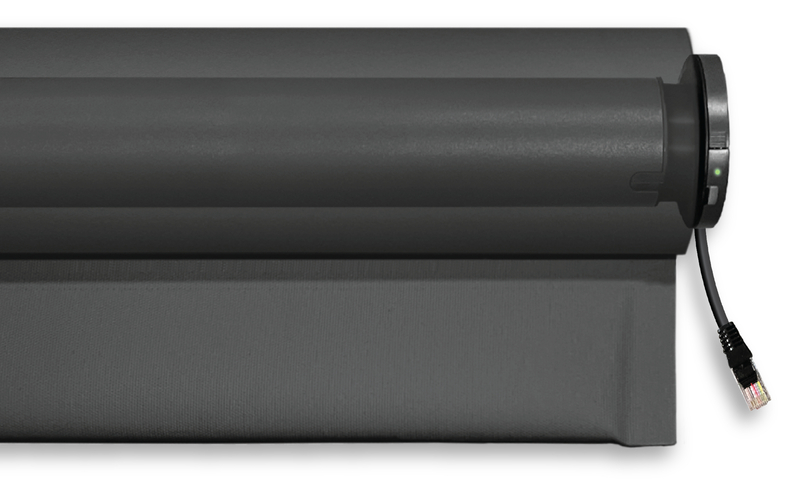
In a native PoE architecture, the motor receives operating power directly from an IEEE-compliant PoE switch, with no external power supplies, proprietary transformers or power-conversion devices required between the switch and the motor.
If additional equipment is necessary to convert, supplement or condition power before it reaches the shade, that’s a different architectural approach with different infrastructure requirements.
2. Single-Cable Architecture
One of PoE’s defining characteristics is delivering both power and communications through a single Ethernet cable. Native PoE implementations generally maintain that simplicity; if additional wiring, separate power circuits or local power sources are required, the installation becomes more complex and moves away from PoE’s original design philosophy.
3. Standards-Based IEEE Compliance
The value of PoE has always been rooted in open IEEE standards. Solutions designed around these established criteria typically offer broader compatibility with commercially available network equipment and greater flexibility for IT departments responsible for managing connected-building infrastructure.
4. Native IP Connectivity
Communication architecture is another important consideration. Some shading systems are directly addressable on the network through native IP connectivity. Others rely on gateways, hubs, controllers or proprietary intermediary devices to communicate with building automation systems.
Native IP communication can simplify commissioning, diagnostics, monitoring, software updates and integration with broader building management platforms, while reducing the number of intermediary devices that must be installed and maintained.
5. Supporting Hardware Requirements
Examining the supporting hardware required for a complete installation is perhaps the simplest way to compare PoE shading architectures.
When systems require injectors, converters, centralized power cabinets, gateway devices or proprietary control hardware before shades become operational, those components add cost, consume space and create additional installation and maintenance considerations.
The closer an architecture comes to a straightforward “switch, cable, shade” deployment, the more closely it aligns with the original infrastructure model envisioned for PoE.
Why Do These Differences Matter?
The differences between architectures may have only a modest impact on smaller projects. Conversely, on larger commercial installations involving hundreds or even thousands of shades, infrastructure decisions can significantly affect installation costs and long-term operations.
Every additional hardware component requires installation, occupies physical space within telecom closets or ceiling cavities, consumes power and introduces another potential failure point. Those considerations can influence commissioning schedules, serviceability and future expansion.
Architectures that rely primarily on standard network infrastructure can also simplify the scaling process. Consequently, adding shades can become an extension of the existing network instead of an expansion of separate electrical systems or proprietary control infrastructure.
Questions Every Specifier Should Ask
Rather than relying solely on marketing terminology, project teams can evaluate any PoE shading solution with a few practical questions. The answers can be a useful element in the ultimate purchasing decision:
- Does the motor receive power directly from an IEEE-compliant PoE switch?
- Which IEEE PoE standard does the system support?
- Does a single Ethernet cable provide both power and communications?
- Is each shade natively IP addressable?
- Are gateways, injectors, converters, transformers or proprietary power hardware required?
- Can the system operate without centralized power cabinets?
- Was the motor engineered specifically for PoE operation or adapted from an existing low-voltage architecture?
The answers often reveal meaningful differences in infrastructure requirements that may not be obvious from product literature alone.
Look Beyond the Label
As automated shading becomes more tightly integrated into IP-based buildings, the industry will benefit from clearer terminology describing different PoE architectures.
Products that operate natively from standards-based PoE infrastructure differ in meaningful ways from systems incorporating PoE alongside additional power or control hardware — even though both may be marketed as PoE solutions.
For integrators and specifiers, the goal is not to determine which architecture is universally better but to understand the tradeoffs each approach presents.
Looking beyond marketing terminology and evaluating the underlying infrastructure can help project teams select solutions that best match the technical, operational and long-term needs of each project.
Jason Turner is the founder and CEO of PowerShades, a designer and manufacturer of manual and motorized shades and a wholly owned subsidiary of Springs Window Fashions.