
Editor’s Note: Here, Commercial Integrator’s editors highlight one of our 2026 Integration Award-winning projects. AVI-SPL earned top honors in the Best Higher Education category. Read on to learn why our judges deemed this project the most impressive higher education project of the year!
Faculty who teach in five different rooms shouldn’t need five different sets of instructions. Yet that’s the reality on many campuses, where each classroom has its own mix of equipment, controls and workflows.
Old Dominion University set out to fix that problem at scale. Its Forward Focus classroom initiative, delivered with integrator AVI-SPL, has now earned the Best Higher Education Project award for building one repeatable classroom model across campus.
Key Things to Know
- The Scope: Forward Focus launched in 2025 and will modernize more than 180 classrooms through 2028.
- Standardization is the core idea: Every instructor station shares common layouts, controls and workflows, so faculty can teach in any room without retraining.
- The tech stack is broad: Rooms include projection and LED displays, interactive boards, wireless sharing, enhanced audio, lecture capture, presenter tracking and document cameras.
- AI is part of the plan: The university calls artificial intelligence an integral part of the classroom ecosystem.
- Scalability drove decisions: The model simplifies support and future upgrades without full room redesigns.
What Is Old Dominion University’s Forward Focus Initiative?
Forward Focus is a multiyear program to modernize more than 180 Old Dominion University classrooms with standardized, technology-enabled learning spaces by 2028. The university launched it in 2025 to meet changing expectations from faculty and students.

Faculty wanted technology they could use the same way in every room. Students expected more interactive and accessible learning.
University leaders describe the program as a shift in teaching, not an equipment swap. Dwayne Smith, executive director of the Digital Integration Environment, makes that distinction directly.
“It’s not a traditional classroom refresh … it is a strategic enhancement of how teaching and learning occur,” Smith says.
Why Did Old Dominion Choose a Standardized Classroom Model?
Old Dominion chose standardization because inconsistent classroom technology creates a steep learning curve for faculty and slows adoption. When every room has different interfaces, instructors spend class time troubleshooting instead of teaching.
AVI-SPL and university stakeholders built one repeatable classroom model rather than a series of separate upgrades. Rooms still vary by size and purpose, but the user experience stays the same.
Consistent stations cut training needs, reduce downtime and make faculty more likely to use the tools in front of them.
What Display Technology Is Inside a Forward Focus Classroom?
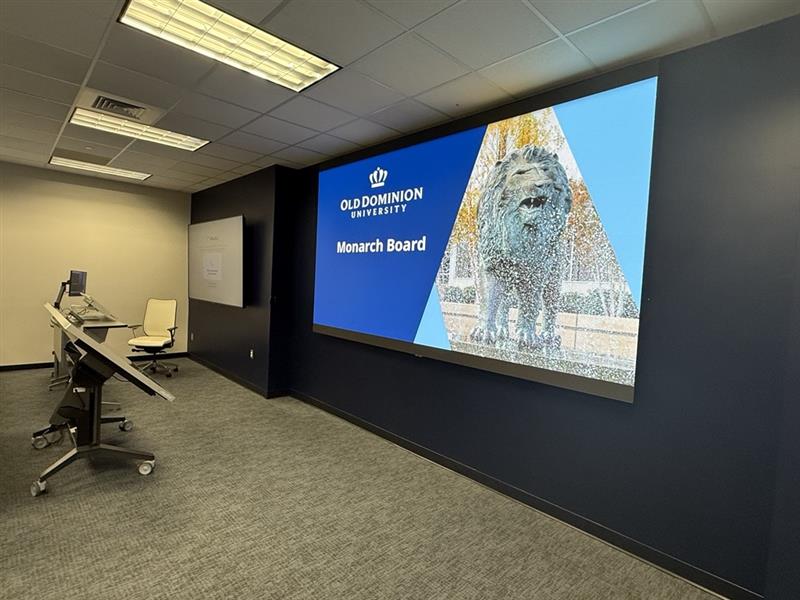
Each Forward Focus classroom uses projection or large-format LED displays matched to the size and layout of the room. The goal is simple: Every student should see presentations, video and discipline-specific software clearly from any seat.
Select rooms add interactive digital boards. Instructors can annotate content in real-time, compare multiple sources side-by-side and build lessons around discussion rather than lecture alone.
How Do Faculty and Students Share Content in the Rooms?
Faculty and students can share content from in-room computers, personal laptops or wireless devices anywhere in the classroom. That flexibility removes the need for instructors to stay tethered to a podium.
Wireless sharing also lowers the barrier for student participation. Students can put their work on screen and contribute to group projects regardless of what device they bring.
How Does Audio Support Hybrid Learning?
Enhanced audio systems make instructors, guest speakers and media content clearly audible to students in the room and those joining remotely. Clear sound is the baseline for hybrid instruction to work at all.
That matters for accessibility too. A student who can’t hear the lecture can’t follow it, no matter how good the displays are.
How Do Lecture Capture and Presenter Tracking Work?
In designated classrooms, lecture capture systems record sessions automatically while presenter-tracking cameras follow instructors as they move. Faculty don’t have to stand still or manage a camera to produce a usable recording.
Students gain the ability to review complex material on their own schedules. Document cameras round out the toolkit, letting instructors share handwritten notes, lab demonstrations, physical objects and printed pages with in-person and remote learners alike.
What Role Does Artificial Intelligence Play in the Initiative?
Artificial intelligence is a planned part of the Forward Focus ecosystem, supporting content delivery, accessibility and student support. The university treats it as a layer built on top of reliable classroom infrastructure.
Smith says AI is “an integral part of this ecosystem,” enabling new approaches to content delivery, accessibility and student support. He also stresses that faculty must still be able to teach effectively as instructional methods change.
For integrators, the takeaway is that AI tools depend on the quality of the audio, video and capture systems feeding them.
How Did AVI-SPL and the University Plan the Project?
AVI-SPL and Old Dominion planned the project through a collaborative process with university leadership, instructional technology teams and faculty representatives. Each technology choice had to tie back to an educational goal.
Equipment was judged on more than performance. The team also weighed usability, scalability and fit with evolving teaching practices.
Smith points to that partnership as a requirement, not a convenience. “Collaboration with industry partners such as AVI-SPL … remains critical to delivering scalable and reliable solutions,” Smith says.
How Does the Design Support Long-Term Scalability?
The standardized model supports scalability by simplifying maintenance, support and future upgrades across every Forward Focus room. When rooms share a common design, one fix or upgrade path applies campuswide.
That means the university can adopt new tools as teaching changes without redesigning individual classrooms from scratch. It’s a framework for ongoing modernization, not a one-time refresh.
Smith ties this to the broader vision of Brian O. Hemphill, President of Old Dominion University. He emphasizes that investing in modern learning environments is essential to supporting faculty and preparing students for a fast-changing world.
What Can AV Integrators Learn From the Project?
The biggest lesson for integrators is that standardization at scale delivers more long-term value than custom one-off rooms. Consistency drives faculty adoption, and adoption is what proves a technology investment worked.
The project also shows the value of planning around pedagogy first. AVI-SPL aligned technology with how faculty teach, rather than letting equipment dictate instruction.
That approach turned more than 180 separate classrooms into one connected system. It’s also what earned the project a 2026 Integration Award from Commercial Integrator.