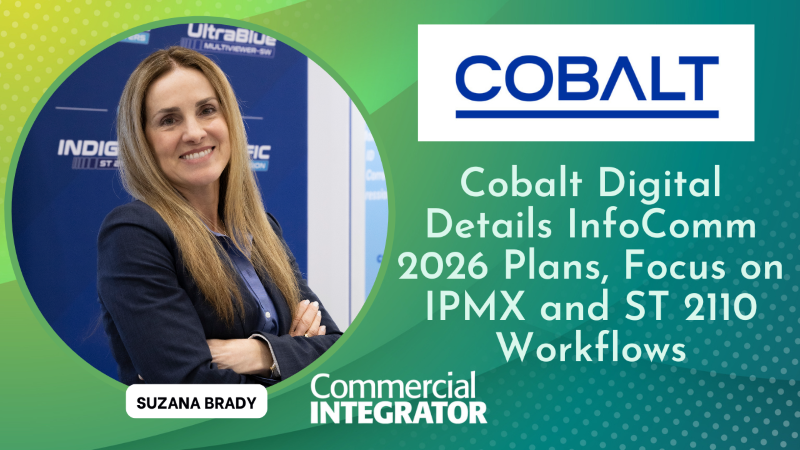
At InfoComm 2026, Cobalt Digital is highlighting practical ways to bring broadcast-level IP technologies into Pro AV and hybrid setups. Suzana Brady, SVP of Worldwide Sales & Marketing, shares how the company’s IPMX and ST 2110 solutions help users modernize without losing SDI support.
In this exclusive Q&A, she spotlights Cobalt’s IPMX-certified products featured at InfoComm 2026, including blueCORE processors, SAPPHIRE converters, ARIA audio, UltraBlue multiviewers and PACIFIC upgrades.
We also explore how Cobalt is making open standards and interoperability straightforward in today’s mixed AV environments.
Cobalt Digital will exhibit in booth N7163 at the Las Vegas Convention Center.

Commercial Integrator: What trends are making the most noise at InfoComm this year?
Suzana Brady: One of the biggest trends shaping InfoComm 2026 is the continued convergence of broadcast and Pro AV technologies. Integrators and end users increasingly expect the same high-quality video, low latency, real-time control and reliability that broadcasters have relied on for years. At the same time, AV users want systems that are simpler to deploy, easier to manage and flexible enough to operate in mixed-vendor environments.
That shift is accelerating the move toward open standards and interoperable IP-based infrastructures, which is why IPMX is generating so much noise across the industry. IPMX brings ‘ST 2110 made easy’ to Pro AV applications, allowing organizations to transition toward IP workflows without abandoning SDI and protecting their investments.
For integrators, interoperability is key. Customers want solutions that can integrate seamlessly with existing systems – avoiding vendor lock-in, and scale over time. IPMX addresses those concerns with a plug-and-play model that combines broadcast-grade reliability with the operational simplicity expected in the AV market.
Another trend that has stood the test of time is the need to do more with less. This is exemplified by customers seeking to consolidate functions such as signal processing, conversion, routing, monitoring, and transport into fewer devices while addressing current workflows and preparing for future evolutions.
Commercial Integrator: How is Cobalt responding to this evolution? What is Cobalt’s biggest news for InfoComm?
Brady: Cobalt Digital has long supported ST 2110 workflows, so expanding into IPMX was a natural progression for us, and we are incredibly proud to be among the first companies to achieve IPMX product certification across multiple product families.
Building on that theme, our focus at InfoComm 2026 is demonstrating how organizations can adopt IPMX and ST 2110 technologies in a practical, approachable way without overcomplicating their infrastructures. We will showcase our end-to-end IPMX-certified ecosystem, which includes openGear® cards, SAPPHIRE mini converters, UltraBlue MV-SW multiviewers, ARIA audio family, PACIFIC encoders and decoders, and our INDIGO ST 2110 gateway product family.
Another major highlight is our newly launched and award-winning COBALT® blueCORE family of standalone signal processors. blueCORE is designed specifically to bridge SDI and ST 2110/IPMX environments in a highly compact and deployable form factor. These 1RU standalone processors combine a tremendous range of audio and video processing capabilities into a single device, simplifying workflows for live production and AV environments transitioning toward IP.
blueCORE supports SDI inputs and outputs in both copper and fiber, four channels of 3G processing or one channel up to 12G, and direct access to ST 2110/IPMX inputs and outputs. Capabilities include up/down/cross conversion, HDR processing, color correction, frame synchronization, frame rate conversion, audio routing and mixing, audio embedding/de-embedding, SCTE 104 insertion, logo insertion, and much more.
What makes blueCORE especially attractive for integrators is its operational simplicity. Deployment is fast and straightforward — power up the unit, connect the signals and it is ready to operate with or without a computer. That flexibility offered with the different platform models and endless software licenses allow customers to modernize infrastructures incrementally while protecting legacy investments.
Commercial Integrator: Are there other products / solutions that Cobalt would like to highlight?
Brady: While we will be demonstrating our entire end-to-end IPMX / ST 2110 ecosystem and while we think they should all be highlighted, there are several standouts product families worth noting.
The COBALT® SAPPHIRE family of IPMX-capable mini converters are available in single, dual and quad-channel configurations. SAPPHIRE converters provide low-latency conversion between ST 2110/IPMX and SDI or HDMI signals. Certain models can simultaneously transmit and receive signals, making them extremely flexible tools for hybrid infrastructures. Their compact footprint makes them ideal for flypacks, control rooms, corporate AV systems and other space-constrained environments.
Cobalt’s ARIA Audio product family includes the industry’s only fully IPMX-compliant audio monitor, providing an easy and reliable way to incorporate professional audio confidence monitoring into IP-based workflows. A customizable touch-display front panel enables intuitive operation with eight individual volume controls for mixing, while remote control is available through a web interface.
We are also highlighting our UltraBlue MV-SW multiviewer family, which gives customers highly flexible monitoring solutions capable of handling both traditional baseband and IP-based sources.
We will also demonstrate enhancements to the COBALT® PACIFIC compression platform including a new ST 2110/IPMX output option for the COBALT® PACIFIC ULL-DEC upgradeable software-defined decoder. The enhancement allows decoded content to be available simultaneously over SDI and ST 2110/IPMX.
The PACIFIC line can also deliver a complete solution for interconnecting IPMX sites over the Internet with “IPMX-to-Internet” and “Internet-to-IPMX” gateways.
Additionally, Cobalt is introducing the COBALT® PACIFIC ULL-DEC + SAT-DEMOD that allows decoding and pass-through of satellite signals, on ASI and over IP via a VB-S/S2 factory-installed demodulator option. In this mode, satellite is used for bulk distribution, and the Internet is used to recover any lost packets, allowing the use of Ku and Ka bands for distribution.
Across all these product lines, the common theme is interoperability, operational flexibility and simplified deployment. Our goal is to help customers adopt IP technologies at their own pace while maintaining the reliability and performance they expect from broadcast-grade systems.
Commercial Integrator: What industries / markets does Cobalt support?
Brady: Cobalt Digital supports a broad range of markets spanning both traditional broadcast and the Pro AV industry. Our technologies are widely used by television networks, local stations, sports broadcasters, production companies and live event facilities. On the Pro AV side, we support corporate communications, hospitality and travel, education, houses of worship, government facilities, esports and entertainment venues, live events and enterprise AV environments.
Ultimately, our focus is helping customers build scalable, open and future-ready infrastructures that deliver high performance today while remaining adaptable for tomorrow’s evolving workflows.
Commercial Integrator: How can people learn more about Cobalt and its products?
Brady: Cobaltdigital.com, email us at [email protected], give us a call (+1 (800) 669-1691), visit us at InfoComm booth N7163.