Key Takeaways
- Ultra-fine precision alignment across three axes is critical to achieving seamless dvLED videowalls.
- Third-party mounting solutions offer a consistent, repeatable installation experience across different display manufacturers.
- Vertical mounting designs and intelligent power platforms protect massive display investments through improved airflow and remote temperature monitoring.
What are the unique installation challenges of dvLED videowalls?
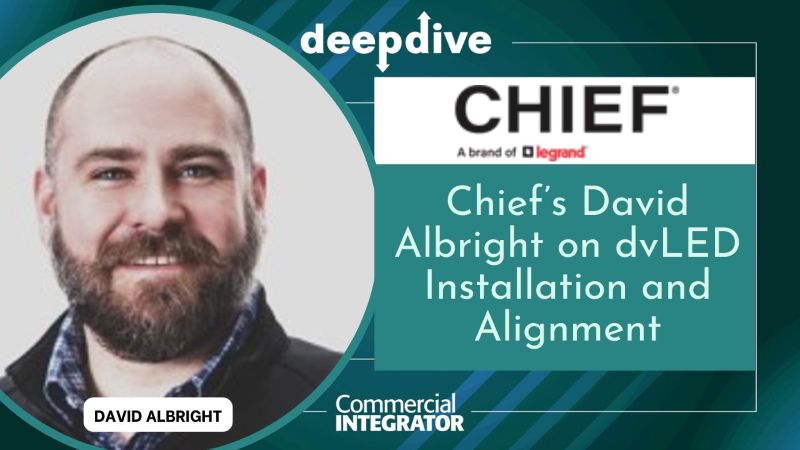
The unique installation challenges of dvLED videowalls center around the need for ultra-fine precision alignment across three axes to achieve a seamless image. While clients invest heavily in these displays for their bezel-less visual impact and high brightness, building a perfect wall requires meticulous adjustments. Building environments naturally shift over time and structural walls are rarely completely flat. David Albright, senior product manager of videowall mounts and services at Chief, notes that specialized mounting systems must accommodate this required precision. These systems give technicians the ability to easily fine-tune alignment issues during the initial setup and return months later to adjust the displays if structural shifting occurs.
Watch the complete video Q&A with Albright below:
How do on-wall and off-wall mounting applications differ?
On-wall mounting relies on existing building structures that require flat foundations, while off-wall applications allow mounting manufacturers to supply their own frameworks. For on-wall projects, Albright recommends installing a three-quarter-inch plywood backing to establish a solid foundation and minimize the time needed for alignment. Conversely, off-wall scenarios like floor stands or ceiling-hung displays make ultra-fine alignment slightly easier because the supplied structure already provides a perfectly flat base. Off-wall solutions are intentionally designed to mirror the familiar experience of hanging multi-display flat panels to keep the process fast and safe.

Why should integrators use third-party mounts instead of OEM options?
Integrators should use third-party mounts because they offer the superior alignment capabilities required for modern sub-1mm pixel pitch displays that many OEM solutions lack. While integrators historically relied on the mounts included in the box, decreasing pixel pitches mean standard OEM mounts often fall short on precision. Albright points out that standardizing on a third-party option like Chief’s tiled mounts gives installation teams a universally repeatable experience. Instead of learning a new mounting workflow for every different display brand they encounter on various job sites, technicians can rely on one consistent method for interlocking cabinets of different shapes and sizes.
How do mounting systems assist with dvLED thermal management?
Chief’s mounting systems assist with thermal management by utilizing vertical designs that ensure unobstructed airflow behind the displays where heat accumulates. Even though modern LED displays operate efficiently, roughly 30% of their heat is still emitted from the back of the cabinet. Providing adequate ventilation space behind the hardware is vital to ensuring the longevity of the videowall.
What real-world value does intelligent power monitoring provide?
Intelligent power monitoring provides real-world value by enabling integrators to remotely power cycle displays during commissioning and automatically shut down systems if ambient temperatures rise unexpectedly. Using Legrand AV’s Middle Atlantic intelligent power solutions paired with the RackLink cloud platform, integrators can install inline temperature sensors behind the videowall. If a building’s HVAC system fails over the weekend and the hardware runs hot, the intelligent system can automatically shut down power to protect the investment. Albright says this capability simplifies front-end setup while giving clients long-term peace of mind.
What new solutions will Legrand AV showcase at InfoComm 2026?
Legrand AV will showcase a new mount-agnostic Tiled Universal trim kit and a free-standing credenza solution designed for all-in-one displays at its InfoComm booth. The universal trim kit ties directly into the wall rather than the mount to give integrators extensive flexibility. It features depth, horizontal and vertical alignment adjustments to eliminate the need to cut sheet metal on the job site. Legrand AV is also partnering with Absen to display the CLV 3 and the Icon 136 all-in-one display. The Icon 136 will be mounted on the new credenza system, which Albright says is an ideal free-standing solution for secure government environments or boardrooms where wall structures are unknown.
What is the most important takeaway for integrators installing dvLED?
The most important takeaway for integrators is that prioritizing the ease, speed and repeatability of the installation experience adds significant value to project teams. Using reliable, universal mounting hardware reduces friction on the job site and ensures a high-quality finish regardless of the chosen display manufacturer. Albright says mounting manufacturers, like Chief, welcome complex engineering challenges and regularly partner with integrators to design custom configurations for highly unique floor-to-ceiling or ceiling-hung videowall projects.