
Editor’s Note: The latest in Commercial Integrator’s InfoComm 2026 reporting, this article discusses Almo Pro AV and its strategy to build even deeper channel partnerships.
Integration leaders have a clear imperative: Build a strong, profitable, resilient business. The distributor relationship is one of the more underappreciated levers to achieving that.
Choosing the wrong partner can mean endlessly chasing quotes and having to manage manufacturer relationships that your team doesn’t have the bandwidth to support. By contrast, choosing a strong distributor partner can mean faster project cycles, stronger design support and better access to vendor solutions, along with a partner that is equally invested in achieving a positive outcome.
During InfoComm 2026, Commercial Integrator sat down with Dan Smith, EVP of Almo Pro AV, and Vishal Chhatralia, SVP of marketing for Almo Pro AV and Nexora. The way that the executives described the business makes clear which kind of partner they intend to be. And that’s why, in a year when Almo is turning 80, the story isn’t the milestone — it’s the operating model.

What Has Kept Almo Pro AV Relevant?
When I ask Smith and Chhatralia what has kept Almo relevant across eight decades of technology shifts, they don’t reach for sentiment. Instead, they point to a deliberate posture toward integrators and vendors that treats them as participants in the business — not as people on the other side of a transaction.
“We genuinely operate with a deep commitment to creating value for our vendors and our customers,” Chhatralia says. “A big part of Almo’s DNA, and why we’ve lasted 80 years, is because we try our best to listen and execute on what people need.”
That partner centricity creates concrete value for integrators.
Smith echoes this, describing the company’s day-to-day role as listening closely to integrators and manufacturers’ needs, and then delivering technology support, education, logistics and custom quoting across tens of thousands of designed projects each year. For integration firms that lack the bandwidth to navigate complex manufacturer relationships or track fast-moving product categories, a distributor’s willingness to embed itself in the design and build process isn’t a convenience; instead, it’s a competitive advantage that builds trust.
And trust, Smith says, shows up in the data. Bid registrations are climbing approximately 19% year-over-year, and IDC data indicates that Almo added 7% in market share year-over-year in May. Integrators, it seems, are bringing more of their work to Almo Pro AV, and they’re bringing that work earlier in the project lifecycle.
If you ask Chhatralia, this kind of momentum stems from Almo having made a deliberate choice about what it wants to be. The company’s leadership has shown a willingness not to chase after business that has the potential to dilute its pro AV focus. “We aren’t in a chase for volume,” Chhatralia explains. “We are in a chase for value and creating the deepest expertise and integration with our partners.”
Commodity IT is a good example. “We stepped away from it so we could double down on pro AV, where we knew we could be the best,” Chhatralia says. That kind of strategic discipline matters because it proves a willingness to let go of something to commit fully to where your business can win.
How Almo Pro AV Can Be an Even More Impactful Partner
This approach has been a pathway, Smith and Chhatralia believe, for Almo Pro AV to be an even more impactful partner to integrators. Rather than allowing itself to be spread thin across categories, Almo goes deep on pro AV, fielding certified salespeople, manufacturer specialists and engineering teams that support design, build and deployment at whatever level the integrator and the project demand.
As Chhatralia frames it, for an integration firm that needs a reliable expert on the other end of the phone, depth is worth more than sheer breadth.
Market performance seems to be validating the approach. “At the minute, the energy is through the roof,” Chhatralia declares. Indeed, returning to IDC data (adjusted to exclude consumer audio and broad IT distribution), he reports that Almo Pro AV held the leading market position in nine of the last 10 months, including an all-time record share of 41% in March and a May outperformance of the broader market of 19%.
“The bids team did 38,000 project registrations, and they’re growing at 19% year on year,” he continues. “So, on that trend, we’ll have done 45,000 projects and bids.”
“That’s not a one-month spike,” he adds. “That’s sustained performance.”
How is Almo Pro AV Investing in Value Creation?
Data also sits at the center of Almo Pro AV’s support for its vendor partners. This, in turn, benefits integrators who work with those vendors. The company has invested in digital transformation across its operations, including a proprietary platform that allows vendors to have direct visibility into market activity and a deeper understanding of what the market responds to.

Logo courtesy of Almo Pro AV.
“We’ve been constructing this new Vendor Intelligence Platform (VIP) to drive a 180-degree shift in how we work. It gives vendors 400 million datapoints at the tips of their fingers, real time, to be able to see what their customers are doing and responding to, to the outmost sphere — which product, which SKU, which sales rep, which region, etc., and the nexus between them all,” Chhatralia says. “They can see four-and-a-half years of activity and performance data, three-and-a-half million email performances that we send out on their behalf, and they can dissect it however they want. “With the core aim to start with the customer; learn learn learn; test test test; and work backwards into strategy rather than starting the other way – a 180-degree shift,” Chhatralia says.
Naturally, when manufacturers make better decisions, integrators benefit downstream: They get more value, support and information; more relevant products; more competitive pricing; and vendor programs built around their actual needs as opposed to internal assumptions.
What’s Next?
The categories that Almo Pro AV is tracking also signal where integrators should be directing their own attention. Video-first collaboration is already driving strong demand for cameras, all-in-one videobars, AI-enabled audio solutions and meeting-space packages from huddle rooms to auditoriums, Smith says. The more significant shift is happening at the design stage, where customers are increasingly asking right from the outset about platform certifications such as Microsoft Teams Rooms. Integrators who bring that conversation forward early, Smith argues, build more complete and more valuable solutions.
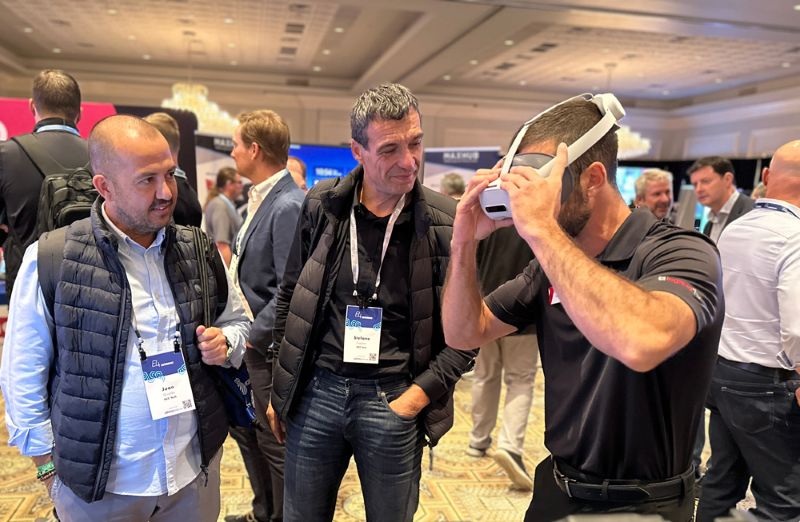
Photo courtesy of Almo Pro AV.
Extended reality (XR) and enterprise drones represent two categories where Almo Pro AV is investing, seizing on early signs of widespread market demand. Smith frames the rationale in terms that any integrator in a fast-shifting technology market will recognize: Assume constant change and position yourself ahead of what’s coming, rather than lagging behind it. Already, XR is growing in commercial deployments, and drone applications are expanding at a pace that sometimes strains product availability.
Toward the end of CI’s interview with Chhatralia, we asked for further clarity regarding the company’s corporate structure amid recent developments. Almo sits within Nexora, which is owned by DCC plc, a public company listed on the London Stock Exchange. DCC is executing a sale of Nexora that it has committed to completing by year’s end. Separately, KKR has made an offer to acquire DCC, primarily for its energy business. Chhatralia emphasizes that both KKR and the DCC board fully support the independent Nexora sale, underlining that the two processes are not in conflict.
The Nexora Business
He is equally direct about what the sale will not mean for the Nexora business.
“Nexora will absolutely not be broken up,” Chhatralia declares. “It will be sold as a single, unified business representing all 25 global specialist companies, with a new investment partner who indeed accelerates our strategy to create more specialist value for partners.”
Commercial Integrator is aware of no official purchase offers as of the publishing of this article. For integrators and vendor partners, the executives’ message is one of continuity.
As noted, the executive interviews took place during InfoComm 2026, where strategy discussions and new business take center stage. But Smith says the relationships that the company has built across the industry run deeper than any single deal. At 80 years, Almo has had a long time to cultivate those relationships.
The question for integrators isn’t whether distribution partnerships matter; instead, it’s how they can leverage them more strategically to win more business and achieve sustained success.