For years, audio in commercial environments was often treated as an afterthought — something added near the end of a project after lighting, displays, networking and infrastructure were already in place. Today, however, that mindset has shifted. Across restaurants, retail spaces, hotels, fitness facilities, wellness centers and mixed-use environments, music and audio experiences have become central components of brand identity and customer engagement.
In these light-commercial environments, audio is no longer simply about filling a room with music. It’s about shaping experiences, reinforcing branding, influencing customer behavior and creating emotional connections with spaces.
As a result, integrators are increasingly being asked to design systems that go beyond basic speaker placement and instead deliver scalable, reliable and easy-to-manage sound that supports broader business objectives.
Whether it’s the energy of a fitness studio, the ambiance of a restaurant or the consistency of a hospitality chain, “experiential audio” can have a meaningful impact on both customer experience and a company’s bottom line.

Consistency Across the Line for Commercial Audio
For businesses operating multiple locations, consistency is often just as important as the sound quality itself. A single retail store or restaurant may be relatively straightforward to manage, but once a company expands to dozens or even hundreds of locations, maintaining a predictable, standardized customer experience becomes much more complex.
Here’s where commercial AV integrators have an opportunity to provide significant value.
A holistic audio strategy allows businesses to establish brand standards that extend across every location. This includes not only the hardware and system design but also the content selection, scheduling, zoning and management tools that support the overall experience.
By standardizing infrastructure and workflows, integrators can help businesses create environments that feel familiar and consistent regardless of geography. This approach also benefits integrators operationally. Once a baseline system design and performance standard are established, future deployments become significantly more efficient.
Instead of redesigning systems from scratch for every project, integrators can replicate proven solutions while making only minor adjustments for floorplans, acoustics or local requirements. That consistency improves deployment speed, simplifies training and often increases long-term profitability.
Creating a Complete and Synchronized Audio Ecosystem
As the role of sound in light commercial environments plays an increasingly important role, integrators are no longer simply installing speakers; they are designing complete ecosystems that encompass not only hardware but content delivery, licensing, control and remote management.
Content – the Missing Link that Gives You an Edge
One critical consideration is commercially licensed music. Businesses require properly licensed content solutions for commercial environments, and integrators should be prepared to educate customers on those requirements while helping them evaluate available options.
In many cases, commercially licensed streaming services can be integrated directly into the audio ecosystem, simplifying deployment and improving overall reliability.
Holistic Design – Grants Ownership of the Entire System
Equally important is maintaining ownership of the overall customer experience. When content delivery, control systems and audio hardware are fragmented across multiple vendors and workflows, integrators often lose visibility into system performance and customer satisfaction.
A more unified, turnkey approach allows integrators to deliver predictable outcomes while simplifying support and long-term maintenance.
That holistic strategy mirrors the way general contractors manage building projects: customers prefer having one trusted professional oversee the complete experience rather than coordinating multiple disconnected vendors themselves.
Multi-User Simplicity – Minimizes Human Error
Commercial spaces present unique operational challenges. Restaurants, hospitality venues, retail stores and wellness centers often have multiple employees interacting with the system daily, many with varying levels of technical comfort. Employee turnover can also create ongoing training challenges.
As a result, intuitive system control has become one of the most important design considerations in commercial audio. Staff members should be able to adjust volume, select zones or trigger pre-configured scenes easily and within prescribed limits. Operational simplicity also preserves profitability for integrators by reducing post-installation service calls.
Flexible Zoning – Creates Unique Audio Vignettes
One of the defining characteristics of modern commercial audio systems is the need for flexible zoning.
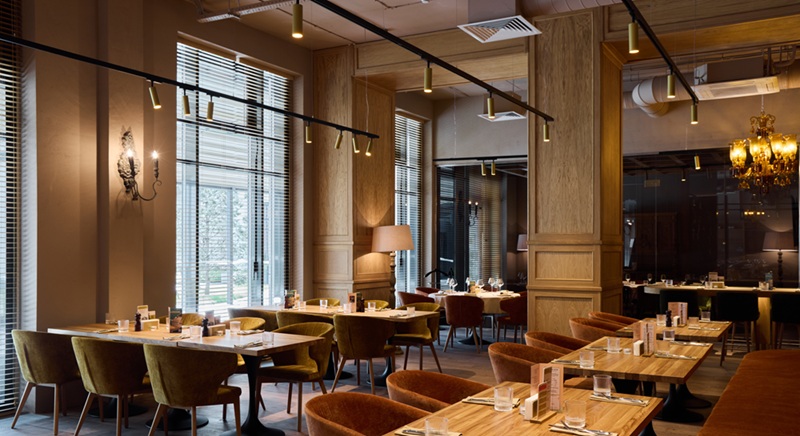
Different areas within the same business frequently require different audio experiences. A hotel lobby may call for calming ambient music, while the adjacent fitness center needs energetic playlists and an outdoor pool area requires entirely different content and volume levels. Similarly, restaurants often need independent control between dining areas, bars, banquet rooms and patios.
By creating distinct zones within a commercial environment, audio can be tailored appropriately for different spaces and distributed simultaneously without sacrificing centralized oversight.
Integrators should consider not only best practices for speaker coverage and acoustics when developing a zoning strategy, but also how content is delivered, managed and controlled to ensure a seamless user experience while helping businesses operate more efficiently and cost-effectively.
Flexible zone configuration also supports evolving business needs. Restaurants may reconfigure layouts, hospitality venues may repurpose spaces, and retail environments may shift branding strategies over time. Systems designed with scalability and adaptability in mind provide greater long-term value.
Uninterruptible Audio – When Sound Can’t Take PTO, Use PoE
Many commercial businesses rely on audio as a core operational element. Sound interruptions in a restaurant, hotel or fitness facility can directly affect customer perception and staff operations.
This need for extreme reliability is driving increased interest in wired-first infrastructure approaches such as Power over Ethernet (PoE). PoE-based deployments simplify installation, reduce cable complexity and improve reliability by minimizing dependence on wireless connectivity. They also provide greater flexibility for retrofits and new construction alike.
At the same time, modern commercial speakers are being engineered with mounting flexibility and installation efficiency in mind. Integrators increasingly need products that support multiple orientations, simplified mounting options and safe installation practices while maintaining consistent audio performance across different environments.
The Profitability Opportunity for Integrators
The rise of experiential audio also represents a significant business opportunity for commercial integrators. Many light-commercial projects have historically been difficult to balance financially due to required control capabilities, time-consuming programming, and limited customer budgets.
However, newer system design philosophies focused on simplified infrastructure, intuitive control, centralized management and scalable deployment models are helping integrators deliver higher-performing systems more efficiently.
More importantly, audio projects can also serve as entry points into broader customer relationships. A restaurant or hospitality client initially investing in background music may later expand into digital signage, lighting control, security or other integrated technologies.
By delivering a strong audio experience upfront, integrators position themselves as trusted long-term partners.
Sound Matters More Than Ever
Commercial audio is no longer just about speakers and playlists. It has become a strategic business tool that influences customer behavior, strengthens branding, and enhances operational consistency across entire organizations.
For integrators, success in this evolving category will increasingly depend on adopting a holistic, end-to-end mindset, one that considers infrastructure, content, usability, scalability, licensing, reliability and long-term customer experience as interconnected parts of a single solution.
Luke Heckel is commercial sales manager, Americas at Sonos.