
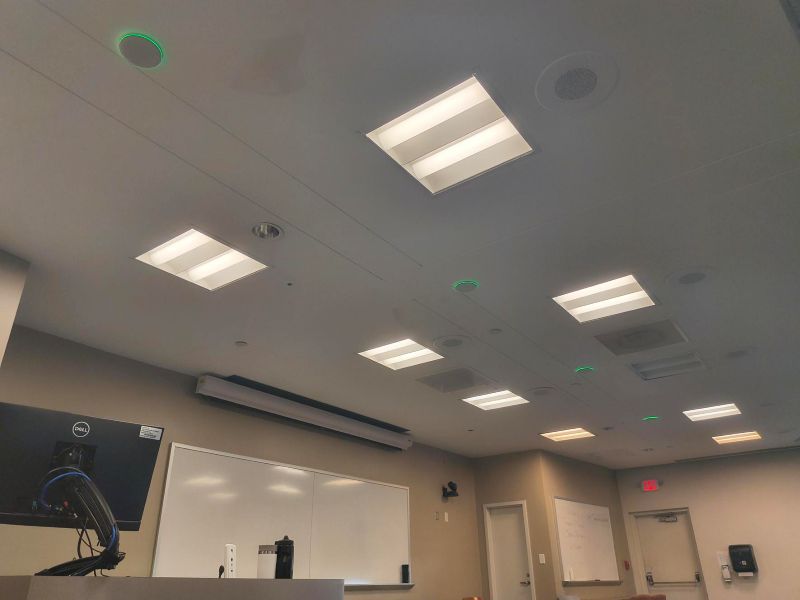
Biamp has deployed Parlé Voice Lift at Emory College of Arts and Sciences in Atlanta, bringing natural voice reinforcement to classrooms without handheld or wearable microphones. The solution runs on Parlé TCM Beamtracking ceiling microphones and TesiraFORTÉ X processors already installed across more than 120 teaching spaces, so instructors and students can lecture, discuss and present without wearing or holding a mic. For integrators, the project shows how to add voice lift to a room without touching the microphone infrastructure.
Key Things to Know
- Biamp deployed Parlé Voice Lift at Emory College of Arts and Sciences, part of Emory University in Atlanta.
- The solution uses existing Parlé TCM Beamtracking ceiling microphones and TesiraFORTÉ X processors across 120+ teaching spaces.
- It eliminates handheld and wearable microphones, recharging docks and disposable batteries.
- Roughly 140 campus learning spaces run Biamp systems, including about 300 Parlé TCM mics and TesiraFORTÉ X 400 and X 800 processors.
- No new microphone infrastructure was required.
What Did Biamp Deploy at Emory College?
Biamp deployed Parlé Voice Lift at Emory College of Arts and Sciences, reinforcing an instructor’s voice through ceiling microphones the campus already owned. The college serves more than 5,000 undergraduate, graduate and doctoral students, and the solution lets faculty lecture and present without a handheld or wearable mic. Voice lift picks up the instructor and reinforces that audio naturally within the room.
The approach removes a familiar burden. By building on existing Parlé Beamtracking mics and TesiraFORTÉ X processors, Emory added voice reinforcement without a parallel microphone system to manage or maintain.
Why Did Emory Avoid Traditional Voice Lift?
Emory avoided traditional voice lift because handheld and wearable microphones create constant management problems. Wireless bodypacks, recharging docks and disposable batteries each add a point of failure, and gear can end up misplaced, uncharged or missing when faculty need it.

Griffin Fisher, manager of classroom technology services at Emory College of Arts and Sciences, points to the battery tradeoff as a core issue.
“Whether we go with rechargeable or disposable batteries, there are different issues we find,” Fisher says. “We have not introduced traditional voice lift in a lot of spaces because of those challenges.”
How Does Parlé Voice Lift Work?
Parlé Voice Lift reinforces the instructor’s voice by pairing existing Parlé Beamtracking ceiling microphones with TesiraFORTÉ X processors. The mics track the presenter as they move through the presentation area, and the processors reinforce that audio so it carries across the room. There’s nothing for the instructor to wear, hold or switch on.
Emory piloted the system in the college’s Anthropology Room 303. Because the room already ran Parlé mics and a TesiraFORTÉ X processor, the pilot tested the voice lift capability rather than a new install.
Did the Project Require New Microphone Hardware?
The project required no new microphone infrastructure because the campus already runs Biamp systems in about 140 learning spaces. That installed base includes roughly 300 Parlé TCM Beamtracking ceiling microphones along with TesiraFORTÉ X 400 and X 800 processors. Parlé Voice Lift activates within that existing ecosystem rather than adding a separate layer of equipment.
For integrators, that’s the practical takeaway. When a room already has Beamtracking mics and a compatible processor, voice lift can extend what’s installed instead of driving a new hardware spec.
What Does Emory Say About the Results?
Emory describes the result as reinforcement that simply works, with no equipment to track or charge. Fisher frames the appeal around reliability and the absence of the gear that usually comes with voice lift.
“There are no handhelds, no disposable batteries, no recharging docks. It’s like magic,” Fisher says. “We really do want solutions that just work. Whether it’s pushing the ‘ON’ button and everything comes on, or microphones that are simply part of that ‘just works’ equation, that’s something we’re hugely interested in.”
What’s Next for Biamp and Emory?
Biamp is helping Emory evaluate additional deployments following the pilot’s success. One candidate is a large administrative meeting room used by university leadership, which would extend voice lift beyond the classroom. The Biamp ecosystem on campus also supports conferencing, lecture capture and hybrid learning.
Joe Andrulis, executive vice president of corporate development at Biamp, ties the pilot’s value to how little it asks of the people using it.
“The pilot delivers natural voice reinforcement that increases presenter confidence while remaining virtually invisible to faculty, students, and IT staff alike,” Andrulis says. “Following its success, Biamp is helping Emory evaluate additional deployments, including a large administrative meeting room used by university leadership, extending the Biamp ecosystem that also supports conferencing, lecture capture, and hybrid learning across campus.”
What Can Integrators Take From This Project?
Integrators can take away a clear model for adding voice reinforcement without expanding the hardware footprint. Emory’s pilot shows that rooms already built on Parlé Beamtracking mics and TesiraFORTÉ X processors can gain voice lift through the existing system, which cuts both installation work and the ongoing support tied to batteries and wireless gear.
The project also points to a selling angle for education and corporate clients. A voice lift solution that stays invisible to faculty and IT reduces day-to-day friction, and leaning on an installed base keeps the deployment simple from spec through commissioning.