
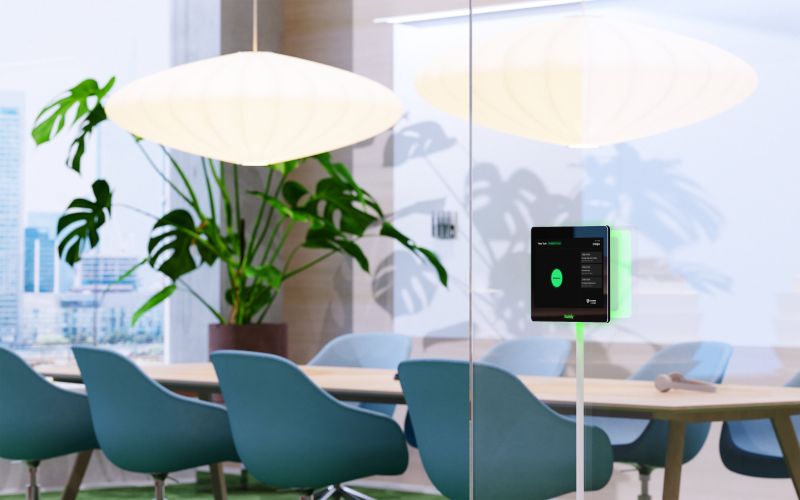
Swedish workplace technology provider Humly and workplace experience platform Comeen by LumApps announced a technology integration partnership. The deal connects Humly Room Display hardware with the Comeen by LumApps meeting room platform.
The companies say the integration gives organizations a way to pair enterprise workplace software with purpose-built room hardware. It covers room booking, workplace analytics and AI-assisted scheduling. Both companies also plan future sensor-driven features.
Key Things to Know
- What’s new: Humly Room Display devices now work with the Comeen by LumApps workplace management platform.
- Core functions: The integration supports room booking, availability displays, booking rules, workplace analytics and wayfinding.
- AI booking: Employees can book rooms through Google Chat, Microsoft Teams and Slack using AI-powered recommendations.
- Ghost meetings: The companies say ghost meetings make up nearly one-third of meeting room bookings, and the system is designed to reduce them.
- What’s next: Both companies plan to expand into occupancy, environmental and utilization data through Humly Sense.
- Where it’s available: The partnership supports organizations in Europe and North America.
What Did Humly and Comeen by LumApps Announce?
Humly and Comeen by LumApps announced an integration that lets organizations running the Comeen by LumApps platform deploy Humly Room Display hardware outside meeting rooms. The displays show room details and availability and support workplace navigation.
The companies say the setup works for new installations and existing deployments in enterprise environments. That matters for organizations that already run one of the two systems and want to add the other without starting over.

How Does the Humly and Comeen Integration Work?
The integration links the Comeen by LumApps scheduling and analytics software to Humly’s physical room displays, so booking data appears at the door of each space. Employees can check availability at a glance and book a room on the spot.
On the software side, organizations can set booking rules and use workplace analytics to see how rooms actually get used. The goal, according to the companies, is better decisions about office space based on real usage rather than reservations alone.
How Does AI-Powered Room Booking Fit In?
AI-powered booking lets employees reserve rooms directly from Google Chat, Microsoft Teams or Slack without opening a separate app. The system recommends a space based on availability, capacity, equipment and location.
The companies say this approach speeds up booking for employees. It also gives organizations better insight into which rooms people choose and why.
What Are Ghost Meetings and Why Do They Matter?
Ghost meetings are reservations for rooms that go unused, and the companies say they account for nearly one-third of today’s meeting room bookings. Those empty reservations block rooms that other teams could use.
For facilities and IT teams, ghost meetings distort utilization data and create the false impression that an office needs more meeting space. The integration pairs booking rules with room displays and analytics to help organizations identify and reduce them.
What Do Company Leaders Say About the Partnership?
Leaders at both companies say the partnership revolves around open integrations and flexibility for customers. Anders Karlsson, CEO of Humly, ties it to the company’s broader strategy.
“Organizations want workplace technology that works together seamlessly, regardless of the platforms and hardware they choose,” Karlsson says. “Our partnership with Comeen strengthens Humly’s commitment to open integrations and workplace ecosystems that give customers greater flexibility.”
He adds that the combination opens new options. “By combining Comeen by LumApps’ powerful workplace experience platform with Humly’s trusted hardware devices and future sensor capabilities, we are creating new opportunities for organizations to deliver smarter, more connected workplace experiences,” he says.
For Comeen by LumApps, the partnership adds a certified hardware option to its platform. Ben Gauthier, general manager of WEX at Comeen by LumApps, points to customer demand.
“Our customers are increasingly looking for workplace solutions that combine powerful software with reliable, purpose-built hardware,” Gauthier says. “This integration with Humly is a natural fit. Together, we can give organizations a seamless way to manage meeting rooms, improve visibility on available spaces and use workplace intelligence to reduce ghost meetings, understand real usage and optimize every room.”
What Is Humly Sense and How Could It Expand the Integration?
Humly Sense is Humly’s open sensing gateway platform, and both companies see it as the path to expanding the integration beyond scheduling. Future additions could include occupancy monitoring, environmental data and utilization analytics.
The companies haven’t announced a timeline for those features. Humly describes the effort as part of a larger plan to build an open ecosystem that connects workplace hardware, software platforms and intelligent building systems through interoperable architectures.
What Does the Partnership Mean for Commercial AV Integrators?
The partnership gives integrators a certified hardware and software pairing to spec for clients that want room scheduling, analytics and chat-based booking in one deployment. Because it supports existing installations, integrators can add Humly displays to current Comeen by LumApps environments or bring the platform to sites already running Humly hardware.
The planned Humly Sense expansion could also shift conversations with clients. Sensor-based occupancy and environmental data may give integrators a stronger case for projects tied to space planning and utilization, not just room reservations.
Where Is the Humly and Comeen Integration Available?
The integration supports organizations across Europe and North America.
Both companies say the partnership lays the groundwork for future collaboration on workplace analytics, occupancy insights, environmental monitoring and broader workplace experience projects.