
During L-Acoustics’ first-ever Media Software Summit on Oct. 7, L-Acoustics revealed its plans to give every Soundvision Connect user the collaboration tools it had formerly reserved for its certified provider network. What’s more, it has added a higher-capacity tier, Soundvision Connect Plus, that is free for the first year.
Scott Sugden, director of product management, innovation, and David Reid, product marketing manager, software, describe the changes as part of L-Acoustics’ evolution into what Reid calls “a platform ecosystem company,” with software as “the connective tissue of the entire ecosystem.”
For integrators, the most practical pieces are tools for sharing designs with clients, as well as for troubleshooting installed systems without having to roll a truck to the client’s site.
What Changed in Soundvision Connect?
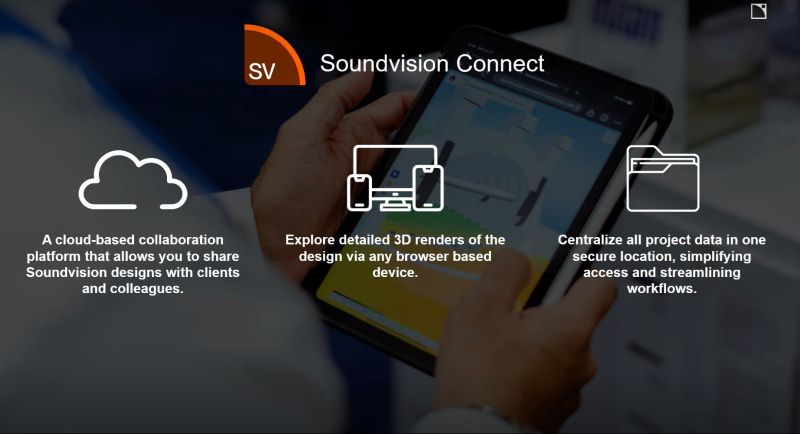
Soundvision Connect, introduced in 2025, is a browser-based platform for sharing Soundvision designs as interactive 3D models. It empowers architects, consultants and venue owners to explore a design via web browser on any device.

Since the start of this year, L-Acoustics’ Certified Providers have enjoyed several added features. For example, users can attach comments to specific components, store multiple design versions for A/B comparison, view a full equipment inventory linked to product specs and download Soundvision project files.
The free base tier allows three projects, three versions per project and three project owners. Meanwhile, Connect Plus raises those limits to 1,000 projects, eight versions per project and 10 owners. Reid notes that, at the base tier, it’s easy to “hit the ceiling” quickly; that makes the step up especially meaningful.
Soundvision Connect Plus is now available, at no cost, for the first 12 months. L-Acoustics says that pricing details beyond the first year are coming. Users can upgrade by registering through L-Acoustics’ All Access platform.
Why Soundvision Connect Matters for Integrators
Reid frames Soundvision Connect as a fix for fragmented project communication: long email threads of PDFs and screenshots in which the current version of a design can easily become lost. Centralizing everything, he says, “can even be the difference between winning or losing a project or a bid.”
What’s more, the sharing is close to real time. The designer can edit in Soundvision and re-share, and then viewers just refresh to see the change. Sugden notes that clients don’t receive a static image; rather, they receive a 3D model that they can rotate, zoom and annotate. Comments appear as they are posted.
Troubleshooting From the Desk
In response to a Commercial Integrator question about how L-Acoustics’ integrated measurement and calibration tools support integrator enablement, Sugden says, “When we use our full workflow from system design, operation [and] calibration, what the integrator will walk away with is a calibration file, as if they are in the venue with 20 to 30 microphones.” If an artist, engineer or venue calls their integrator partner to relay a problem they’re experiencing, the integrator is perfectly positioned to help without having to roll a truck.
“They can verify the settings that they have, and say, ‘You know what it looks like? It looks like you have flipped the polarity of your subwoofer since we left. It looks like you have added an EQ in at 100Hz…,’” Sugden continues. “Once we hit the system, we can then see if the changes that have been implemented since that person left have caused this issue. And that’s all because of that measurement data set incorporated with the DSP platform.”
Sugden had raised this very kind of scenario earlier, imagining a call about a church whose audio sounds strange because a house engineer accidentally flipped the subs’ polarity. “All of that can be seen from their desk at home without having to deploy someone [onsite],” Sugden says. This is a clear business enabler for integrators, for whom time on the road is money.
Discussing L-Acoustics’ M1 measurement and system calibration software suite, Sugden adds, “It is a force multiplier for your measurement and dataset. If you have one or two microphones, you can have the effect of 30 or 40 in the venue because of the way it stores, processes and manages the data.”
Soundvision Update Launches Today
The next Soundvision release, available today, targets performance on Apple silicon Macs. L-Acoustics says that many everyday operations will be more than 1.5 times faster; what’s more, beta testers have already reported better mapping, a more responsive interface and improved workflow efficiency. In addition, this release introduces EASE export support for L1 systems.
A Software-First Strategy
The L-Acoustics Media Software Summit’s larger message was that software now sets the pace at a company that may be best known for loudspeakers but whose research and development spans far beyond them. Sugden recalls that, around the time he joined in 2009, L-Acoustics’ R&D team was seven people, none of them dedicated to software. Today, more than 40 people focus their efforts on software.
That investment in human capital has resulted in blazingly fast development cycles. “It’s not a new system every 10 years,” Sugden says. “It’s a new software product every few months.”
L-Acoustics’ software portfolio now includes not only Soundvision and Soundvision Connect but also LA Network Manager, M1, the L-ISA spatial audio platform and its free L-ISA Studio and two machine-learning products, L-Acoustics DJ and Source Intelligence. The latter, introduced in May, isolates a live vocal from stage noise, reducing the risk of feedback. Sugden notes that it’s already in use at major corporate events, as well as on tours.