
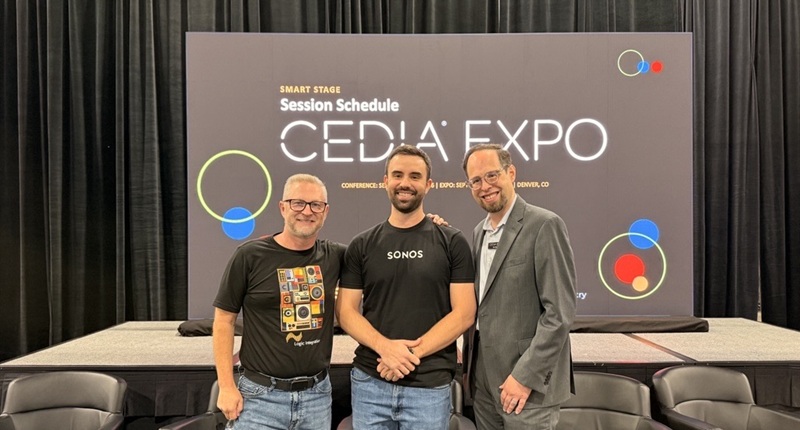
When Shawn Hansson sits down at a restaurant, he doesn’t just order. Eventually, he looks up.
“I look at the TVs,” Hansson, founder and CEO of Logic Integration in Lone Tree, Colo., says. “I look at the hanging wires. Maybe there’s a speaker out.”
Integrators who notice the same flaws should act on them, he says. “Why not say something?” Hansson asks rhetorically. “Ask for the manager.” His suggested pitch is disarmingly straightforward: “Do you want us to come in and make this look better? That’s what we do.”
That thinking captures the idea behind “From Homes to Main Street: Scaling to Light Commercial Projects,” a Smart Stage session held at CEDIA Expo 2026.

Hansson and Chapin Ruark, account manager at Sonos, explained to a packed audience of residential integrators that they can grow into doing light commercial work.
But they also emphasized what to avoid and why partnership matters.
Dan Ferrisi, group director of content + editorial, industrial + tech, Forge, moderated the session.
Already Working With These Clients
Ruark defines “light commercial” as small mom-and-pop shops, restaurants, bars, gyms and salons, many of which are owned by the same people whose homes integrators already serve.
“This is a great opportunity for you guys to break into doing [those clients’] businesses, as well,” Ruark suggests.
Asked to make the case to residential specialists who may be skeptical about light commercial, Hansson points first to leveraging existing relationships. “Well, we’re already working with these clients,” he says, pointing to the white-glove service they’re accustomed to for their residential projects. “We’re in their homes. We have their contact information.”
Many homeowner clients work for large companies, Hansson notes, and he’s found that asking about their meeting spaces has won projects for his firm.
Ruark points to diversification as another key element — a pathway for reducing reliance on new home construction and facilitating recurring monthly revenue (RMR). “There’s a lot of RMR opportunities that are in commercial spaces, as well,” Ruark says.
Hansson layers in a cash-flow argument. A custom home can take many months — indeed, a year or more — to build. That leaves dips in revenue after the initial deposit. Quick-turn commercial jobs fill those gaps, smoothing what he calls “the shark-tooth effect” on integrators’ profit-and-loss statements.
Low-Hanging Fruit for Residential Integrators
So, where should a residential specialist start when tackling light commercial? Ruark suggests pivoting from home offices to the offices in which those homeowners work.
After all, he says, they’ll want products they already know. “Also, boutique shops are really easy to get into…,” Ruark says.
Ruark singles out home builders as one of the ripest opportunities. “When [home builders are] building these neighborhoods, they typically have clubhouses,” he notes. “It’s an awesome opportunity to get a small commercial project, doing those clubhouses that are built into the neighborhoods.”
For Hansson, meeting rooms are an obvious entry point. “Small and medium meeting spaces, I think, are very, very low-hanging fruit,” he says, noting that many CEDIA Expo exhibitors now sell meeting-space-in-a-box kits that take very little training to deploy.
Asked which verticals are less-opportune entry points, Hansson cites government, pointing to bonding, insurance and other paperwork and regulatory hurdles.
“It’s a very, very difficult and long process to get into that system in order to bid on the work,” he acknowledges. “Oftentimes, [government agencies] go with the low bidder, or you’re just being used as a bidder placeholder. … Because they may already have a relationship.”
Not the Person Writing the Check
Commercial work also means new stakeholders. For IT managers and facilities teams, Ruark says, dependability is the top priority.
“I think the key there is reliability, scalability [and having] redundancies that are set in place,” he says, “making sure that whatever the solution is that you’re giving to them is going to work all the time.”
Hansson’s team strives to identify the actual buyer early because, he says, the person who submitted the lead form might not be the decision-maker. An IT manager, for instance, might be the client insofar as that’s the person dealing with the meeting spaces.
“But that’s not the person writing the check,” Hansson says. “You might have a CFO involved who just wants the lowest dollar amount to fix the problem.”
Code-related issues can surprise residential firms, too. In a house of worship, Hansson explains, “If the music’s playing in the main sanctuary, and there’s a fire, that music must shut off. You can’t have the band playing and 95 decibels of audio going [with] the fire alarms going off, and no one knows.”
He also challenges how residential firms define “done” in their project work. “In residential, when a job is complete, is it substantially complete or is it actually complete?” he asks. “In commercial, it has to be complete.”
Take the Lift Off Your Team
When does partnering with a commercial specialist make more sense than building expertise in-house? Hansson offers two answers. The first one centers on manufacturer support.
On projects using Sonos’ new PoE speakers, for example, Logic Integration is relying on Sonos for zone layout and heat mapping. “A lot of manufacturers here will help you do the layout and all the calculations and take the lift off your team,” he says.
The second one involves larger integrators. Hansson’s team provided labor as a subcontractor on a $3.5 million AV contract that it probably couldn’t have won alone; meanwhile, a national firm handled engineering, commissioning and programming.
“So, if you’re not sure about a project, bring in a manufacturer,” he suggests, “or maybe talk to another larger integrator in your area.”
Ruark outlines Sonos’ own push into light commercial. “Sonos actually has an entire commercial team now that’s based on planning these projects and helping our commercial integrators,” he says.
The company pairs commercially licensed music through Sonos Pro with hardware such as the Era 100 Pro PoE speaker.
Hansson prompts Ruark on a common mistake that clients can make: streaming a personal music account in a business setting. Ruark cites the danger of being fined — or worse — for doing so. “It’s a great way to have your business shut down very quickly,” he warns.
Enforcement is improving as technology advances, Hansson adds, so clients need a licensed-music subscription, whether through Sonos or from elsewhere.
It’s the kind of strategic guidance that makes integrators indispensable to their clients.
Making Every Room the Same
On deployment simplicity, Hansson returns to the topic of meeting rooms, where a mix of Zoom, Teams and Webex platforms can confuse end users.
His team’s answer when designing and deploying light commercial projects is to standardize. In short, that means making every room the same, with meetings as close to one touch as possible.
Ruark agrees, and he ties consistency to familiarity. “I think standardization is extremely important,” he declares. “That way, it doesn’t matter what room [users] walk into. They know how to work it.”
Continuing, Ruark notes that many smaller businesses want something that’s rather homelike. “If Sonos is what’s in their home, and then they go to their work and Sonos is at their business, they easily understand how it works immediately,” he explains.
Standardization pays off in service, too. Why? It enables integrators to potentially support hundreds of sites, all while profiting from predictable monthly plans.
Asked for integrators that successfully balance residential and commercial, Hansson names Fusion Audio Video and Maxicon. But he admits that striking a balance is an ongoing challenge.
“It is hard to market and message to both markets…,” he concedes candidly. “It’s hard to train for both. And we really try not to mix as much as possible. If we’re short on labor or we need resources, we do mix, but it is really challenging to do both.”
But Hansson hastens to present the other side of the coin. “I’m also grateful that I do both because when one’s down, usually the other is up,” he says. “And, once again, I want nice, smooth financials.”
Creating Sticky Clients
Service and support are expected in commercial work, Hansson says, and his firm pitches them from the first meeting. “[They create] sticky clients,” he observes. “You’re regularly talking. You’re checking in.”
Regular visits turn up the next room that a client wants done, and staff turnover means new contacts to meet, Hansson says.
So, what should integrators ultimately weigh before deciding whether to broaden into light commercial?
“Whenever we take on a new vertical, or even a new product line, we always want to ask why,” Hansson advises.
Diversifying because residential is down might be a good reason, but the work still must be done well. “If we try to take on something new, I want to do it with excellence,” he declares. “I don’t want to [do it half-heartedly].”
Ruark’s advice is to lean on vendors. “I think the big thing is to not be afraid to lean into your manufacturers,” he states, “and they will always try to help you.”
How Residential Integrators Can Avoid Horror Stories
Hansson, who admits that he loves sharing deployment horror stories, backs up that advice by sharing one. He recalls his firm installing eight-inch SpeakerCraft commercial speakers years ago.
“We hung them all in the ceiling tiles, but we didn’t put in the tile bridges, and we didn’t do hangers. So, after about two or three months, the ceiling tiles started to sag more and more and more,” he recounts. “What if those speakers hit people in the head?”
It’s the perfect case-in-point showing where manufacturer engagement would have made a difference.
Ruark says that Sonos wants its products to be installed correctly (a prerequisite, after all, for meeting client needs).
“Whenever you install [our products] right, and it looks good, it looks really good for us,” he states. Accordingly, Sonos provides training (e.g., Sonos Academy, webinars), while also having account managers who can connect integrators with the right internal resources.
Hansson closes by asking the CEDIA Expo audience how many have heard someone say they hate complicated AV. Many in the packed audience raised their hands.
His diagnosis? “It probably was not designed or installed correctly,” Hansson says. “So, for the sake of our industry, get it done right. Have somebody help you.”
And that advice holds true whether you’re outfitting a multi-million-dollar custom home or the fleet of meeting rooms at the homeowner’s offices.