
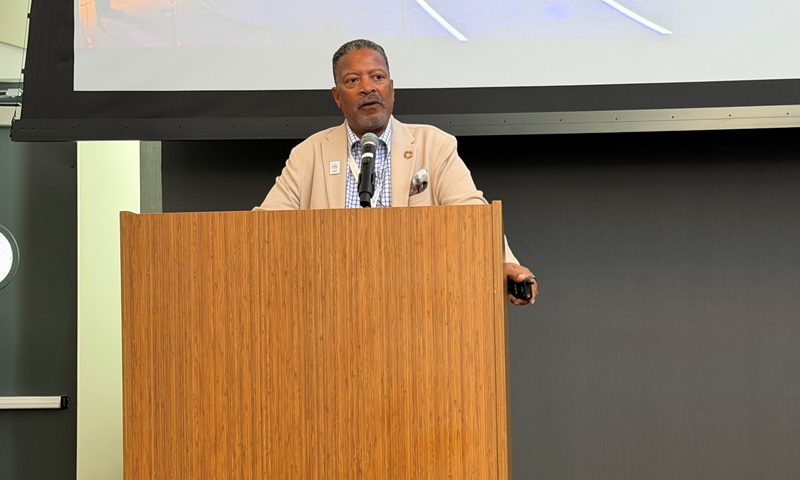
Mike Blackman, managing director of Integrated Systems Europe, took the stage at the SAVe Global Conference 2026 to deliver a message aimed squarely at an industry he said has outgrown the luxury of treating sustainability as someone else’s problem.
SAVe, which became ISE’s official sustainability partner after the two organizations began collaborating in 2022, describes itself as a movement built around the United Nations Sustainable Development Goals. Blackman called it exactly that in his keynote.
“What began as a partnership developed into a shared commitment for our industry to understand that sustainability is not separate from innovation, growth or good business,” Blackman told the audience.
He added that SAVe has grown “from an ambitious idea into a movement that is bringing our industry together around the UN Sustainable Development Goals.”

What Is Our Responsibility About What We Build?
Rather than recap what AV technology does, Blackman posed a more direct question to the room: “I want to ask you a harder question: What is our responsibility about what we build?”
He explains that every display draws power for the length of its operating life. Every rack generates heat that must be managed. Every product contains materials that were extracted and processed somewhere, and every product eventually reaches an end of life.
The stakes are scaling with the industry itself. Blackman cited AVIXA’s IOTA forecast showing the professional AV industry on track to reach 402 billion dollars by 2028.
“When an industry scales at that rate, its environmental choices stop being purely internal matters,” he said.
Sustainability Is Becoming an Innovation Question
Blackman organized his remarks around four lenses: product and manufacturing innovation, lifecycle thinking and new business models, shifting customer expectations, and what all of this means for ISE’s own events.
He also framed the United Nations’ 17 Sustainable Development Goals as the connective tissue running through each one, offering what he called “a common language and a common framework.”
“Sustainability is no longer simply a compliance question,” he said. “It’s increasingly becoming an innovation question.”
Blackman then pointed to LED display technology, which he said is growing at a 12.6% compound annual growth rate — the fastest of any display category — as a case where design decisions made today around power consumption and materials will be multiplied across a rapidly expanding installed base.
Three product examples anchored his argument. Sony developed SORPLAS, a recycled flame-retardant plastic that can contain up to 99% recycled content and, according to Sony, can cut manufacturing carbon dioxide emissions by as much as 72% compared with virgin plastic.
Blackman emphasized that Sony licensed the material to other manufacturers rather than keeping it proprietary. “Collaboration increases the impact,” he said.
Secondly, Sharp’s NaViSet Administrator platform offered a software example, letting enterprise customers automate power scheduling across large display estates and monitor energy consumption at scale.
Last but not the least, Shure’s rechargeable wireless systems illustrated how audio hardware is eliminating disposable battery waste. Blackman cited David Byrne’s “American Utopia” tour, where Shure estimated rechargeable systems avoided roughly 21,000 AA batteries on a single production.
On the manufacturing side, Blackman noted Epson’s achievement of 100% renewable electricity across its global manufacturing sites; Sony’s AI-driven chiller control in Nagasaki that has improved energy efficiency by about 30% versus 2015 levels; and Philips’ carbon neutrality, reached in 2020 and aligned with science-based targets.
New Business Models Change Who Owns End of Life
Blackman then turned to the commercial implications of designing for an entire product lifecycle rather than a single sale. He cited AVIXA projections that managed services revenue will grow roughly 11% annually, surpassing 13 billion dollars by 2028, and argued that shift changes who is incentivized to extend a product’s working life.
“If I remain responsible for delivering a service using that hardware, suddenly my incentives are different,” he added. “I’m motivated to maintain it, not replace it.”
He also pointed to supply chain visibility as a growing capability, citing Sony’s identification of 339 potential high-risk smelters and refiners, of which 229 were confirmed compliant through the Responsible Minerals Assurance Process.
Why Are Procurement Teams Asking for Sustainability Data?
Blackman described a structural shift in how AV purchases get approved these days. Public sector buyers increasingly embed environmental criteria directly into tenders and whole-life cost evidence is becoming a standard requirement rather than a differentiator.
“Sustainability claims are moving from marketing language toward measurable procurement data,” Blackman said, adding that vendors able to supply that evidence “will increasingly have an advantage.”
He expressed directly about what is at stake commercially. “It’s not just about doing the right thing,” he proclaimed. “Increasingly, it’s about market access.”
What Is ISE Doing About Its Own Environmental Footprint?
Blackman did not exempt ISE from the scrutiny he applied to the broader industry.
“Trade shows have a significant environmental footprint,” he said. “We have a responsibility to change.”
Blackman pointed to Fira Barcelona’s investments in the Gran Via venue’s sustainability infrastructure, including renewable energy sourcing, water recycling, and public transport partnerships.
He also highlighted the ISE Foundation, which counts sustainability among its three founding pillars alongside education and innovation.
“We want to support initiatives that help our industry better understand its environmental impact” and identify ways to reduce it, Blackman said, describing the foundation as “an important part of how we want to extend our impact beyond the show itself.”
The Constraint Is the Catalyst
Blackman closed by reframing the entire conversation: “The AV industry is in the middle of a genuine transformation.” This transformation reflects in how companies think about what they make, how they make it and what happens across a product’s full lifecycle.
“The constraint is the catalyst,” he added, arguing that environmental limits are pushing engineering teams toward solutions they might not have otherwise pursued.
Blackman’s closing challenge to the audience was practical rather than aspirational: go back to your organization, look at your product roadmap through a sustainability lens and identify one concrete action worth taking.
“None of us can do it alone,” he emphasized.
Frequently Asked Questions
- What is SAVe, and how is it connected to ISE?
- SAVe is ISE’s official sustainability partner, a movement focused on bringing the AV industry together around the United Nations Sustainable Development Goals. The partnership began in 2022, and SAVe joined ISE in 2023.
- Who is Mike Blackman?
- Mike Blackman is the managing director of Integrated Systems Europe, the trade show and conference organization behind ISE.
- How is the AV industry’s business model changing because of sustainability?
- Growth in managed services is shifting providers away from one-time hardware sales toward ongoing relationships, which incentivizes maintaining and refurbishing equipment rather than replacing it.
- What is ISE doing about its own environmental impact?
- ISE has reduced printed materials, encouraged public transportation to its venue, and partnered with Fira Barcelona on renewable energy and water recycling initiatives. Its ISE Foundation also lists sustainability as one of three founding pillars.