
Many integrators and consultants know Yamaha for its conferencing gear, its mixing consoles and perhaps even its music products. Fewer, however, might realize how complete the company‘s installed sound ecosystem has truly become. But the Yamaha installed sound ecosystem, which might once have been a well-kept secret, is starting to become known and appreciated.
“It’s something that we’re trying to [be] louder [about] because we’ve got very compelling solutions,” Daniel Bennett, manager of the technical sales team at Yamaha, says.
According to Bennett, Yamaha now has a fully refreshed Gen 2 lineup, designed from product development through deployment with ProVisionaire as the core control and design platform. “We had it before, but it wasn’t quite as powerful as it is now,” he explains. “Now, it’s a polished thing for us to show the world. And so, we’re trying to be bigger noisemakers in that area.”
To back that up, Yamaha has made significant investments to further fortify internal teams, bringing together specialists ranging from tech support and pre-sales support to marketing. The result? One workflow that ties every piece of the system together and one team that stands behind it all.

Yamaha Installed Sound Ecosystem Speaks the Same Language
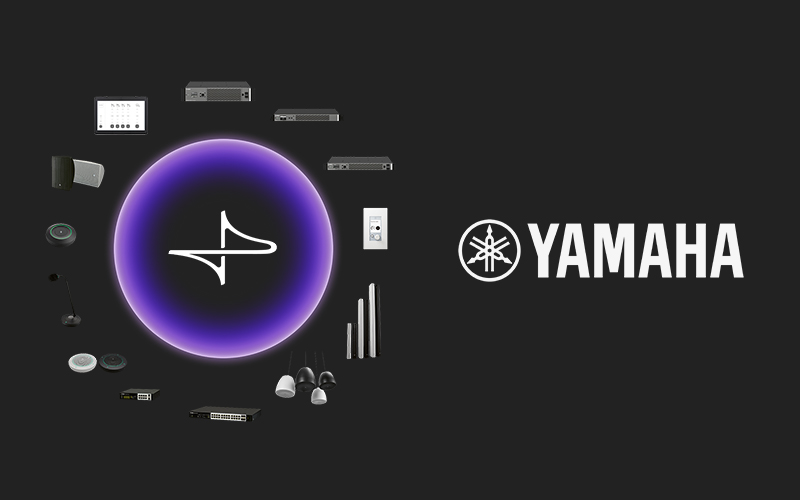
Image courtesy of Yamaha.
In framing the ecosystem, Bennett says it encompasses the full signal chain. “We’re the only manufacturer that can take you from [the] stage to [the] listener’s ear, or the content input to the content being amplified and output,” he states. Because Yamaha covers the full expanse, it can control all those elements from one software platform and one control surface, heavily reducing the need for the external controls that other solutions might require.
That software platform is the ProVisionaire suite, which Bennett says spans ProVisionaire Plan, ProVisionaire Design and ProVisionaire Touch; after deployment, it continues with ProVisionaire Cloud and ProVisionaire Edge.
Bennett says that, for integrators, the greatest thing boils down to this: “You’re not left wondering on commissioning day whether all the stuff you’ve baked into your programming of different platforms is going to work together when they’re finally connected.
When Integrators Leverage ProVisionaire Design
When integrators leverage ProVisionaire Design, all those elements are preloaded and designed to talk to one another. As a result, nearly all the programming can be done offsite and simply loaded once the team arrives. The site visit, therefore, really becomes a matter of confirming that everything is connected properly. And that’s no small benefit when, for the average integrator, field hours are a precious, profitability-shaping commodity.
Bennett analogizes the ecosystem approach to “organizing all your troops,” where every component of the system is speaking the same language. “If you were to get out onto the commissioning battlefield and everybody’s speaking different languages when you show up, [it’s] a little difficult to get your system online,” he states.
The ecosystem is built to scale, with Yamaha’s power-sharing amplifiers serving as a perfect case in point. “With that power sharing, it allows you to adjust your amplifier to meet your needs and not overpay for amplification,” Bennett says. What’s more, if the amplifier is already in place, integrators can reallocate its power resources as needed.
Bennett says that Yamaha is unique in its ability to deliver DSP controls and performance-audio equipment controls on a single control surface. “You could put a fader of the console on the same control platform,” he explains.
Integrators can brand those control interfaces with their brand fonts and aesthetic and then repeat them across installation types. As Bennett puts it, “It’s a kind of signature that they can put on this project that the customer sees day in and day out.”
Accountable Customer Support for Yamaha Installed Sound
Accountability lies at the heart of Yamaha’s ecosystem promise. “The number one thing about using the ecosystem of ProVisionaire and all the devices that are supported within ProVisionaire through Yamaha is that you’ve got one customer-support phone call to make now,” Bennett declares. “You’re not chasing your issues through a bunch of 800 numbers and trying to figure out whose device is the one causing the problem.”
That single point of accountability carries through service and warranty replacements, as well. In fact, it begins before the sale.
“If you could put everything on one PO and get one customer-support number and one warranty claim and one field sales engineer to help out with that, [it] really cuts a lot of time that you need in chasing, purchasing, support and warranties…,” Bennett says.
ProVisionaire Plan Helps Customers Define Elements
Those field sales engineers become involved early. On projects that are simpler, ProVisionaire Plan helps customers define the elements critical to achieving success. On more complex projects, Bennett’s team can help with the design itself, including training integrators who are deploying Yamaha systems for the first time. Whether they’re preprogramming in the office or working onsite, Yamaha provides the scaffolding to let them work with confidence.
“The greatest thing is we don’t want any of the credit,” Bennett declares, emphasizing Yamaha’s commitment to its channel partners. “We’ll do as much heavy lifting as we can, and you can take all the credit.”
It’s the essence of a vendor standing shoulder to shoulder with its integrator partners. And when an integrator learns the process well enough to handle a design without ancillary support, Bennett counts that as a win, too.
Yamaha’s involvement doesn’t end when the PO arrives, nor does it end with system commissioning. Instead, Yamaha focuses on long-term relationships. “Where we find our validation in providing you with awesome solutions is [when we get] that second project…,” Bennett says. “We want to be a trusted resource.”
Yamaha Installed Sound Is Not One-Size-Fits-All
For all the advantages of a single ecosystem, Bennett is candid that Yamaha doesn’t push one-size-fits-all on customers. Sometimes, existing infrastructure must remain in place; other times, projects will be done in phases; and sometimes, clients simply have a favorite amplifier, DSP or console. That means mixing manufacturers and embracing interoperability.

Image courtesy of Yamaha.
Bennett is realistic about this, acknowledging that “we’re not going to convince the entire world overnight that 100% Yamaha is the way to go.” Yamaha wants to find its place in every project, even when it sits among other brands.
Yamaha’s current lineup reflects another shift — and this one entails a little bit of a learning curve. “One of the challenges that we are taking on is with our new wave of DSPs being open architecture,” Bennett explains. According to Bennett, Yamaha is developing templates for customers for common applications, such as hospitality, as a highly accessible starting point.
The very successful previous generation used a closed architecture. “The beauty of our older DSPs was that it basically looked like a mixer inside,” he recalls. “You open it up, and if you just replace the word ‘aux’ with ‘zone,’ you had your DSP.”
Open Architecture Transcends Previous Limitations
But open architecture transcends previous limitations on what DSPs can do, recognizing that not every project needs to spend DSP resources the same way.
Yamaha’s ongoing refinements are driven straight from the field. The company’s partners around the world share constructive feedback — whether it’s tactical guidance on a workflow or a small tweak to an existing feature — and the R&D team acts on it.
Yamaha’s reach across a wide breadth of product categories sharpens its insight. “If we were only making DSPs, it would be difficult for us to know what the trends are in speakers, what are the trends in mixers, input devices and all that,” Bennett says. “But we make those products.”
‘We Make That Piano’
Yamaha’s other differentiator comes from outside installed sound entirely. “We have a vested interest because we make that piano that’s on the stage,” Bennett says matter-of-factly. “We make that saxophone that was recorded for that background music.”
That’s why, he says, Yamaha adopts 96K across its entire ecosystem, ranging from DSPs, amplifiers, mixers and I/O boxes to endpoint speaker systems.
“There’s so many amazing-sounding speakers on the market that produce really good sound,” Bennett states. “But, you know, it gets choked through a funnel of an underperforming DSP or a lower-quality amplifier. And when you’ve got that within the signal flow, you might as well have not spent that money on those really nice speakers.”
Yamaha has already affirmed its long-term commitment, highlighting its focus on relationships and outcome assurance rather than mere project closeouts. ProVisionaire plays a role in this, as well.
ProVisionaire Cloud and ProVisionaire Edge
According to Bennett, along with ProVisionaire Cloud, which, he says, handles licensing and firmware-update management, “we also have ProVisionaire Edge, which is our monitoring system [where], at one glance, you can look to see [whether everything is working].”
And that is what outcome assurance looks like. Outcome assurance extends to day 10, day 100 and day 1,000. It means making sure the listeners hear what they’re supposed to hear, with the quality that it merits. Underlining that mindset, Bennett declares that repeat customers are Yamaha’s biggest indicator of success. In short, it’s not project closeouts — it’s delighted clients.
To learn more about the entire Yamaha installed sound ecosystem or to request design support for your next project, please connect with the sales team today.