What You Need to Know
- DVLED projects are more than just about panels and modules
- Early client talks should focus on expectations, use cases and goals
- Price-only comparisons can miss service, spares and long-term performance
- Education and transparency matter most for first-time DVLED buyers
- Crimson AV plans to show DVLED products, kiosks and mounts at InfoComm 2026, booth N7945
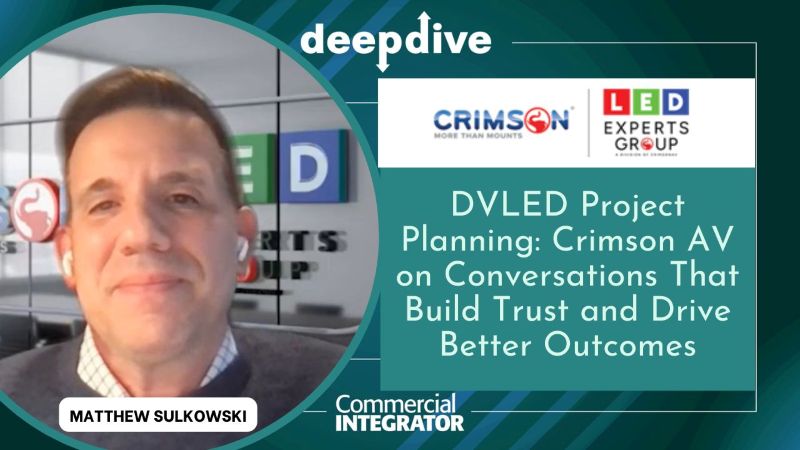
Direct-view LED (DVLED) projects often begin with technical questions, but Matthew Sulkowski argues that integrators should start somewhere else. In a video Q&A with Commercial Integrator Senior Editor Alyssa Borrelli, the Crimson AV executive describes DVLED conversations as trust-building exercises that work best when integrators act more like consultants than product sellers.
The discussion focused on a familiar challenge in the DVLED market: buyers are hearing more about pixel pitch, processing and pricing, but many still need help understanding how those details connect to outcomes. Sulkowski’s points to a broader industry reality. As DVLED options expand, successful projects depend as much on education, planning and post-installation support as they do on display hardware.
Watch the video Q&A below:

What is Crimson AV’s role in the DVLED market?
Crimson AV’s role in the DVLED market is rooted in mounting expertise and expanded support services. Sulkowski says the company is best known for mounting solutions and has more than 30 years of experience across commercial and residential markets.
He explains that Crimson moved deeper into DVLED because integrators needed more than access to display panels. In his view, the market gap involved support, education, mounting knowledge, processing guidance, logistics and post-installation service. That led to the creation of the company’s LED-focused division, which Sulkowski describes as a more specialized extension of the core business.
Sulkowski says Crimson now supports indoor, outdoor, all-in-one and customized DVLED projects. He presents that range as part of a broader effort to reduce complexity for integrators and end users. Rather than treating DVLED as only a display purchase, he frames it as a system-level project that includes engineering, logistics and long-term maintenance.
Why did Crimson AV expand beyond mounting into DVLED support?
Crimson AV expanded beyond mounting into DVLED support because integrators needed broader project help. Sulkowski says the company saw repeated demand for expertise that went well beyond hardware brackets or structural support.
According to Sulkowski, DVLED opportunities often brought questions about processing, transportation, customization and support after installation. He says those recurring needs showed that many partners wanted a resource that could guide them through the full process, not just one piece of it. Crimson’s mounting background gave the company a practical foundation because structure, serviceability and installation planning are central to DVLED deployments.
What should integrators ask first in a DVLED conversation?
Integrators should first ask what the client knows about DVLED and what has shaped their expectations. Sulkowski says those early questions help establish whether the buyer understands the difference between general LED lighting and direct-view LED displays.
He recommends starting with open-ended questions. He says integrators should ask where clients have seen DVLED before and what drew them to the technology. In many cases, those reference points may include restaurants, concerts, sports venues, Times Square or Las Vegas. That context can reveal what kind of visual impact the client expects and whether those expectations match the intended application.
Sulkowski argues that this stage should come before a detailed discussion of specs. He says integrators should act like consultants, not salespeople, and use the conversation to uncover the project’s real goals. Only after that should the discussion shift into viewing distance, ambient light, content type, budget and maintenance. His approach suggests that a strong DVLED sales process begins with discovery, not product positioning.
How can integrators shift the discussion from specs and price to value?
Integrators can shift the discussion from specs and price to value by explaining what the client is actually buying over time. Sulkowski says lower-cost options are entering the market, which makes price comparisons more common, but he adds that not all DVLED products perform the same way.
He points to several variables that shape long-term value. Those include the type of LED technology in use, the grade of the product, the quality of the diodes, refresh rate, PCB design and service access. He also notes the difference between front-service and rear-service designs, which can affect maintenance planning and project fit.
Warranty coverage and spare inventory are also part of the value discussion, according to Sulkowski. He compares spare modules to extra flooring kept after a home project: if something breaks later, matching replacements from the same batch may no longer be available. In a DVLED environment, that means spare planning can directly affect uptime and visual consistency.
Logistics is another factor. Current shipping conditions and fuel costs can influence pricing in ways that buyers may not initially understand. He urges integrators to explain the trade-offs between air and sea shipping and to make sure end users know why those choices affect both cost and timing. In practical terms, his message is that value comes from a full explanation of lifecycle performance, support and delivery, not just from a lower quote.
What helps build trust with first-time DVLED buyers?
Education and transparency help build trust with first-time DVLED buyers. Sulkowski says newcomers to the category can quickly become overwhelmed by technical language, configuration choices and pricing differences.
His advice is to simplify the process while staying clear about trade-offs. That means walking buyers through the pros and cons of different options, showing them what they are paying for and setting realistic expectations for timelines and delivery. He also recommends using real-world examples, including case studies and video demonstrations, so buyers can better visualize the result.
Sulkowski places special emphasis on expectation-setting. He notes that many DVLED products are not off-the-shelf items sitting in a box waiting to ship. Instead, large-format solutions are often customized to the project. Explaining that early can help reduce friction later in the process.
He also stresses the importance of discussing the wider system. In addition to the LED processor, clients need to understand how the control platform and source devices will work together. By addressing those details upfront, integrators can reduce the chance of surprises during installation and reinforce their credibility with buyers who may be making a first major DVLED investment.
What will Crimson AV show at InfoComm 2026?
Crimson AV plans to show DVLED products, kiosk offerings and mounting solutions at InfoComm 2026, booth N7945.
He says the booth will feature indoor and outdoor DVLED applications along with displays in different pixel pitches. The company also plans to debut kiosk products and present its broad catalog of mounting solutions. Sulkowski notes that Crimson has more than 320 mounting products in its warehouse ready to ship.
What is the main takeaway for integrators?
DVLED outcomes start with better conversations. Sulkowski returns throughout the interview to a simple theme: successful projects depend on asking the right questions early, explaining trade-offs clearly and guiding buyers through decisions that go far beyond display specs.
That approach reflects how the DVLED market is maturing. As more options enter the field, integrators may need to do more translation work between technical performance and business value. Sulkowski’s perspective suggests that trust, education and lifecycle planning are becoming just as important as brightness, pitch and price. The strongest discussions do not start with a product sheet. They start with context, expectations and a clear explanation of what long-term success will require.