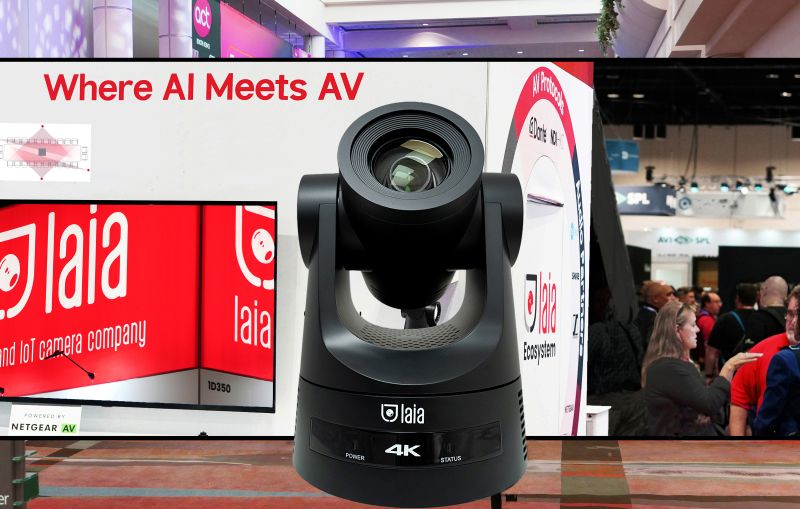
Editor’s Note: Learn more about Laia Technologies and the new camera stack in our informative webinar, occurring May 26.
As AI embeds itself more deeply into pro AV workflows, cameras are being evaluated on a new set of criteria. Resolution, zoom range and mounting options still matter, of course, but they don’t tell the full story. For integrators, consultants and end users alike, the bigger question is whether a camera platform can operate as part of a broader software-defined ecosystem — one that supports automation, interoperability, simpler deployment and ongoing, iterative improvement.
That shift is helping reshape how the market looks at PTZ cameras and adjacent collaboration tools. It also helps explain why Laia Technologies — a Spain-based company that established a dedicated U.S. presence in early 2025 — is drawing more attention when projects demand more than just image capture.
Commercial Integrator recently spoke to Marc Yakubisin, systems integration sales manager at Brownestone; Bradford Terry, senior manager, educational media team, Pace University; and Michael Corkery, director of information technology at the Pennsylvania Eastern District Court, and each one shared a similar sentiment: Across higher education, courtroom environments and related commercial spaces, camera value is increasingly tied to software intelligence, seamless audio integration and long-term adaptability.
How Have Pro AV Camera Buying Decisions Changed?
For years, pro AV camera buying decisions started with hardware specifications. And, without a doubt, that’s still part of the conversation. But as AI-enabled features become more practical, buyers are looking beyond the spec sheet and asking how a camera behaves within a technology ecosystem.

Marc Yakubisin says that, once Brownestone became aware of Laia, it quickly became acclimated to its solutions. Photo courtesy of Marc Yakubisin.
Marc Yakubisin says that Brownestone became aware of Laia through an opportunity to partner in the Pacific Northwest and quickly became acclimated to its solutions. “That really got us down the road of understanding that Laia is not just a camera company or a software company. [It gave me] an understanding of what an Internet of Things (IoT) company is.”
Indeed, in many environments today, the camera is no longer a passive endpoint. Rather, it’s part of an intelligent room experience shaped by tracking, automation, control and integration with microphones and networked infrastructure. And this is exactly where Laia shines, shaking off the limits of a traditional camera manufacturer and, instead, aligning with a software-led view of AV.
As Yakubisin puts it, “A vendor like Laia that is proactively thinking about automation, AI [and] software-driven workflows is, in essence, positioning themselves to ride that continuing wave.”
As Camera Platforms Mature, What is the Differentiator?
Our interviewees are unambiguous that, as camera platforms mature, hardware still matters but software increasingly determines how much value an organization gets from its technology investment.

Bradford Terry ties the value that Laia delivers directly to long-term growth and feature expansion, including ongoing software development. Photo courtesy of Bradford Terry.
Bradford Terry ties that value directly to long-term growth and feature expansion. “With a software-driven, AI-driven outlook, I know that, if I buy this hardware, [in] year one, year two and year three, I’m probably going to be getting some extra features [as a result of ongoing] software development.”
He continues, “The housing isn’t going to need changing. It’s got a lens. It has everything that it needs to grow from there. So, that’s a plus.”
That kind of futureproofing is essential in environments where refresh cycles are slow, budgets are heavily scrutinized and users expect systems’ longevity to be measured in years. A good example of this would be courtrooms, and that’s exactly where Michael Corkery just made a significant investment in Laia camera technology.
During the interview, he shows Commercial Integrator the current fixed-camera setup, but he dreams big about the transformative effect that Laia will have upon deployment. “I think there’s things we can do with their product lines,” he says optimistically, “if I want to make my courtrooms a little bit more modern and utilize the toolsets that are in there versus the more standard cameras.”
These capabilities — especially at the price point — position Laia as the market leader that others are chasing. “I wouldn’t be surprised if you see the other household names start to incorporate some of this technology over the next couple of years,” he says. “But Laia is in front of them. I think they have a leg up on where that stuff’s going.”
Do Software-Driven Camera Systems from Laia Reduce Complexity?
That software-driven camera systems from Laia help reduce room complexity was another common theme among our interviewees. That matters to integrators trying to control costs, simplify support and avoid overbuilding systems with bulky, extraneous peripheral hardware.

For Corkery, whose team handles all technology deployment in house, having less rack gear and a more compact deployment model is an advantage. Photo courtesy of Michael Corkery.
When discussing what stood out to him, Corkery highlights that lighter-footprint appeal, especially as he looks ahead to building out ancillary spaces. “When we’re building out conference spaces going forward…I think I’d be looking at Laia there. I like the medium- to large-size conference gear that they have.”
He continues, “I think I can do more creative things in the courtroom with speaker tracking and [people] moving around. There are things here that are pretty attractive that I think won’t give me headaches.”
For a team like Corkery’s, which handles all technology deployment in house and without integrator assistance, having less rack gear, fewer add-ons and a more compact deployment model is a real advantage.
And for channel partners, the implications extend beyond installation labor. A camera platform that can do more within its own ecosystem can make systems easier to standardize, scale and maintain across multiple room types.
Cameras and Audio Must Work in Harmony
As AI pushes cameras forward, it’s raising expectations for how cameras and audio systems work together. Tracking, framing and room automation depend on reliable interaction among multiple devices — not just cameras working in isolation.
Terry describes that requirement in practical classroom terms, saying, “The reason that we decided to go with Laia for our classroom installs was, one, the ease of installation and use for our users.” But another key consideration, he hastens to add, centered on lecture capture and hybrid-learning needs.
“We need cameras that can know where the professors are [and] that can track the users,” Terry states. “We need cameras that don’t need the user’s intervention. We needed microphones that do the same. And we need the whole system to work harmoniously.” Investing in Laia unlocked that possibility.
But Laia also aligned seamlessly with Pace University’s infrastructure needs. As Terry explains it, “We needed the cameras to be able to be controlled by our current infrastructure or further [additions to our] infrastructure as we build out. We need networked devices as we bring the campus into a more converged network space for our AV systems.”
“And when we were shopping around at the price point that Laia offers,” he adds, “it was the strongest choice.”
That’s a welcome reminder that camera selection increasingly sits inside a larger design conversation centered on convergence, standards-based deployments and systems-minded interoperability. And Laia’s rapid ascent in the North American market attests not only to its compelling AI feature set but also to how well those features mesh with a practical, networked AV architecture.

Logo courtesy of Laia Technologies.
New Buying Lens for the AI Era Positively Distinguishes Laia
Discerning pro AV stakeholders like our interviewees are clearly adopting a more layered approach to evaluating cameras. Producing good images has become table stakes; the real question is whether the platform is AI-infused, software-forward, network-friendly and capable of supporting the workflows that clients are dreaming about building.
“It really gets you to see the bigger picture of how an ecosystem can come together,” Yakubisin says. “Not just the hardware and the software, but how it all comes together [in] ways that you would never thought [possible].”
For Laia, this paradigm shift has conferred a meaningful competitive advantage. Software-led development, practical interoperability and scalable deployment impress clients like Corkery and Terry. But arguably even more importantly, there’s a boldness of vision that implicitly challenges where the category has historically been.
As cameras continue to become more central to AI-enabled room experiences, the salience of those attributes is likely only to grow.
For pro AV stakeholders, the takeaway is straightforward: Camera selection must now account for the full stack. AI may be the headline, but software design, ecosystem fit, audio integration and long-term flexibility are determinative in assessing a camera platform’s lasting value.
And those differentiators are where Laia is making its case, deployment by deployment.
Please join Commercial Integrator, Security Sales & Integration and Laia Technologies for a deeper look. On May 26, at 2 p.m. EDT, we’ll present an informative webinar, entitled Automated Camera Systems: Redefining Where AI Meets AV.
It’s a prime opportunity to dive into camera companies’ AI solutions and which ones can assure seamless audiovisual experiences.