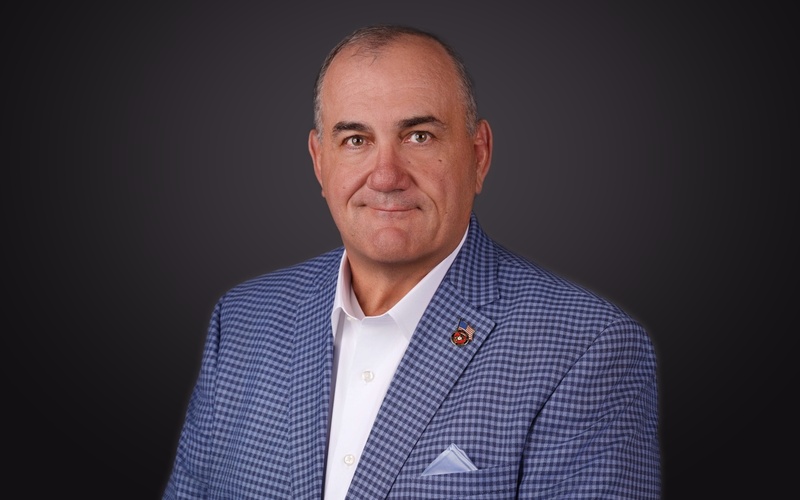
As Commercial Integrator’s #AVLivingLegends series continues, we’re pleased to honor Ronald Willis, co-founder of the Command+Control Alliance (C2A) and AVP mission critical technologies AV with AECOM, as our latest inductee. A veteran designer and consultant in the mission-critical AV space, Willis is right at home among the AV Living Legends.
Willis’ path into commercial AV began in the Marine Corps, where he served as a combat photographer and AV specialist. That early exposure set the tone for a career spanning more than 30 years, with work reaching across the Department of Defense, federal agencies, utilities and transit. From CRT projectors and matrix switches to today’s software-defined systems, Willis has witnessed multiple cycles of technology reimagining. Yet the core challenge has never changed: getting the right information to the right people at the right moment.
Beyond his design work, Willis co-founded the Command+Control Alliance, a nonprofit dedicated to the education and growth of the command-and-control industry. He sees it as a community for skilled practitioners who once solved the same hard problems in isolation but who now can finally learn from one another.
Interview with Ronald Willis of the Command+Control Alliance
In this interview, Willis reflects on the mentors who shaped his trajectory, including Steve Emspak at Shen Milsom & Wilke, as well as the satisfaction of paying those lessons forward. He shares his philosophy of mission-critical design, recounts the moment an operations manager in Virginia told him “what you’ve done here saves lives” and offers the guiding wisdom that has anchored his career: “You have to be smarter than the technology.”
Read on to learn more about Ronald Willis. And don’t forget to visit our hub page to explore past #AVLivingLegends inductees!
Commercial Integrator: What motivated you to join the commercial AV industry?
Ronald Willis: I actually started in AV while still in the Marine Corps, being a combat photographer and an AV specialist supporting a large training device. That was my first real exposure to this kind of work, and it set the tone for everything that came after.
The Corps wires you a certain way: You care about systems that have to work when it matters, not just when conditions are perfect. So when I moved into the civilian world and into AV and the broader mission-critical world full time, it felt like a natural fit from day one.
I still remember the first time I stood in a control room and watched it all come together: a wall of displays, the audio, the signal paths, everything feeding operators a clear picture in real time. In those days, it was all CRT projectors, four- and five-wire RGB cable and large matrix switches. That was the moment it clicked for me. The work was never really about the gear. It was about decisions getting made faster and better, and the design and the technology had to serve that mission, not the other way around. That’s what pulled me in, and it’s what keeps me here.
Commercial Integrator: What kept you motivated and engaged in the decades that followed?
Ronald Willis: The problems never stopped getting harder, and the stakes never stopped mattering. In my 30-plus years in the field, I’ve watched the technology turn over completely several times: analog to digital to IP to software-defined. But the core challenge has never changed: Get the right information to the right people at the right moment. Working across DoD, federal agencies, utilities and transit kept me from ever getting comfortable. Every client defined “mission critical” differently, and learning what it meant for each of them never gets old.
That’s the part that still pulls me in. Clients keep bringing me new and unique problems, and chasing down the right solution to each one is what keeps me intrigued after all these years. And the people have kept me engaged just as much as the work: the operators who live in these rooms day in and day out, and the next generation of designers coming up behind me. Between the problems and the people, I’ve never had a reason to lose interest.
Commercial Integrator: Reflect on your role as both a mentee early in your career and as a mentor later in your career. Who helped shape the trajectory of your professional life? How have you tried to help shape others’ careers?
Ronald Willis: Early on, I was shaped by people who were generous with hard truths. What they had in common was a willingness to let me carry real responsibility. In the Marine Corps, you’re a young Marine and responsibility is thrust upon you whether you’re ready or not. That was the start of my journey. Senior staff NCOs provided the mentorship, but not much knowledge of the technology. In the late ’80s, a computer wasn’t commonplace and technology was in its early stages. That experience set the baseline for my learning over the next 20-plus years in the integration space, and for how I would later mentor the younger workforce.
When I switched over to the dark side as a consultant, it was a different world and a different kind of responsibility. Luckily, at Shen Milsom & Wilke, I had Steve Emspak, who stepped in to provide the guidance and mentorship I needed and became a great friend. Being new to the consulting side, everything was different, especially the processes, and that’s where Steve made the difference. He showed me how projects are run from the consultant’s seat, and he opened my eyes to the bigger picture you don’t always see on the integration side of the house. His guidance and leadership helped make my success possible.
I’ve tried to do the same: handing younger designers a piece of a project that would stretch them, giving them room to own it and being there to support them when needed. Building the Command+Control Alliance (C2A) was something that started early on at SMW with Steve and the Randys, Pagnan and Smith, but it took years to get going. C2A was partly about that: creating a community where people in the command-and-control arena could learn from each other. A pool of knowledge anyone could draw from, whether a young integration team member, an end user or a manufacturer.
Who Has Ronald Willis Mentored?
One person I think I’ve made a significant impact on as a mentor is Shawn. We’ve worked together for at least 10 years, starting in the integration arena and now on the consulting side. Shawn is a great engineer and control programmer. I couldn’t help much with the programming, but as he took on more responsibilities as the lead senior engineer, more of the day-to-day business was coming his way. So, I focused on putting a foundation in place, the knowledge and practices to strengthen that skill set, while also planning for a smooth transition if I ever pursued another opportunity.
His growth continued when we reunited on the consulting side. I brought him in, and just like me, he found it was a different world and a different process. With ongoing support and knowledge transfer, Shawn grows stronger as a consultant every day.
Mentorship isn’t always a one-on-one process. In this technology arena, your best friends, and sometimes your not-so-good friends, turn out to be your best mentors. We’re learning every day, with every conversation. Everyone is always there to support you, and you can never really leave. You may try, but it always draws you back in.
Commercial Integrator: What’s the most memorable story/anecdote of your career in commercial AV?
Ronald Willis: This event happened in the early 2000s, after the attacks on the World Trade Center and the start of the war in Iraq. I had just completed three different operations centers for the U.S. Army, each with a different mission, all on the East Coast. My team and I set out to visit them and make sure they weren’t running into any issues. Every one of them was working as planned.
I was speaking with the operations manager of one of the centers in Virginia. I asked him how things were going. He said, “Everything’s good. But I have to tell you: What you’ve done here saves lives.” That has stuck with me ever since, and it’s the most enduring comment I’ve ever received. To me, it sums up my entire career mission as a designer and consultant: mission success.
Commercial Integrator: What has been your greatest professional accomplishment?
Ronald Willis: This is not an easy thing to narrow down. Throughout my career, I’ve designed, integrated and supported countless environments that impact the warfighter and corporate customers, both stateside and worldwide. These range from headquarters for SOF groups, to corporate enterprise operations centers monitoring data from around the world, to utility transmission and distribution centers across the U.S. Each one carried its own mission, and each one taught me something I carried into the next.
But if I have to choose, it’s helping found the Command+Control Alliance (C2A), a nonprofit focused on the education and growth of the command-and-control industry. It’s an area that had real practitioners but no organized professional home: skilled people solving the same hard problems in isolation, with no shared place to learn from one another. Building something that outlasts any single project, something others grow to rely on now and in the future, is a different kind of accomplishment than delivering a great control room. A control room serves its mission. An institution serves the people behind every mission. Both matter, but one of them keeps giving long after you walk away.
Commercial Integrator: What has been your biggest professional regret?
Ronald Willis: I don’t know if I can categorize any single thing as a professional regret. My career has been rewarding at every stage. There have always been opportunities to do something different or chase more money, but money has never been the driving force for me. The sense of accomplishment, the missions I supported and knowing I could provide for my family mattered far more. I don’t regret any major move I’ve made or any company I’ve worked for.
Commercial Integrator: What’s the best advice or pearl of wisdom you either received during your career or came to realize on your own?
Ronald Willis: This is probably one of the easiest questions to answer. It’s something I’ve been telling my kids and others in the industry for years: “Technology is only as smart as the user. You have to be smarter than the technology.”
It sounds simple, but it’s the truth I keep coming back to. We can design the most advanced control room in the world, with the best displays, the fastest networks and the most elegant signal paths, and none of it matters if the people operating it don’t understand it or can’t trust it under pressure. The technology doesn’t make the decision. The person does. Our job has never been to build something impressive. It’s to build something that makes the operator better at their mission, and then to make sure they actually know how to use it. The smartest system in the room is still the human being sitting in front of it.