
For years, AV systems were managed room by room, device by device. But as organizations build collaboration spaces across campuses, offices, and hybrid work environments, that model is rapidly becoming unsustainable. Today’s AV ecosystems are deeply interconnected and increasingly aligned with enterprise IT expectations, creating both new opportunities and new operational challenges.
One of the biggest challenges arising from this shift is visibility. In multisite deployments, understanding how devices are performing in real time has traditionally required a reactive approach; entailing AV and IT teams to wait for something to fail before troubleshooting can begin. As organizations rely on more installations utilizing networked microphones, conferencing systems, and collaboration technologies, maintaining oversight through manual checks and onsite support simply cannot keep pace.
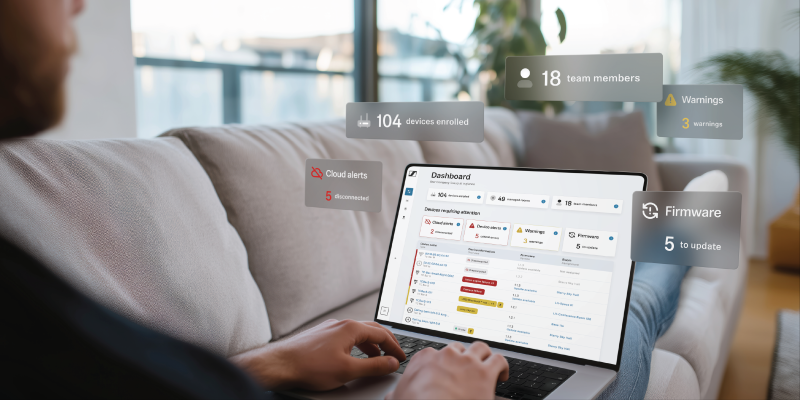
That shift is accelerating the move toward cloud-based AV management platforms such as Sennheiser’s DeviceHub. Launched earlier this year, DeviceHub is a secure, browser-based platform built to centralize the setup, monitoring, and management of Sennheiser devices across enterprise, education, and corporate environments. Built on Microsoft Azure, it follows recognized IT security standards across authentication, encryption, authorization, and data handling, helping organizations align AV management with broader IT governance requirements.
Centralized cloud platforms like DeviceHub provide AV and IT teams with a unified view of device health, configuration status, firmware alignment, and performance conditions across entire networked audio installations. Instead of treating systems as isolated endpoints, organizations can manage their AV infrastructure as a connected ecosystem – one that can be monitored, optimized, and supported from virtually anywhere.

For audio environments specifically, the impact is significant. Consistent audio performance is essential to collaboration, particularly in hybrid work settings where every participant requires the same audible experience regardless of location. Cloud-based oversight allows teams to proactively identify issues, maintain system consistency, and reduce downtime before it affects users while assuring every person can both hear and be heard clearly.
DeviceHub is designed with exactly this challenge in mind. By giving teams continuous visibility into their audio infrastructure, the platform helps ensure meeting spaces deliver dependable, high-quality collaboration experiences regardless of where users are located. Importantly, DeviceHub is not intended to replace existing workflows, but rather integrate alongside them. By combining cloud-based visibility with existing on-premises tools, AV and IT teams gain flexibility while maintaining uptime and reducing operational complexity.
The longer-term opportunity may be even more transformative. As cloud platforms mature, the centralized data they generate — including device states, usage trends, fault histories, and environmental conditions — creates the foundation for intelligent automation. AI-driven monitoring and diagnostics could eventually automate routine tasks such as firmware updates, room validation, and performance optimization, shifting AV professionals away from repetitive maintenance and toward higher-level oversight and strategy.
Ultimately, the industry is moving beyond simply managing devices. The future of AV lies in managing system intelligence, and solutions like DeviceHub are crucial in creating environments that are proactive, scalable, and continuously improving. In that future, visibility is no longer a luxury feature – it’s the foundation of reliable collaboration.
Learn more about Sennheiser DeviceHub at www.sennheiser.com/en-us/catalog/products/software/devicehub/devicehub-platform