
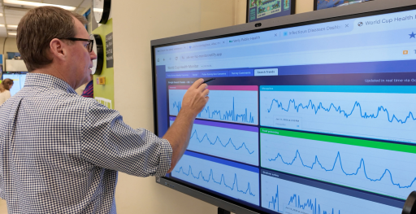
Samsung Electronics America joined a coalition to protect public health during the 2026 World Soccer Games, providing the Health Security Operations Center with display and mobile technology while AT&T delivered the secure connectivity behind it. Together the solutions move critical data and support near real-time collaboration among the organizations working to spot and respond to infectious disease risks.
Key Things to Know
- Samsung equipped the Health Security Operations Center (HSOC) with smartphones, tablets, PCs, wearables, smart signage, interactive displays, audio solutions and monitors.
- AT&T provides the secure wireless mobility and networking infrastructure that keeps HSOC devices and systems connected.
- Samsung Knox, a government-grade mobile security platform, protects sensitive workflows across connected devices.
- HARMAN, a Samsung subsidiary, supplied JBL speakers and headphones for clear voice communication.
- Verily Health tests wastewater for pathogens including SARS-CoV-2, influenza, RSV, norovirus and measles.
- The HSOC unites more than 40 organizations and sends daily situation reports to over 350 public health organizations and 1,000 individuals.
What Is the Health Security Operations Center?
The Health Security Operations Center is an independent public health initiative led by Georgetown University and MedStar Health to monitor infectious disease risks during the 2026 World Soccer Games. The center pulls together data from wastewater monitoring, hospitalizations, real-time health reports, environmental monitoring, open-source intelligence and international health alerts. Analysts use that combined view to monitor, analyze, report and coordinate throughout the games.
“The Health Security Operations Center depends on timely information, multidisciplinary coordination and the ability to translate complex data into actionable insights,” says HSOC Director Rebecca Katz, a professor at Georgetown University. “Technology, like that provided by Samsung, helps create the connected environment our teams need to execute our work.”
What Technology Did Samsung Provide?
Samsung equipped the HSOC with technologies from across its ecosystem, including smartphones, tablets, PCs, wearables, smart signage, interactive displays, audio solutions and monitors. Large-format displays and monitors let teams view dashboards, situational updates and emerging public health trends across the operations center. Smartphones, tablets, PCs and wearables keep staff connected and productive as they develop reports and support public health partners.

Samsung built the contribution on years of experience supporting control rooms and command centers. Its display technology, from QMC Smart Signage and Interactive Displays to commercial monitors, gives response teams the round-the-clock performance needed to streamline operations and maintain situational awareness.
“Public health teams need technology that provides them with visibility into what’s happening, and allows them to share information quickly and coordinate with confidence,” says Todd Maxwell, director of regulated business development, B2B at Samsung Electronics America. “Samsung’s contribution to the Health Security Operations Center reflects how connected devices, displays and the Knox security platform can support faster situational awareness and help experts act on complex information in high-stakes environments.”
How Does AT&T Support the HSOC’s Connectivity?
AT&T supports the HSOC with the secure connectivity, wireless mobility and networking infrastructure that helps power the ecosystem. That foundation keeps the center’s devices and systems connected so researchers, healthcare organizations and public health experts can share information and respond quickly.
“In environments where timely information can drive critical decisions, organizations depend on secure, resilient connectivity to keep people, devices and data connected,” says Nazanin Hoglund, assistant vice president of mobility devices and converged products, AT&T Business. “AT&T is proud to support the Health Security Operations Center with wireless connectivity and secure networking services that help researchers, healthcare organizations and public health experts collaborate, share information and respond more effectively in virtually real time.”
How Does Samsung Knox Secure Operations?
Samsung Knox, the company’s government-grade mobile security platform, secures the technology environment for teams working across connected devices. As the HSOC analyzes multiple sources of health-related information and distributes daily situation reports to more than 350 public health organizations and 1,000 individuals, Knox helps teams manage devices, protect sensitive workflows and maintain confidence in the technology behind mission-critical operations.
What Role Does HARMAN Audio Play?
HARMAN, a Samsung subsidiary, provided audio solutions, including JBL speakers and headphones, to support clear voice communication across teams. The audio supports collaboration in the operations center, where analysts coordinate across disciplines and organizations throughout the games.
What Is Verily Health’s Role in the Coalition?
Verily Health, a Samsung partner, tests wastewater samples for pathogens such as SARS-CoV-2, influenza, RSV, norovirus and measles. The company also aggregates wastewater data from additional sources using its research environment, Verily Workbench, adding another data stream to the HSOC’s monitoring effort.
“The future of public health readiness depends on the ability to bring people, data and technology together in practical ways,” says Stephen Gillett, CEO of Verily Health. “By supporting Georgetown, MedStar Health and the broader HSOC coalition, Samsung is helping provide the connected tools teams need to turn information and insight into coordinated action.”
The work expands on an existing collaboration between the two companies. Earlier this year they announced plans to pair Samsung’s Galaxy Watch 8 with Verily Health’s precision health platform, Pre, to accelerate research for life sciences and government customers by combining advanced health analytics with consumer-grade wearable data.
How Many Organizations Make Up the HSOC Coalition?
The HSOC coalition brings together more than 40 organizations spanning academia, public health, technology and communications. That group distributes daily situation reports to more than 350 public health organizations and 1,000 individuals, extending the center’s monitoring and coordination well beyond the operations room.
How Does the Technology Support Public Health Readiness?
The technology supports public health readiness by giving teams a connected environment to collect data, collaborate and act on complex information quickly. Samsung’s mobile track record in the public safety sector, combined with AT&T connectivity, helps sustain the operational environment teams rely on to assess information and coordinate action across the games.
“Having built and scaled telehealth operations, I have seen firsthand how technology can drive agility, innovation and collaboration,” says Ethan Booker, vice president of care innovation at the MedStar Institute for Innovation and chief medical officer for telehealth at MedStar Health. “The Health Security Operations Center shows how a technology-forward initiative can help those gathering do so safely and securely.”