

Artificial intelligence (AI) is rewriting the rules of AV design, and the consultants who shape that work are racing to keep pace. Walk into any AV project today and the hardest problems no longer live in the equipment rack. Clients now arrive sharper, schedules run tighter and nearly every device lands on the network.
To map this shifting terrain, four consultants share how their work is changing: Mark L. Peterson, senior principal and global AV discipline leader at Shen Milsom & Wilke (SM&W); Brandon Creel, partner at Hewshott; Kristin Bidwell, owner and principal consultant at Audiovisual Consulting Team (AVCT); and Tony Warner, principal and COO at Phase Shift Consulting. Their accounts describe a profession in steady transformation, one where the technology is often the easy part, and the harder work lives in planning, coordination and judgment. What follows explores that evolution, from the trends drawing their attention to the misconceptions they would most like to retire.
The Trends Pulling Focus
The conversation circles back to one force: artificial intelligence. For Peterson, AI-driven efficiency is “the fundamental direction that the AV industry is heading,” a shift visible at InfoComm 2026, where Cisco unified collaboration and network insight under one “Connected Intelligence” banner, Microsoft pushed Teams meetings that turn discussion into action, and management vendors like Xyte and NETGEAR drove AI monitoring to the network edge. Cloud-managed platforms like Neat’s Open mode and Cisco’s Connected Intelligence, he says, show exactly where the industry is headed.
Creel frames the moment around “AVoIP interoperability, AI camera solutions and convergence of AV, IT, cybersecurity and facilities.” Bidwell states that “designing systems with a security first approach is imperative for a successful project. With the convergence of AV and IT driving our solutions, we need to protect data, monitor devices, and be proactive and not reactive. Implementing a secure remote management solution for day-2 helps to alleviate risk.”

Warner argues that the lines between AV, IT and security “are essentially gone,” and that the industry’s long-overdue reckoning is operational. “Monitoring, remote management, lifecycle planning,” he says, “that’s ultimately where systems succeed or quietly break down a few years after turnover.”
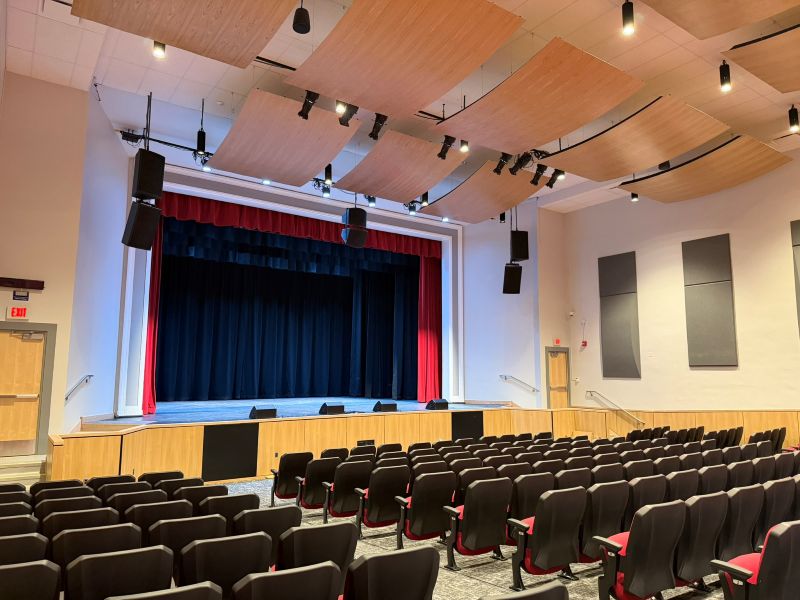
Courtesy / Hewshott
A More Informed Client
The shift reshaping design work most may be the client sitting across the table. Clients now arrive at requirements far better informed, having used AI and other tools to research technology themselves, and that raises the stakes for consultants.
“We have to know the options cold,” says Peterson, who frames much of his value as closing the gap for clients “that may know a product’s marketing better than its real-world limitations.” Schedules are tightening too, as architects fold design development and construction documents into a single phase. The commoditization of collaboration spaces eases some of that pressure, a standardization visible in announcements from QSC’s RoomSuite Modular Systems to Shure’s MXA320 and IntelliMix Room Kits, Sennheiser’s TeamConnect ceiling platform, Barco’s now-Teams-certified ClickShare and Logitech’s push around room standards and meeting equity. In larger rooms, automatic camera preset recall complicates design rather than simplifying it, because systems now carry logic about which way a participant is facing, and commissioning “stops being straightforward” once three or more cameras come into play.
Creel sees “a big push for data and analytics so clients can make informed decisions” alongside a parallel demand for intuitive systems. “We’ve been complicating systems and UI/UX for far too long,” he says. Warner sums up the through-line: clients “expect simplicity on the front end and sophistication behind the scenes,” and that demand increasingly comes with a push for “repeatable, scalable solutions instead of reinventing things project by project.”
What Lands on the Drawing Board
Ask the four consultants what they spend their days designing and the answers converge on collaboration spaces before branching out.
Peterson’s work spans “from small huddle rooms to large multipurpose rooms and boardrooms,” with more clients leaning on automatic camera switching to reduce staffing. The hard problems, he says, are no longer about reliability — they come down to a seamless start-of-meeting experience and getting intelligent systems to behave consistently from one meeting to the next. “The focus is on providing end users with effortless connectivity,” Peterson says, adding that “100% uptime is a foregone expectation.”
Creel’s roster tilts toward complex, non-standard UC rooms such as boardrooms, multi-purpose spaces, and studios – as well as enterprise AV networks and full-service theatre consulting.
Bidwell works across 20 verticals globally, from corporate and higher education to broadcast studios, arenas and cyber range.
Warner rounds out the picture with enterprise-scale deployments — meeting environments, learning spaces and hybrid collaboration systems “that need to work consistently across entire organizations” — alongside mission-critical facilities “where performance expectations are high and failure isn’t really an option.”
Design Challenges and Where Demand Runs Hottest
Nearly every project now begins with the same question: what belongs on the corporate network and why. For Creel, the conversation is shaped by compliance, risk and governance as much as technical requirements. When a client invests in new infrastructure, he explains, it must support not only today’s AV system but the one arriving in roughly five years, a tension sharpened by the pace of change.
Bidwell’s answer is standardization, rolling AV design standards across multiple campuses to ease complexity and give end users consistency. Warner points to interoperability as a persistent headache and coordination as ever more complex, warning that if those conversations don’t happen early, “it becomes difficult to recover later.”
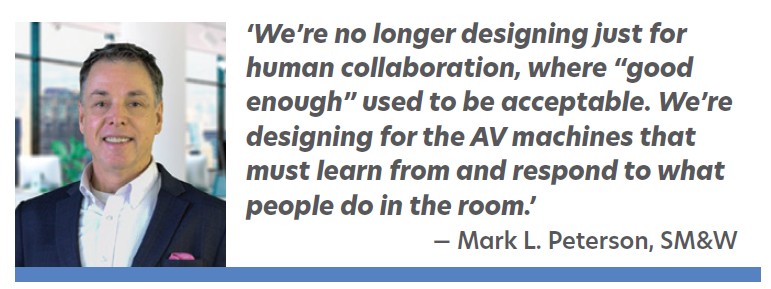
On the demand side, the unified communications ecosystem dominates. Peterson notes that Cisco room devices running Microsoft Teams and now Zoom are especially popular, and ceiling microphones are “basically standard in any room for nine people and over.” The bigger shift, he says, is designing not for human collaboration but for the machines that serve it. “We’re no longer designing just for human collaboration, where ‘good enough’ used to be acceptable,” Peterson says, pointing to Microsoft’s Device Ecosystem Platform and its AI Facilitator as the reason precision audio and video now matter in a new way.
Creel sees AI automated camera systems become “a hot topic,” with some clients pursuing AI initiatives aggressively while others move cautiously. Bidwell notes broadcast has become standard for corporate clients, with projects shifting “from Fireside Chat solutions to fully blown Broadcast Studios.” Warner adds that higher education, corporate and public sector spaces are all strong, especially where reliability and long-term supportability drive the brief.
What a Vendor Brings to the Table

Photo courtesy of Kristin Bidwell, AVCT
When the conversation turns to vendor value, the four consultants return to the same idea: access matters more than marketing.
Peterson says responsible specification starts with hands-on testing. “To specify a new technology responsibly we need to set it up and experience it firsthand,” he says, noting that platforms like Symetrix’s Cognio control system or Neat’s new Open mode simply cannot be judged from a datasheet. He also emphasizes how manufacturers treat the consultant channel. As pure consultants with no financial relationship to any manufacturer, he notes, “we specify what we think is best for the client and the project,” and that influence shows up in the client’s standardized kit of parts, driving long-term brand loyalty.
Creel prizes transparency about capabilities, limitations and lifecycle expectations. “Strong documentation, realistic lead-time information, product roadmaps, and access to knowledgeable technical resources are often more valuable than marketing materials,” he says.
Bidwell values consultant liaisons who are responsive and technically precise, and stresses that the relationship cannot end at installation — “not only the successful implementation of the designed system, but a successful future for our end users” is the goal.
Warner distills it to trust. “Responsiveness matters,” he says, “but alignment with long-term outcomes matters more.”
The Consultant-Integrator Relationship
Ask the consultants what a strong relationship with an integrator looks like and the answers settle on a single idea: both sides are working toward the same goal.
Peterson says the relationship works when the consultant clearly defines objectives and explains the reasoning behind each design choice so the integrator can “focus on getting it built instead of weighing every option and alternative the AV products give them.”
Creel puts it simply: “Consultants and integrators each bring unique expertise, and projects are most successful when both parties collaborate constructively. We’re on the same team.” Bidwell looks for integrators with the qualifications and experience to follow the design intent and finds an integrator who respects a collaborative approach for a successful project.
Friction, the consultants agree, most often comes from scheduling pressure. Clients “routinely underestimate how much programming, budgeting and planning AV takes,” Peterson says, leaving the integrator with a tight window and little room to maneuver. Warner describes the ideal as a true partnership where the consultant defines intent and the integrator brings execution, and trouble arrives “when expectations aren’t aligned early” — whether around scope, level of detail or performance standards.
Top integrators distinguish themselves through network fluency, Peterson says. “Every AV product sits on the network now,” he notes, so the integrator must be comfortable with IT networking, PoE budgeting and what AV traffic does to infrastructure. Creel prizes proactive communication and a solutions-oriented mindset alongside technical skill. Bidwell values PMs who are technically savvy enough to oversee the procurement and installation and who not only catch issues early but arrive with a substitution solution already in hand.
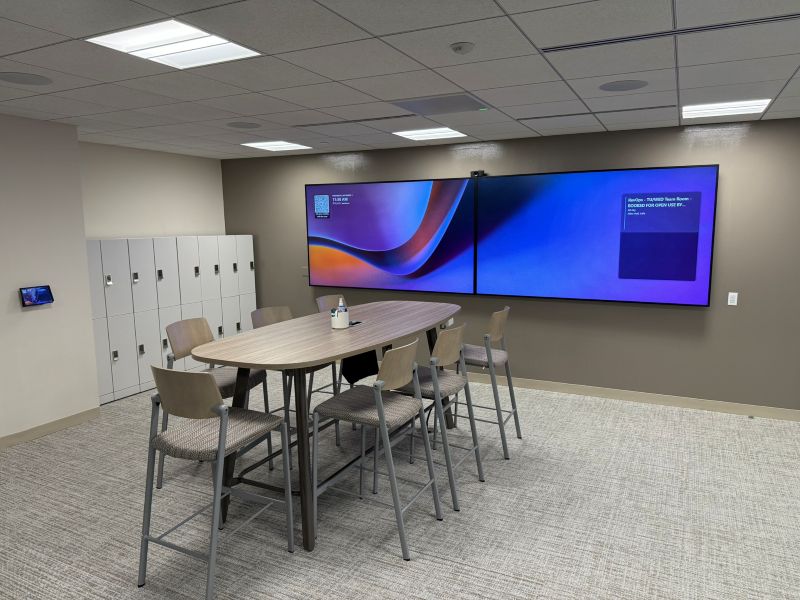
Courtesy/ Hewshott
Beyond the Drawings
Asked about the biggest misconception surrounding their work, the consultants share the same frustration: that AV consultants simply design systems and pick equipment.
Creel says design is just one deliverable in a much longer engagement that encompasses planning, needs definition, standards development, budgeting, IT and facilities coordination, RFP management and construction administration.
Bidwell roots the misunderstanding in independence. Independent consultants do not sell products or work for manufacturers, she says, and take no profit from one specification over another — they act as the end user’s advocate “throughout the entire design process, substantial completion, and beyond.” That advocacy extends past handoff at her firm, which offers day-2 managed services that deliver performance reports, sustainability metrics and self-fix processes to lower long-term costs.
Warner puts it bluntly: clients assume consultants are “just specifying equipment” when the role covers how technology supports the organization, crosses disciplines and helps clients avoid costly missteps.
Independent consultants “aren’t in competition with integrators,” Creel says — firms like Hewshott do not buy, sell, install or service products because that is the integrator’s domain. Warner agrees that keeping design focused on the client’s goals, separate from product selection and installation, “generally leads to better long-term outcomes.”
A Profession Defined by Judgment
Taken together, the four accounts describe a discipline in which the most visible part of the job — the gear — has become the least of its challenges. AI is rewriting what systems must do, clients are arriving sharper and more demanding, the network underpins everything and success hinges on coordination, standards and trust built long before installation begins.
What unites Peterson, Creel, Bidwell and Warner is a conviction that the consultant’s real value lies in judgment: knowing the options cold, aligning the right people early and keeping the design anchored to the client’s goals rather than any single product.
As technology grows more capable and more complex in equal measure, that independent perspective looks less like a luxury and more like the steadying force that keeps the whole process pointed in the right direction.