
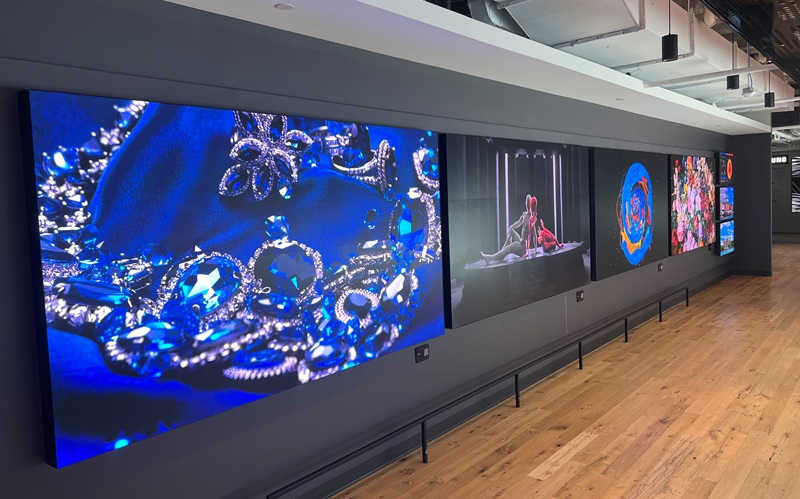
Stepping into the Samsung Connected Experience Center in Englewood Cliffs, N.J. reaffirms that display technology is ubiquitous — and indispensable — across vertical markets and applications. The space serves as an evolving showcase for the company’s signage and display portfolio — a place where hardware solutions and robust software platforms merge to serve retail, education, hospitality, corporate settings and more.
Replete with LED videowalls, interactive classroom displays, zero-power e-paper and glasses-free 3D spatial displays, the Connected Experience Center illustrates Samsung’s efforts to reshape visual communications across organizations.
While touring the Connected Experience Center, I learned about Samsung’s newest releases and its strategic vision. Christopher Kwon, head of smart signage product marketing, Samsung Electronics America, described the engineering and design choices underpinning Samsung displays. Meanwhile, TJ DiQuollo, technical product marketing — software and solutions, Samsung Electronics America, explained the capabilities and innovations powering Samsung VXT, the cloud software platform that completes the ecosystem.
These conversations serve to underline Samsung’s approach to developing visual solutions intended to reduce complexity and maximize value for integrators and end users alike.

Throughout the Connected Experience Center, one theme remains consistent: Visual solutions must prioritize practical needs, including streamlined installation, accessible software interfaces and sustainable development. This reflects a total-cost-of-ownership mindset and a commitment to delivering value.
Simplifying LED Installation for Integration
The Samsung Connected Experience Center tour opens with large-format LED displays. The visuals are high-impact to say the least: wall-filling screens that are bright and clear from every angle, even in spaces filled with ambient light. Pixel pitches range from as tight as 0.6mm to as loose as 4mm for much further viewing distances.
Next, Kwon explains Samsung’s take on all-in-one LED signage. “We want the display to come in one box,” he says. “We want it to be easy to install because that’s what matters to our integrators and partners.”
Describing the modular approach, Kwon says, “We put a skeleton frame on the back that you just mount on the wall. And essentially you install this in three layers — sometimes four, depending on the size.” Showing me up close, he says, “If you look from the side, you can still see the individual modules that make up the LED. Our goal is to provide an enhanced install experience because we know it can be difficult for integrators.”
This configuration significantly curtails setup time for large jobs. Kwon notes, “We know that large LED executions can take days to install properly. We’ve gotten this install down to two hours.”
He adds, “Two hours on an LED is a huge breakthrough. That’s basically LCD signage.” The LED displays I saw deliver typical brightness of 500 nits and with peak capability of 1,600 nits, providing vivid, rich color even in well-lit environments.
Interactive Technology in the Evolving Classroom
The tour soon shifted from videowalls to connected classroom solutions. The showcase is Samsung’s new WAFX-P interactive professional display, a product designed to strengthen engagement in both educational and enterprise scenarios as hybrid and remote collaboration becomes commonplace.
According to Kwon, “The primary use case for this display is in the classroom. Our education customers are looking for technology that engages students and easily fits into lesson plans, which is what we aim to achieve with this premium model.”
The WAFX-P is purpose-built for teaching environments that need flexibility and ease of use. Available in 65-, 75- and 86-inch sizes, the display is powered by Android 15 with an octa-core CPU to handle multi-app workflows. It integrates a 4K camera, microphones and dual 20-watt speakers, ensuring support for student interaction, remote guest speakers and everything in between.
Underlining a commitment to accessibility, Live Caption is built in, converting audio and video to real-time onscreen text. Samsung AI Assistant app features will be available with a future software update later this year.
The display’s multi-touch surface supports 50 simultaneous users and recognizes a variety of pen styles and pressures. For IT and admin teams, Samsung’s Device Management Solution enables remote content updates and alert deployment. This supports school safety protocols while simplifying network management.
Sustainability With Zero-Power E-Paper Displays
Sustainability-conscious organizations are increasingly committing themselves to reducing their environmental impact and lowering energy consumption. Samsung’s response includes Color E-Paper alternatives that are superior to standard printed materials. The EM13DX, a 13-inch Color E-Paper display, stands out: light, ultra-thin and built for cost-efficient deployments.

Courtesy / Samsung
“We think that, with the cost savings [of] reducing your printing and your shipping, the total cost of ownership is especially beneficial for customers regularly changing content,” Kwon opines. “Lower power draw; you don’t have to print and ship; you don’t have to redesign.”
The first commercial display with a housing derived from phytoplankton bio-resin, it’s verified by UL to include 45% recycled plastic and 10% bio-resin. This change alone can reduce carbon emissions in the manufacturing process by more than 40% as compared to traditional plastic. The display itself draws zero watts when maintaining a static image and only uses energy when content refreshes. Battery-powered, its design is free of permanent cables; moreover, it boasts a slim 17.9mm profile, meaning it can be installed almost anywhere.
The EM13DX offers a crisp 1,600×1,200 resolution on a 4:3 aspect ratio. An advanced color imaging algorithm enables poster-quality graphics for shelf labeling, pop displays or meeting room schedules. End users can manage single screens from the Samsung E-Paper App; meanwhile, larger rollouts can connect to Samsung VXT digital signage cloud software for remote fleet control. Samsung will expand the lineup with a 20-inch version, broadening sustainable options even further.
3D Spatial Displays for Retail Engagement
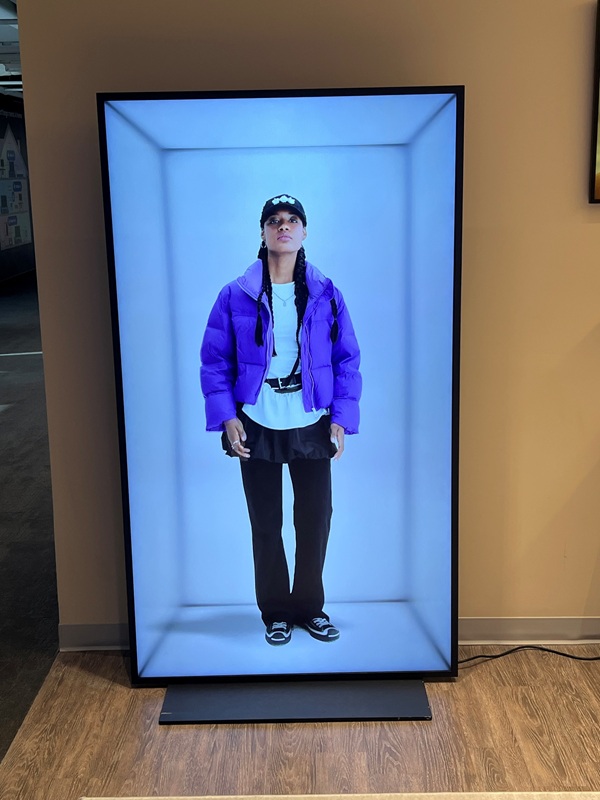
For me, the most impressive demo was arguably Samsung’s immersive, glasses-free 3D Spatial Signage display. Built to attract and hold shoppers’ attention, this technology represents a compelling avenue for high-end retail and branded experience activations.
“We use our own 3D Plate technology to be able to create a multidimensional experience,” Kwon explains. “Your left and right eyes are actually seeing two different images, which causes the 3D effect.”
Courtesy of Emerald/Commercial Integrator
The display’s realistic depth effect allows content — virtual products, avatars or anything else — to project outward, boosting customer engagement and making them likelier to return. Despite these remarkable capabilities, the actual display is only about two inches thick, permitting flexible installation in retail spaces.
While currently catering to premium retail, Samsung is scaling the tech for broader deployment. Despite launching at 85 inches, the product will soon be available in 55-inch and 32-inch options.
Glasses-free 3D digital signage like this promises to facilitate digital engagement with customers, clients and passersby in ways not previously thought possible.
Orchestrating It All: Samsung VXT Software
Of course, robust software is vital to all these display advancements. Samsung VXT — the company’s cloud-based device and content management platform — serves as the operational core. TJ DiQuollo details the capabilities developed for this new platform, which will replace the older MagicINFO system.
“It’s all maintained by Samsung in the cloud,” DiQuollo explains. “Embedded on each of the displays, whether it’s Color E-Paper, Spatial Signage, LCD [or] LED — we have it on the chip itself.” He continues, “There’s no external media box, [no] extra expense to buy to drive content. It’s all built in. Just like a smart TV at home, there’s a smart TV in the commercial sense.”
Through a browser-based interface, users, regardless of location, can adjust device schedules, display brightness, security settings and lock out physical ports.
“You can pair that device to your account — it’s charged per display on a license basis,” DiQuollo explains. “And as soon as it’s connected to your instance, you can control the hardware itself through the screen section. So, you can set the on/off timers, set the backlight to conserve energy [and] lock it down in a public environment.” That way, nobody can disrupt the client’s content plans with a rogue remote control, USB plugin or Bluetooth connection. “So, from a security perspective, you can manage your entire fleet,” he adds.
The VXT platform also incorporates a tool called VXT Canvas, a content-creation suite for digital signage. “Think of it as a visual editor for making static content, animated content [and] even dynamic content,” DiQuollo says.
He continues, “We have apps for different verticals. Linking to the point-of-sale system is an app, so you can bridge that data connection. Our AI Studio will also be an app within VXT to build content for Samsung signage, including Spatial Signage, through prompt-based gen AI content creation.”
Leaning into vertical market specificities, DiQuollo says, “For education or corporate communication, we have integrations into Microsoft. We have integrations into programmatic advertising. We have integrations into our SmartThings sensors so [that] sensors can trigger content when certain things happen.”
A Compelling Journey
Walking through the Samsung Connected Experience Center makes for a compelling journey. Display hardware innovations combined with solutions that improve setup, management and sustainability show the company’s commitment to supporting integrators amid rapidly increasing client expectations.
Whether you’re deploying a videowall, bringing collaboration to modern classrooms, swapping paper for e-paper or reimagining retail engagement, the Samsung Connected Experience Center demonstrates a holistic approach that delivers innovation and value.