
The LED display industry has long pursued smaller pixel pitches to meet demand for higher resolution and more immersive visual experiences, but traditional DIP and SMD technologies hit a wall as pitches dropped below 1mm. The transition to Chip-on-Board (COB) addressed many of those limitations, yet introduced its own challenges around capital investment, repairability, and manufacturing consistency. Micro-in-Package (MIP) architecture emerges as the pragmatic next step, restructuring the integration pathway to make ultra-fine-pitch LED displays commercially viable at scale.
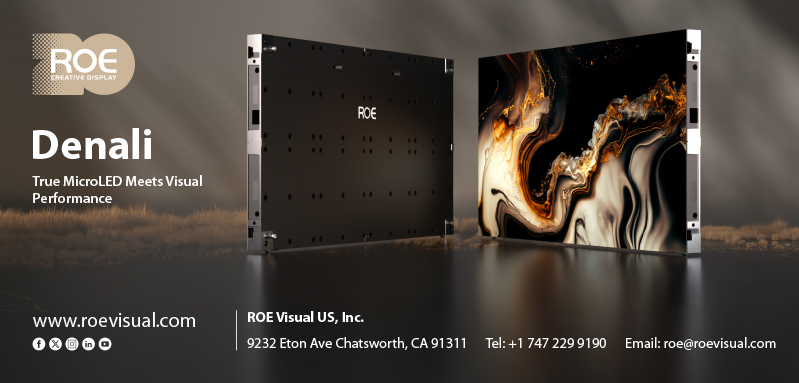
ROE Visual’s strategic entry into MIP technology is embodied in Denali, their next-generation MIP display solution built on a native 16:9 architecture with fine pixel pitches down to 0.78mm. Rather than rushing to market, ROE waited for the advanced tech supply chain to reach commercial maturity enabling a focus entirely on engineering excellence. The result is a display platform purpose-built for mission-critical environments like control rooms, broadcast studios, and executive boardrooms, delivering improved contrast, deeper black levels, and wide viewing conditions that previous LED architectures couldn’t match.
Key Takeaways:
- MIP bridges the gap between current fine-pitch LED technology and the long-term potential of Micro LED, improving yield stability and system-level consistency without the prohibitive costs of direct Micro LED adoption
- Denali’s structured packaging approach improves yield control, simplifies testing and binning, and enhances long-term serviceability compared to traditional COB-based fine-pitch systems
- MIP delivers measurable optical advantages over SMD and COB, including superior contrast performance, deeper black levels, and more stable image uniformity across large-scale installations
- ROE Visual’s deliberate market timing, entering at the optimal inflection point of tech supply chain maturity, allowed Denali to bypass proof-of-feasibility and go straight to performance refinement
- Over the next three to five years, MIP production costs are expected to decline further, strengthening its competitiveness across broader display market segments