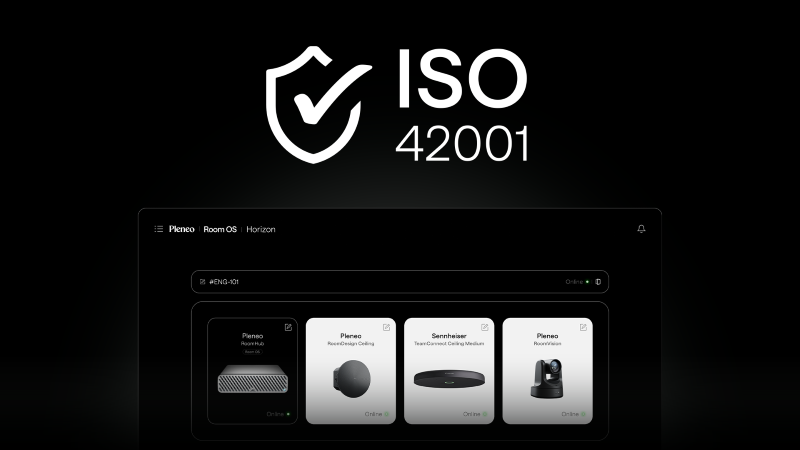
In a significant move for the AV and unified communications (UC) industries, Pleneo has announced it is the first device manufacturer to achieve ISO 42001 certification. This international standard specifically addresses the governance and security of artificial intelligence systems. The achievement comes as AI features become increasingly common in meeting room technology a domain where formal accountability frameworks have been slow to develop.
The certification signals a potential shift in enterprise expectations for intelligent meeting environments. As AI capabilities grow more sophisticated, questions around risk management data governance and operational transparency are becoming central to purchasing decisions. Pleneo’s certification addresses these concerns head-on.
What is ISO 42001 and Why Does It Matter for UC?
ISO 42001 provides a structured framework for organizations to manage AI systems responsibly. It establishes clear requirements for several critical areas including the documentation of AI-driven decisions data governance risk assessment and the role of human oversight. For the UC sector where AI now handles tasks like noise suppression speaker tracking and automated system deployment such a standard provides a benchmark for trust and reliability.
As intelligent meeting rooms become more autonomous and integrated into corporate IT networks governance moves from a desirable feature to a foundational requirement. This certification validates Pleneo’s management of the AI technologies built into its Room OS platform. These technologies include features like AI AutoDeploy and AI NoiseSense which operate directly on the company’s hardware.

The Role of Edge Computing in AI Governance
A key aspect of Pleneo’s AI strategy is its reliance on edge computing. All AI processing occurs locally within Pleneo devices inside the physical meeting room. This “on-device” approach enables real-time environmental adaptations while ensuring sensitive meeting data remains within the control of the organization.
Processing intelligence locally offers several advantages. It reduces dependency on cloud services which can introduce latency and potential privacy vulnerabilities. By keeping computation at the edge Pleneo ensures its adaptive collaboration features operate in milliseconds. As AI begins to influence meeting workflows and experiences this local governance model extends beyond data protection to ensure the integrity of automated decision-making.
“Artificial intelligence shouldn’t live somewhere else it should live where people meet” says James Knight CEO of Pleneo. “If AI is embedded in the room it must be explainable controlled and accountable. ISO 42001 provides that framework proving that innovation and responsibility can scale together.”
A Consolidated Framework for Enterprise Trust
Pleneo’s ISO 42001 certification builds upon its existing security credentials including SOC 2 Type II and ISO 27001 accreditations which were achieved earlier this year. Together these standards create a comprehensive governance structure that covers security privacy and now AI management. This triple certification positions the company’s intelligent collaboration platform as an enterprise-grade solution designed for long-term scalability and trust.
As artificial intelligence continues to reshape the unified communications landscape such formal governance standards may become a key differentiator. They help distinguish mature platforms from more experimental ones. By pursuing these certifications Pleneo is making the case that intelligent meeting environments should be viewed not as emerging technologies but as reliable and accountable enterprise systems.