Key Takeaways:
- Design for movement: AV systems should follow instruction as faculty and students move, present and create content throughout the room.
- Move beyond the lectern: A single fixed camera is no longer enough for today’s active learning environments.
- Capture the full learning experience: Use multiple capture points and flexible PTZ placement to cover whiteboards, lab tables and student presentation areas.
- Build for every learner and every layout: Support remote participants with equal visibility and ensure reconfigurable spaces work in every room setup.
- Scope smarter from the start: Plan display and capture together, and ask where content will be created, where students will present and how instruction will move.
For most of higher education’s history, the lecture followed a reliable pattern. An instructor stood at the front of the room, delivered content and students received it. They took notes, they listened and participation was largely limited to the occasional question at the end. The room was built for exactly that: content flowing in one direction.
That model has not disappeared, but it has evolved. The pace of that evolution is accelerating in ways that should change how integrators approach every higher education project.
How Has the Student Role in the Learning Space Changed?
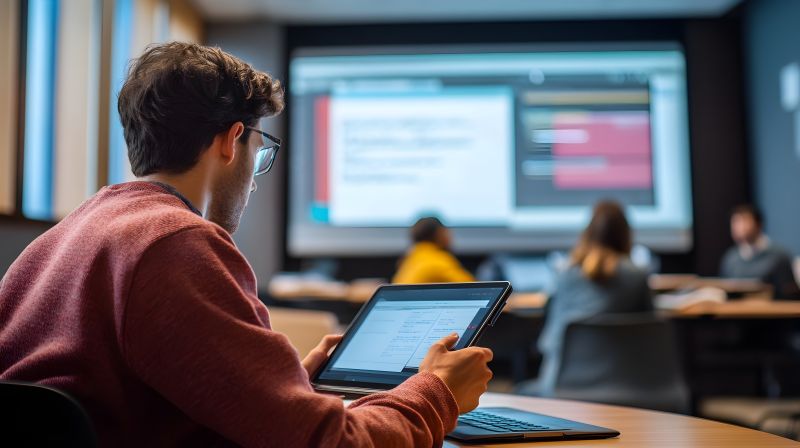
The shift starts with students. In an era where information is immediately accessible, the value of sitting in a room with an instructor has less to do with receiving content and more to do with demonstrating understanding. Students are increasingly expected to show their work, not just submit it. They produce video presentations. They create podcasts as course deliverables. They capture and share their process as part of how learning is assessed. The role of the student in the learning space has moved from passive recipient to active participant and, in many cases, active creator.
How Are Faculty Adapting Their Teaching Approach?
Faculty are adapting to meet that shift. Instructors who once prepared a lecture and delivered it now build ideas in front of their students in real time. A faculty member might open at the lectern, move to the whiteboard to work through a concept live, then step to a lab table on the side of the room to walk students through a physical demonstration — all within the same session. Students get pulled into the conversation, asked to present their thinking, or invited to the front to share work with the group. The content of a class session is increasingly co-created, and instruction moves around the room rather than originating from a single fixed point.

Why Do Legacy Learning Spaces Fall Short of Today’s Teaching Models?
The problem is that most learning spaces were not designed with any of this in mind. They were designed for one signal path: instructor to audience. A camera at the front, a display facing the students, audio capture centered on the person at the lectern. That infrastructure serves a one-directional teaching model well. It was not built for a room where instruction moves, where students are as likely to be presenting as listening, and where content is created rather than simply delivered.
How Does Distributed and Remote Learning Compound the Problem?
This challenge is compounded when participants are in different rooms. Students joining from satellite campuses, overflow spaces, or other locations deserve the same access to the learning moment as those seated in front of the instructor. A single fixed camera pointed at the lectern cannot deliver that. When the instructor moves to the whiteboard, when a student presents from the side of the room, when a demonstration happens at a lab table off to the side, remote participants lose the thread. Equal access to instruction requires the room to capture learning wherever it happens, not just where it was expected to happen.
What Does the Room Actually Need to Capture Now?
For integrators, the implications are concrete.
Most lecture capture systems were designed with a single capture point in mind. When the room needs to support a student presenting at the front, an instructor moving through the space, and content being produced at a desk or lab bench, one fixed camera is no longer sufficient. The design brief has changed.
What institutions are beginning to specify, and what integrators are increasingly being asked to deliver, are systems that support multiple capture points with the ability to switch between views. An installed PTZ camera with flexible wall or ceiling placement can be positioned with clear, unobstructed views of the room, centered in the space and at a height that clears ceiling-mounted speakers, microphones and projectors without compromising the angle of capture. Paired with preset switching capability, faculty or students can move between an instructor view and a content view without technical intervention. That kind of setup is meaningfully different from a camera bolted above a display and pointed at a lectern.
It also requires integrators to ask different questions during the scoping process:
- Where will students present?
- Where will content be created or demonstrated?
- How does instruction move through this room and how should the AV system follow it?
Increasingly, those questions extend to the room itself. Some learning spaces are designed to be reconfigured, with partitioned rooms that open into a single larger space, and the AV infrastructure needs to be flexible enough to serve both configurations independently and as a combined environment.
Why Does Display Strategy Matter as Much as Capture?
Display strategy matters too. A room with two large displays at the front and additional screens on either side, one showing shared content and another showing remote participants, gives faculty and students more ways to stay connected to the learning regardless of where they are seated. That kind of setup requires deliberate thinking about how capture and signal distribution are planned from the start. These are not questions that come up in a traditional lecture capture conversation, but they are the right ones for the learning spaces higher education is trying to build now.
What Does This Mean for Integrators Specifying Higher Education AV?
The integrators navigating this transition well are the ones who understand that the pedagogical shift is real and that it has direct consequences for how rooms are designed and equipped.
If you are specifying AV for higher education, the question worth asking before finalizing any design is whether the room you are building reflects how learning actually happens there today, not how it happened ten years ago. The institutions getting this right are the ones working with integrators who know the difference.
Jay Lyons is Principal Product & Portfolio Manager, Education at Logitech.