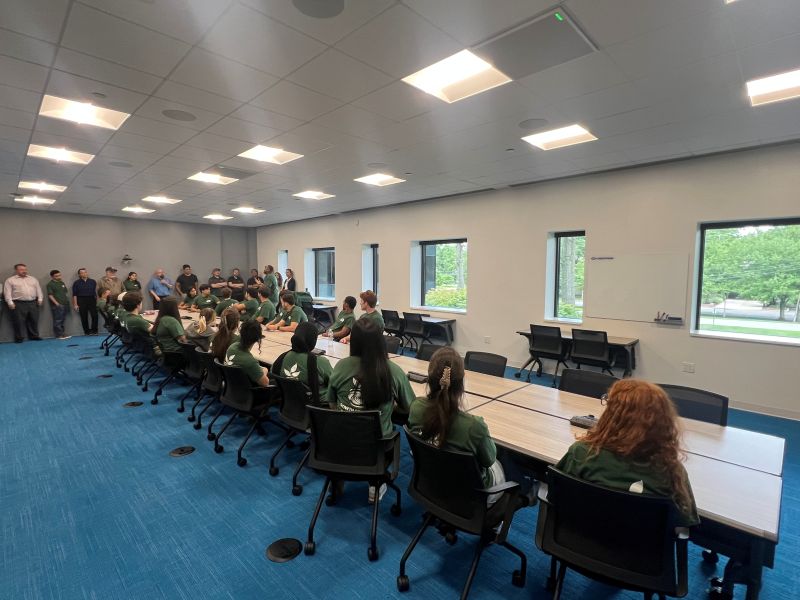
Editor’s Note: This article focusing on the Crestron Internship Program is based upon firsthand reporting by Dan Ferrisi. He visited the company‘s Rockleigh, N.J., offices on July 29.
If you think of the word “intern,” your mind might conjure up the image of a “go-fer” on the corporate campus: someone doing coffee runs, taking lunch orders and waiting for long stretches until someone hands over busywork.
But, if that’s your preconceived notion, it’s dead wrong. Crestron Electronics built its internship program to be the exact opposite.
Over five years under the leadership of Christian Bliss, program manager of campus relations and inclusivity, the Crestron internship program has grown, then contracted to sharpen its focus, all while continuously serving as a genuine talent pipeline for one of the AV industry’s preeminent suppliers.

That progression deserves the attention of any integration firm facing the same vexing question: How do I identify, develop and keep good people?
Crestron Internship Program: It Grew, Then Got Even More Selective
When Bliss arrived, the program was near its largest point. His predecessor and current manager, Chris Fitzpatrick, had diligently built it up, with each year’s intern class growing ever larger.
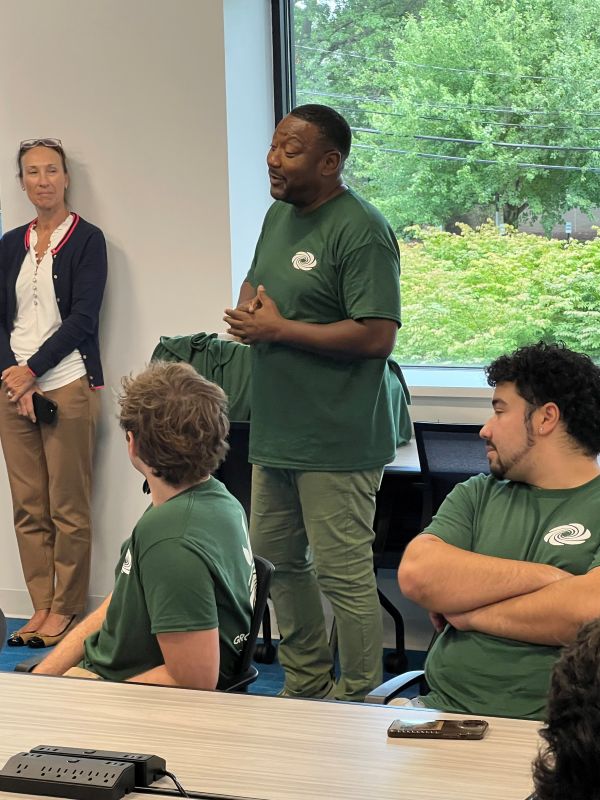
According to Christian Bliss, Crestron’s move to tighten the number of interns “gave me an opportunity to just focus on what works best.” Photo by Emerald/Commercial Integrator.
“The Crestron internship program had been growing steadily and ended up doubling in size over the course of four years,” Bliss recounts.
Then, amid ongoing market shifts and macroeconomic developments, Crestron reassessed how to make the program its best. Ultimately, Crestron reimagined the program and ended up tightening the intern class to focus on a smaller group of participants. A smaller class of interns could be misperceived as a retreat, but Bliss knows that it, in fact, represents an opening.
“It gave me an opportunity to just focus on what works best,” he declares.
That meant matching each intern to a team where the fit truly made sense. The contraction also raised the bar significantly. Fewer seats forced tougher choices, and tougher choices produced better selections.
“The less individuals you have…well, the talent pool did not shrink,” Bliss notes. The result? “We ended up getting the cream of the crop,” he says with pride.
The curation shows in Crestron’s intern roster this year. In fact, the 2026 class of interns includes the first in program history to return for four separate cycles. This illustrates just how deliberately Crestron now develops the people it wants to hang onto.
Building the Right Campus Partnerships
Crestron is an engineering company first and foremost, so engineering naturally claims the largest share of intern slots. That reality shaped which schools Crestron pursues, and how.
Rather than blanket recruiting, Bliss studied the curriculum at nearby institutions and invited schools in to meet business leaders directly. The strongest technical partners now include Stevens Institute of Technology, New Jersey Institute of Technology (NJIT), Rutgers and The College of New Jersey (TCNJ). On the non-technical side, Crestron’s ties to local schools such as Ramapo College and Dominican University continue to deepen.
The company’s reach extends well beyond New Jersey. After Crestron acquired 1 Beyond’s products and technology, the company tested the Boston market and gained a foothold.
“Tufts University and Northeastern University are our biggest campus partners in Boston,” Bliss says. “And for Plano, Texas, we use University of Texas at Dallas.”
The lesson for integrators who recruit from technical and trade programs is straightforward: Partnerships built on real curriculum fit always beat a scattershot outreach strategy.
The ‘Not Just an Intern’ Philosophy
The phrase that Crestron repeats — from the recruiting table through day-one orientation — is “not just an intern.” It signals that the work is real, and so are the stakes.
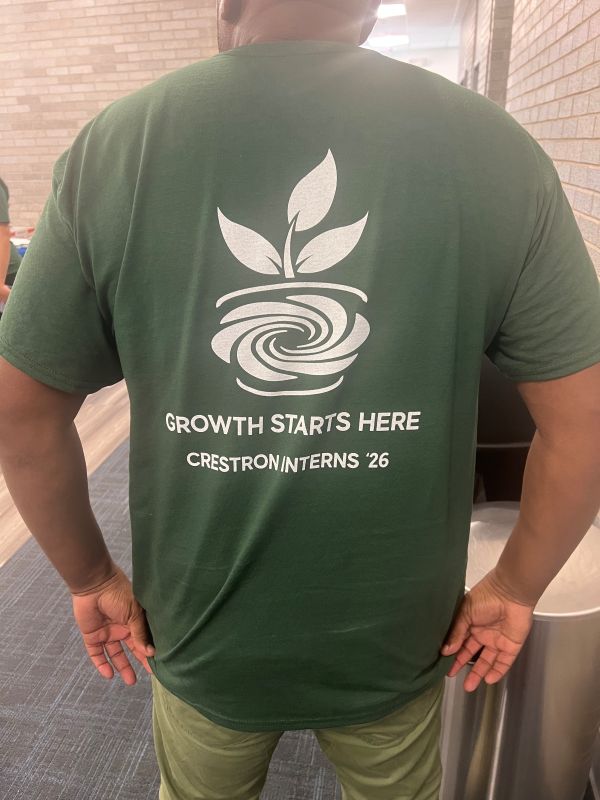
Crestron’s internship program offers the broader pro AV community a workable template. Meaningful work keeps talent in the fold. Photo by Emerald/Commercial Integrator.
“Our interns are working on projects that have deliverables a year or two out,” Bliss says. And his proof point is hard to top. “[For] one or two of those interns, their names went on a patent application because of the contribution to that,” he states.
When Commercial Integrator spoke to two of this year’s interns, their perspective aligned with Bliss’ ambitious vision for the program. Amanda Fausto, now in her third year, started on the customer support team and noticed the difference at Crestron right away.
“I really liked how hands-on everything was and how I didn’t feel like I was just doing busywork,” she says.
Rayna Schlossberg, who works on the supply-chain analytics team, amplifies this point, saying, “A lot of people around me forget that I’m still technically an intern.” And that’s the point. The work carries enough weight that the intern label falls away.
Crestron Internship Program: Mobility Across Teams
Movement within the larger organization is one of the quieter strengths of the Crestron internship program structure. Interns aren’t locked into a single lane, and that latitude — one might call it a corporate lattice rather than a corporate ladder — helps them find where they really belong.
Fausto is the clearest example. Over three years at Crestron, she has rotated through customer support, subscription services and finance, encouraged by managers who told her to keep exploring.
“I think going with three different departments was really helpful,” she reflects. The rotations widened her exposure and pointed her toward finance, where she has now stayed the longest.
Meanwhile, Schlossberg found the same openness on her team, where pursuing problem-solving opportunities across departments earns encouragement.
“It’s not like you’re put in a box,” she describes. In fact, her manager routinely asks whether there’s anyone else she’d like to meet, or if there’s any part of the business that she’d like to see.
For a company like Crestron, which is organized around specialized engineering disciplines, that kind of cross-pollination matters.
Crestron Internship Program: A Remarkable Conversion Rate
Numbers decide the argument about whether an internship program is an investment or an expense. Crestron’s conversion rate settles the debate quickly and decisively.
“The ratio right now is 42.8%,” Bliss says with evident pride. “So, roughly 43% of the individuals we bring in as interns get converted to a full-time position.”
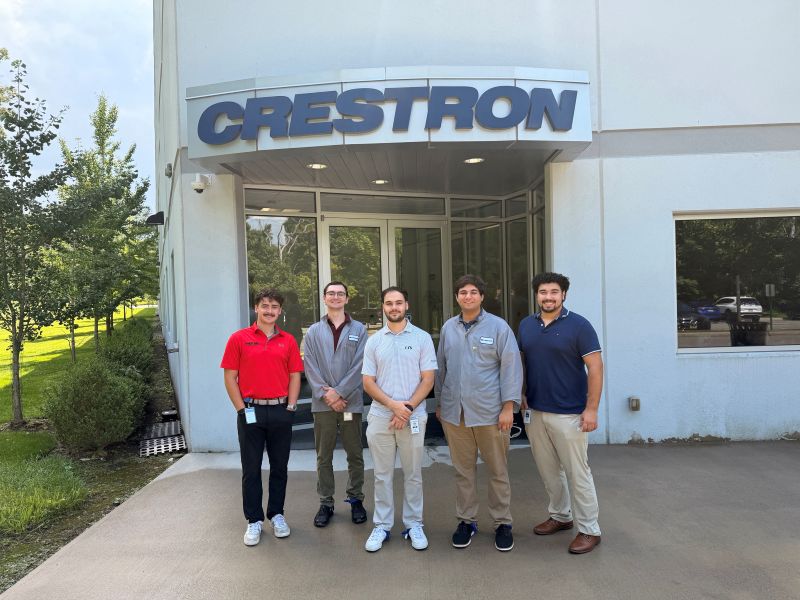
Crestron’s internship program is not a feel-good gesture; it’s a hiring engine.
Having seen the other end of that scale at a prior employer, Bliss knows that Crestron’s achievement is cause for celebration.
That shows that the Crestron internship program isn’t a feel-good gesture; rather, it’s a hiring engine.
The clearest result is Alex Peras, Crestron’s EVP of product and engineering, who joined as an intern back in 2012. In a campus setting, a trajectory like that recruits on its own. When a prospect can see someone who sat in the same seat just a few years earlier, Bliss says, the story gives potential interns a real sense that a career path can follow this opportunity.
The Year-Round Model
Traditionally, internships run summer-only, with a nine-month gap that forced projects to stall and restart. But Crestron offers interns a more immersive experience than that. Both Fausto and Schlossberg stayed on through the full school year, keeping the thread on long-term work.
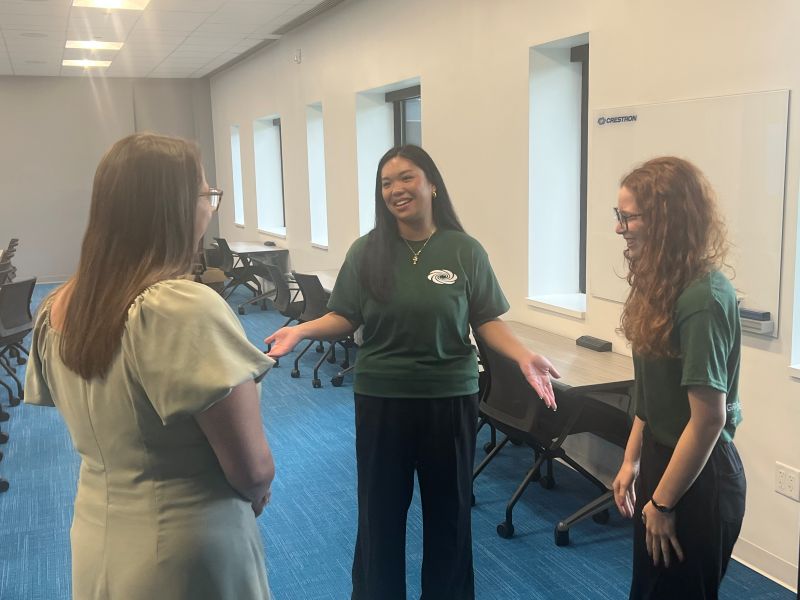
(L-R): Crestron’s senior manager, global public relations, Kaylie Sanchez, Amanda Fausto and Rayna Schlossberg. Photo by Emerald/Commercial Integrator.
To make sure the approach was sustainable, Crestron built their schedule around college commitments. Schlossberg, who attends school in Buffalo, N.Y., worked remotely on a company-provided computer and came into the office over breaks. Classes came first, she says, and the work just molded around them.
“It didn’t feel like I was balancing Crestron or school,” she attests.
For students juggling coursework and real deliverables, that flexibility separates an internship they can sustain from one they might have had to abandon.
A Culture Built on Feedback
Bliss and the Crestron team treat intern feedback as operational input, not a box to check. Every year, he surveys the class on what worked, what didn’t and what could improve. The next step — acting on whatever is practical — is the differentiator.
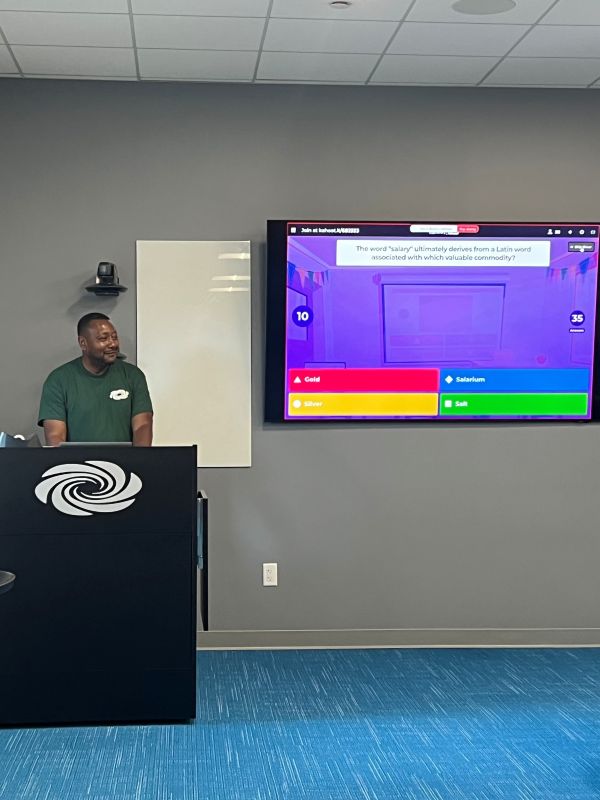
Trivia, conversation and fun round out the Crestron internship experience. Photo by Emerald/Commercial Integrator.
For example, three years ago, he launched Open Hour Fridays, a social hour split in two. The first half brings in a subject-matter expert to illuminate a corner of the business that the interns might otherwise never see. The second half is lighter: trivia, conversation and, this year, a game pitting interns against Crestron executives.
The interns can tell the ongoing feedback loop is real. Schlossberg and Fausto approached Bliss in May to ask for a modified role, and he welcomed the conversation.
“It can sometimes be a very big wall between HR and everyone else, and he is very good at breaking that down,” Schlossberg states.
Widening the Pond
Inclusivity is part of Bliss’ job title, and he treats it as a top priority rather than a talking point.
“If we’re looking for different types of fish, if I may use this analogy, we have to learn to fish from different ponds,” Bliss tells me. “So, we go where they are.”
In practice, that meant building a ground-up partnership with the Society of Women Engineers chapter at NJIT and showing up on campus with female engineers. The idea was to give prospective interns exemplars of where they could go one day.
And the results were exactly as Bliss had hoped.
“In 2024, 50% of the internship program were women,” Bliss says. This year’s class sits near 38% female, a small dip that Bliss ties partly to returning interns who are on the path to conversion.
The Takeaway for Integrators
Crestron’s internship program offers the broader pro AV community a workable template. Meaningful work keeps talent in the fold. Curation beats volume. Feedback, when taken seriously, compounds and elevates culture. And for the interns, the experience clarifies what comes next.
“Crestron was really able to provide me a more concrete vision of what is out there for me,” Schlossberg says.
Meanwhile, three years in, Fausto cites the culture as what keeps interns from leaving.
“It’s very family-oriented,” she says. “It feels like we’re all very close.”
The labor crunch in pro AV may not be easing. But Crestron’s answer is a compelling one: Treat young talent as talent from day one. A nearly 43% intern conversion rate says the approach works.