Earlier this month at CEDIA Expo 2026, five channel leaders told attendees that business is shifting from products to experiences, and from installs to relationships.
On the Smart Stage, a panel of manufacturer and distribution executives sat down to answer a deceptively simple prompt: what does custom integration look like five years from now and why.
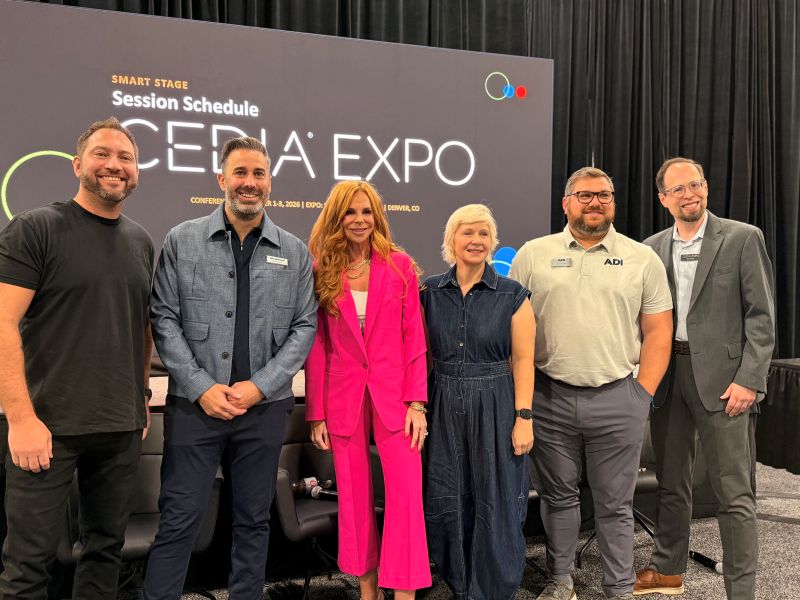
The session, entitled “What Every Integrator Needs to Know About the Next Five Years,” brought together Nick Berry, CEO of Origin Acoustics; Michael Short, global vice president of marketing operations and residential at Crestron; Matt Kamp, vice president of product management at ADI; Melissa Andresko, chief corporate brand ambassador at Lutron; and Kathleen Thomas, head of custom integration sales at Sony Electronics.
Dan Ferrisi, group director of content + editorial, industrial + tech, Forge, moderated the session.

The panel represented five different pieces of the custom integration channel: audio, control, distribution, lighting and displays. Nevertheless, three ideas united everyone on the Smart Stage: the selling experience has evolved, AI is a tool rather than a takeover and relationships with clients matter now more than the individual install.
Below, we take you back to the panel, offering a real-time recap of the live conversation and valuable insights shared by the panelists.
Why Integrators Need to Pivot From Product to Experience
As the panel begins, Andresko frames the shift in the selling experience, remarking, “I think it’s going to be a lot less product-based and more experience-based.”
From her perspective, homeowners are no longer calling with a request for a specific product. They’re describing an outcome instead: a home that runs itself, a room that feels right, a life made simpler. She sums up where that leads in three words. “This concept of just invisible luxury,” says Andresko. That reframing changes what integrators sell and how they talk about it with clients.
Short sees artificial intelligence accelerating that same shift rather than working against it. He reveals that Crestron spent years building toward a single, standardized operating experience for every customer and AI is what lets integrators break from that uniformity again.
“I think now with AI coming, we’re going to be able to give a unique experience to everyone and put the power back into the integrator’s hands,” Short says. The tools get more capable, he observes, but the differentiation moves back to whoever is doing the install.
AI as Tool, Not Takeover
Continuing the topic of AI, Short describes a practical use case already built into Crestron’s platform: automating the tedious front end of a project.
“So we’re showing ways within the platform that you can upload a floor plan from an architect of a 10,000 square foot home and the system then automatically builds all the rooms,” he says. According to Short, the pitch isn’t a smarter house; rather, it’s a faster setup, freeing integrators to spend that time elsewhere.
Berry also pushes back on the idea that AI leads to fully autonomous, sentient homes. “I think everybody’s mind is going to race to AI controlling the house and being living, breathing,” he says. “I don’t think that that’s necessary and I don’t think that that’s something that we should race to.”
Berry frames the technology instead as an efficiency layer, useful for diagnosing systems and speeding up service rather than a selling point on its own.
Thomas goes further, arguing AI can’t touch the part of the job that actually keeps integrators in business. “There’s no chatbot that’s gonna replace what I hear in conversations with integrators. That’s just not gonna happen,” she says.
Lighting Has Its Time to Shine
In response to a question about which category has gone from niche to essential in the last five years, Andresko points to lighting. “Lighting was actually a number-one category,” she says.
Short goes a step further, framing lighting as close to a prerequisite for staying relevant with architects and designers. “Lighting is the gateway drug to many people’s hearts,” he says.
Andresko then extends the point beyond product into partnership, telling integrators to spend as much time cultivating architects and designers as they do clients. “Make yourself indispensable to builders, to designers [and] to architects,” she says.
Security and Service: The Quiet Priorities for Integrators
Turning to other categories, Kamp names one that rarely gets top billing: cybersecurity. He explains, “I actually think cyber is going to be a really big part of what we all are responsible for over the next several years.”
Kamp describes security less as a product line and more as a baseline expectation that clients won’t think to ask about until something goes wrong.
Short raises a related priority: keeping systems running without a truck roll. “Systems are going to self-heal and AI again is going to help them actually figure out how to do service in a way that doesn’t mean picking up your phone and rolling a truck every other day,” he says.
Piggybacking off of Short’s remarks, Thomas notes that remote monitoring and other background services should also be available to integrators.
Own the Relationship, Not the Project
The panel’s clearest through-line centers on the business model, not the technology.
Kamp puts it succinctly: “Own the relationship, not the project.” He then posits that integrators who treat every job as a one-time install are leaving recurring revenue, and loyalty, on the table.
Thomas’ advice is less about vision and more about discipline. “I have a deeply, deeply boring answer — learn to understand profitability,” she says, pointing to labor costs and service overhead as the numbers that quietly erode a margin that looks fine on paper.
Andresko frames the same shift in terms of the role, not revenue. She explains, “You are not just the provider. You need to change your mindset that you are an advisor.”
Thomas then takes that even further, flipping the tables on who’s actually the product. “[A]t the end of the day,” she says, “the integrator is the product that they’re selling to the customer.”
Turning Assumptions Around for Integrators
In the last segment, the panel turns to assumptions that the industry gets wrong, a path that brings the conversation in interesting directions.
For Thomas, a major assumption is that clients only care about price and features, not about quality. “Better stuff typically costs more. You typically make more money on it, but also the customer is getting a better value,” she says.
The idea that homeowners won’t pay for craft, in Thomas’ view, says more about how integrators pitch a job than about what clients actually want.
Berry focuses on a technical take that doubles as a sales pitch for talking to clients directly rather than defaulting to convention. Here, he points to how most installers default to the ceiling because it’s easier to sell and easier to hide and not because it actually sounds better.
“Speakers in the walls always sound better than in ceiling [yet] 95% of speakers go in the ceiling,” emphasizes Berry.
Andresko reiterates her stance on integrators needing to rethink and adapt their mindset. She adds that the integrator’s value today lies in “creating [the] magical moments for [clients] and their families, no matter where they are.” Berry agrees, proclaiming that the best recurring revenue is getting clients’ second and third homes.
Kamp then chimes in, declaring it as the “customer lifetime value.” He explains that measuring success is not “on the type of product or how much product we install, but the type of experiences we can deliver and the type of value that we can offer to the customer.”
Integrators Repositioning Themselves
Summing up the conclusions, the panel’s five-year forecast isn’t about a specific device or platform. Instead, it’s about integrators repositioning themselves: from installers to advisors, from selling products to selling experiences, and from one-time jobs to relationships that last as long as the house does.