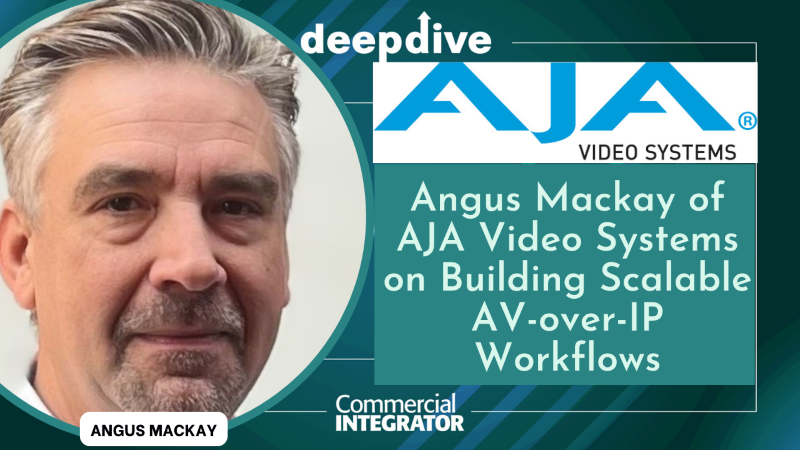
Editor’s Note: This Q&A with AJA Video Systems focusing on AV-over-IP stems from our recent Deep Dive report focusing on AVoIP technology and advancements.
Scalability is one of the most used words in AV right now. It’s also one of the least defined. In a new interview, Angus Mackay, product marketing manager at AJA Video Systems, takes a practical look at what the term actually means for commercial integrators and what it takes to build AV-over-IP (AVoIP) systems that can grow with the work.
The conversation, hosted by Dan Ferrisi, group director of content and editorial, industrial and tech at Emerald, is part of Commercial Integrator’s AVoIP Deep Dive featured in the July/August print edition.
Defining Scalability on the Ground
Mackay frames scalability around a straightforward question: how do you get more from the infrastructure you already have?
“It’s kind of like how do I get more from what I have or do more with what I have?” he says.
That means trimming labor and cost on the same deliverable, adding capability without a full rebuild or finding ways to repurpose existing rooms and gear as production demands shift.
The Limits of Traditional Infrastructure
The Q&A covers the friction points integrators encounter in baseband environments: physical wiring, routing matrices and rooms designed for a single function. Mackay describes how a video editing suite, for example, can’t easily pivot to audio work if the physical environment doesn’t support it.
The shift to IP-based addressable media streams changes that calculus. With devices accessible through a network switch and a standard web browser, integrators can manage and reconfigure workflows without walking back to a central equipment room. Mackay highlights NMOS as a tool for identifying, querying and triggering devices within an orchestrated pipeline.
AJA on What Dependable AVoIP Deployments Require
Mackay identifies the network switch as the foundational element of any reliable AVoIP deployment. Beyond that, he points to the need for devices that support multiple formats and the protocols integrators work with most: NDI, Dante, ST2110 and SRT.
AJA’s BRIDGE LIVE and IP25 serve as his primary examples. BRIDGE LIVE can receive baseband input and output NDI, Dante or ST2110 across a network, with built-in SRT for streaming and final delivery. That multi-format capability, Mackay explains, is what allows customers to use the same equipment across post-production, live events, streaming and corporate AV applications.
Watch the Full AV-over-IP Q&A with AJA
The conversation covers more ground than a summary can capture, including Mackay’s take on where the company and AVoIP adoption are heading.
Watch the full video Q&A below for the complete discussion. Commercial Integrator’s AVoIP Deep Dive report is available in the July/August issue and available for download here.