
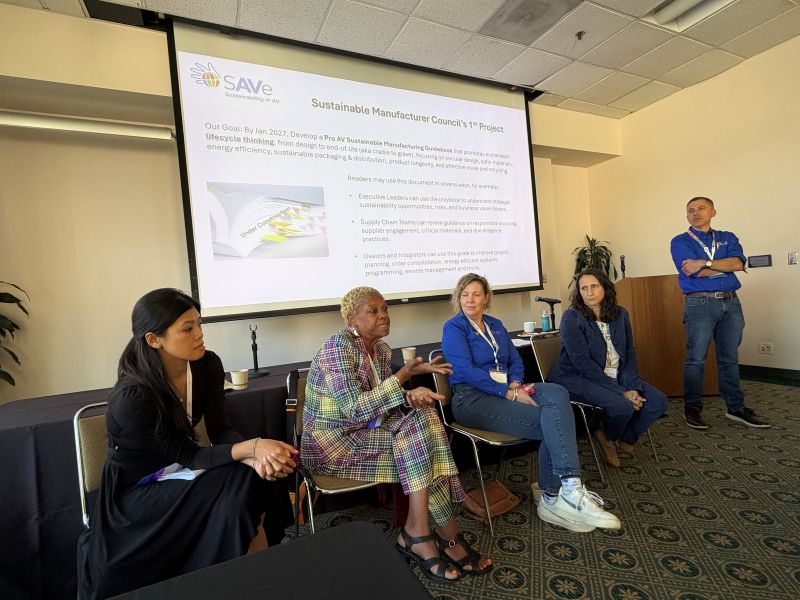
Sustainability rarely makes headlines as a team sport, but that’s exactly how the SAVe Sustainable Manufacturer Council framed it during its session at the 2026 SAVe Global Conference.
Five leaders from four AV manufacturers took the stage together at the event, swapping notes on packaging redesigns, battery innovations and recycled materials instead of guarding them as trade secrets.
The panel featured council co-chairs Mike Rogers, senior sustainability manager at Crestron Electronics, and Wendy Feldstein, senior vice president of design at Crestron Electronics. They were joined by Sarah Drysdale, chief operating officer and head of product at CommBox; Althea Ricketts, chief transformation officer at Shure Inc.; and Joyce Kwan, environmental stewardship program manager at Sony Electronics.
How Do Sustainable Manufacturer Council Members Work Together?
The premise underpinning the Sustainable Manufacturer Council challenges a basic business instinct: Companies that often chase the same customers are choosing to compare notes on environmental strategy instead of hoarding it.

Ricketts argued that even the largest manufacturers can’t afford to go it alone. Shure has won tenders because of its sustainability credentials, she said, and lost others when it couldn’t supply data such as the carbon footprint or life cycle assessment for a product like its MXA910 ceiling array microphone.
“In sustainability, there’s no competition. It’s collaborative,” she said. “What you’ve learned from Crestron and what I’ve learned from Sennheiser, [and] what I continue to learn from other folks will make us get better.”
Rogers said council members meet by phone every couple of months to discuss climate change, pollution and circular-economy trends, along with the emerging regulations they track together, such as the EU’s Packaging and Packaging Waste Regulation (PPWR).
How Is Sony Electronics Advancing Its Road to Zero Goal?
Kwan said Sony’s sustainability work is anchored in Road to Zero, the company’s long-term environmental plan, with research and development teams in Tokyo working alongside its U.S. sales organization. Sony launched Road to Zero in 2010 with the goal of a zero environmental footprint by 2050, and it has since moved its value-chain net-zero target up to 2040.
Central to that effort is SORPLAS, Sony’s proprietary flame-retardant recycled plastic. Sony says the material contains up to 99% recycled content, drawn from used water bottles and waste optical discs. The company uses SORPLAS in BRAVIA televisions and select cameras.
“We’re really seeing a demand for reducing virgin plastics, and then our customers are also wanting more sustainable products too,” Kwan said.
Winning executive support is harder, she added, because leadership often sees sustainability first as a cost. Her answer has been to prove a concept with a small pilot before asking for more.
One such pilot began with a networking conversation. About two years ago, Kwan met a representative of 4ocean, an ocean-cleanup company, at an industry conference. Sony’s Tokyo team was hesitant at first, but she worked with the marketing team on a campaign that funded the removal of one pound of marine plastic and trash for every product registration.
“We saw a 40% increase in our registrations,” she said, a result that showed executives customers cared.
Ricketts agreed that data is what moves leadership. “This short-term investment is talking about your long-term survival,” she said.
Sony is also launching a rebate program for its BRAVIA professional displays to encourage responsible recycling, Kwan said. The company chose a vendor that runs refurbishment and recycling at the same site, so returned products are evaluated for reuse before they’re recycled.
How Has Shure Reduced Battery Waste and Packaging Materials?
Shure Inc. treats sustainability as a continuation of a longstanding identity rather than a new initiative.
“You can brand it whatever you want. Shure has been doing it for over 101 years, and it’s part of our core value,” Ricketts said.
When Shure built its sustainability strategy, she said, the team was Ricketts and one colleague from engineering. It has since grown into a cross-functional group that includes product design and sales, and Shure is now hiring a sustainability manager. “It’s no longer an option,” she said, pointing to regulation and what’s on the horizon.
Packaging reform followed a wake-up call. Shure thought it was ahead on packaging until a major customer returned all of its packaging to Shure’s doorstep. The company hired a packaging scientist to optimize its approach; at one point, Shure had 1,500 different types of packaging, a number Ricketts said is now down to roughly 100.
Working with the Sustainable Packaging Coalition, Shure set a stretch goal of 75% recyclable packaging by 2023. “We hit 90% by the end of 2023,” Ricketts said.
The last 10% has proven stubborn, largely because of supplier challenges around plastic. When Apple told Shure it needed zero plastic in its packaging to do business, Shure said it wasn’t there yet, and Apple kept buying anyway. Ricketts now questions whether closing that final gap is the best use of her team’s energy. “Is 90% good enough?” she asked.
Shure’s rechargeable wireless systems delivered some of the session’s most concrete waste-reduction numbers. Ricketts cited David Byrne’s “American Utopia” production, which used Shure’s rechargeable batteries. “The engineer said he was able to save 21,000 batteries from going into the environment,” she said.
Across Shure’s broader customer base, Ricketts said she believes the company’s rechargeable technology has kept about 22 million disposable batteries out of the waste stream. Shure reported in 2023 that the figure had passed 20 million over the previous five years.
How Has Crestron Transformed Its Packaging Strategy?
Feldstein traced Crestron’s packaging evolution to 1991, when she found products shipping in a box within a box, padded with eight Styrofoam corners. She standardized box numbers, wrote engineering standards and cut the company’s general shipping boxes from a dozen or more down to five.
She also added drop testing followed by electronic testing, to catch internal damage, like a cracked circuit board, that wouldn’t show on the outside. Her rule, she said, is “no production surprises and certainly no customer surprises.”
When plastic began creeping back in, Feldstein put a strategy in writing in 2019: use plant-based and recycled materials; reduce size, part count and waste; eliminate plastic; and choose vendors close to manufacturing facilities.
The results, tracked by product count rather than weight, show steady progress: Crestron reached 28% renewable packaging in 2022, 79% in 2024 and 86% in 2025.
Progress has continued since. Feldstein said a chip manufacturer that had used a plastic enclosure switched to sugarcane pulp packaging recently, following repeated requests from Crestron.
Rogers said that supplier pressure is now formal. Crestron added a packaging question to its annual supplier survey, and vendors that wouldn’t improve didn’t get favored. “The biggest sustainability impact sometimes isn’t happening in the decisions you make at your desk, but the money you spend and who you spend it with,” he said.
Customer expectations shape what goes in the box, too. Products powered over Ethernet don’t need a power supply in every box, Feldstein noted, and she has launched a cross-functional initiative to go further, such as selling power and USB cables in 10-packs instead of including them with each product. Fewer bundled accessories mean a lower product price, smaller boxes, fewer plastic bags and less e-waste.
Crestron also began sizing boxes for palletization, fitting more products into the same pallet space to cut shipping emissions and save money. “I showed them that eco-friendly equals money, and that’s one of the most important things,” Feldstein said.
How Is CommBox Using Modular Design to Support Circularity?
Drysdale said CommBox, an Australian display technology company, is far smaller than its Sustainable Manufacturer Council peers, which means fewer approval layers. “I don’t have to go and convince anyone,” she said.
“Ever since I joined CommBox, we’ve been committed to improving the sustainability of our products, and it does help us to win work,” Drysdale said. Sustainability now appears in tenders from large Australian enterprises, including the big four banks and major consulting firms, driven in part by reporting requirements. Something as simple as automatically turning a display off at the four-hour mark can give CommBox a better power score than competitors on a tender.
“That is helping my business, but ultimately helping everyone,” she said.
One of CommBox’s toughest engineering challenges involves balancing product longevity with cybersecurity. Its main interactive display runs on Google’s EDLA Android platform, which Drysdale said receives security patches for only three years, far shorter than the hardware’s useful life. To avoid leaving unpatched displays on customer networks, CommBox is moving toward a modular design that lets the compute module be replaced while the LCD panel stays in service.
Drysdale is also pressing factories to replace polyfoam with molded pulp. CommBox uses the same contract manufacturers as its competitors, she said, and one factory they all share still won’t make the switch. She has kept up the pressure even as one of its smallest customers.
She also described how an idea from a council meeting became a community partnership. After hearing Feldstein discuss leaving unneeded cables out of the box, Drysdale asked resellers whether CommBox could do the same. Defense-sector clients told her they couldn’t use the included cables anyway, because they require specially specified ones.
An integrator that serves as CommBox’s Indigenous partner then suggested setting those cables aside and pairing them with CommBox screens being repurposed for Indigenous communities.
“That’s where planting one seed in a global meeting then translates right down to something that impacts people,” Drysdale said.
What Does This Mean for Integrators?
Several of the panel’s examples reach directly into integrators’ day-to-day work.
Sustainability is becoming a scored part of bids. Shure and CommBox both described winning tenders on sustainability, and Ricketts said buyers now ask for product-level carbon footprints and life cycle assessments. Integrators responding to those bids may need that data from their manufacturers.
What ships in the box is changing, too. As manufacturers like Crestron drop power supplies and cables many customers don’t use, integrators should confirm what’s included with each product and quote accessories separately where a project needs them.
Regulations the panel discussed are already in effect. Kwan pointed to California’s embedded-battery law: Since Jan. 1, 2026, SB 1215 has required a recycling fee of 1.5% of the retail price, capped at $15, on products with batteries that can’t easily be removed with household tools. Products with screens larger than 4 inches fall under the state’s separate e-waste fee. In Europe, the PPWR began applying to all packaging placed on the EU market on Aug. 12, 2026.
What Are the Sustainable Manufacturer Council’s Next Strategic Goals?
Regulation is one reason the council wants a shared playbook. Rogers pointed to the EU’s Ecodesign for Sustainable Products Regulation (ESPR), which introduces a digital product passport: a QR code giving customers data such as country of origin, product carbon footprint and recycling instructions. Electronics aren’t in the first wave, he said, but the rules could reach AV products by 2030.
Feldstein sees regulation as a necessary push. “We wouldn’t be doing any of this if we weren’t being forced by Europe,” she said. Her concern is execution. “The regulations have to be thought out and clear,” she said, and they must anticipate unintended consequences.
The council’s first project is the Pro AV Sustainable Manufacturing Guidebook, designed to give the broader industry a shared reference point. “We needed a reference point. We needed a backbone of information,” Rogers said.
“By January 2027, this council wants to create this Sustainable Manufacturing Guidebook that promotes sustainable life cycle thinking from cradle to grave,” he said. The guidebook will address circular design, safer materials, energy efficiency, sustainable packaging and distribution, product longevity, and reuse and recycling.
Ricketts pushed back on the framing slightly, favoring a circular model over a linear one. “I would prefer cradle to cradle,” she said.
The council plans to publish the guidebook’s first edition and launch it at ISE 2027 in Barcelona. Rogers highlighted a section on substances of very high concern, a list he said keeps growing as new science emerges.
Why the Industry Must Keep Pushing Forward
The SAVe Sustainable Manufacturer Council’s session made one point clear: Much of the progress in AV manufacturing sustainability starts inside individual companies, and the council exists to help it spread.
Sony’s recycled plastics, Shure’s rechargeable batteries, Crestron’s packaging overhaul and CommBox’s modular displays each represent lessons earned the hard way. CommBox’s cable program shows what happens when those lessons travel: An idea shared in a council meeting became a partnership that put equipment to use in Indigenous communities.
For integrators and manufacturers building their own sustainability programs, the panel offered a consistent playbook: Pair grassroots enthusiasm with executive-backed strategy, prove ideas with small pilots and measure results in numbers executives understand.
Frequently Asked Questions
What is the SAVe Sustainable Manufacturer Council? The SAVe Sustainable Manufacturer Council is a cross-company working group affiliated with SAVe that brings together AV manufacturers, including Crestron Electronics, CommBox, Shure Inc. and Sony Electronics, to share sustainability strategies and coordinate industry-wide initiatives.
Why do competing manufacturers share sustainability strategies with each other? Council members argue sustainability is a noncompetitive space because environmental progress benefits the entire industry, and because no single company has solved problems like plastic-free packaging on its own.
What is the Pro AV Sustainable Manufacturing Guidebook? It is a planned industry resource from the SAVe Sustainable Manufacturer Council covering sustainable product life cycle practices, from circular design and safer materials to reuse and recycling. The council aims to publish its first edition and launch it at ISE 2027 in Barcelona.