
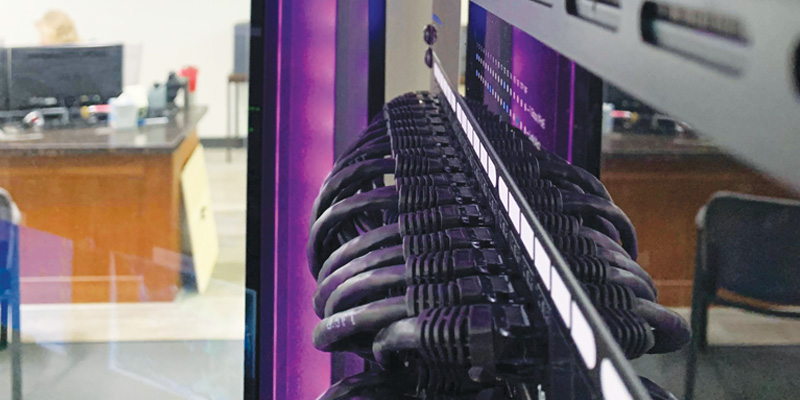
The debate over whether integrators would embrace AV-over-IP is over. Across conference rooms, command-and-control centers, campuses and production environments, the network has become the default fabric for moving audio, video and control. Commercial Integrator’s 2026 AVoIP Deep Dive asks a tougher question: What does it take to truly operationalize the technology?
To find answers, Commercial Integrator gathered perspectives from a market analyst and five integration and consulting professionals, then layered in survey data from its audience.
The interviewees include:
- Sean Wargo, principal, Apogee Insight LLC
- Lincoln King-Cliby, commercial market director, ControlWorks Consulting
- Dalton Parker, director of sales and marketing, ClearVista
- Tim Kersting, chief design officer, CTI
- Dave Schwarz, senior solutions architect, Diversified
- Phil Rapp, senior director of engineering, Diversified
AVoIP Is Now the Starting Assumption
AVoIP no longer needs justification. It’s the default.

“The biggest shift is that we’re no longer evaluating whether AV-over-IP makes sense,” Parker says. “We’re assuming it does and only reverting to fixed architecture when it clearly isn’t the right fit. Nearly every project we design today is approached with an IP-first mindset.”
Kersting frames it culturally. “AVoIP is not the scary new thing anymore,” he says. “It is part of the normal design conversation now.”
Commercial Integrator’s survey data backs this up. Nearly two-thirds of respondents say AVoIP is common but not ubiquitous, and one-third now deploy it in 80% or more of their projects.
What Separates Deployment From Maturity
Moving a signal is easy. Sustaining networked AV across its full lifecycle is not.
“An integration company that is deploying AVoIP can get the signal from point A to point B,” Kersting says. “An integration company that is very skilled with AVoIP can design it, document it, secure it, test it, troubleshoot it and support it without needing a hero every time something gets weird.”
Rapp points to the network as the most common weak spot. “Too often, this area is taken for granted,” he says. Assumed that, “if there are enough ports, then we are ‘good to go.'”
King-Cliby zeroes in on fundamentals like IP multicast, IGMP and snooping, plus the checklists and documentation that make deployments repeatable.
Where Friction Still Lives
Product performance has matured. Implementation hasn’t caught up.
Schwarz flags a surprising culprit. “AVoIP video has become relatively simple,” he says. “The biggest remaining friction point is audio.” Changing channel counts in a multicast stream and working around IGMP limits, he notes, quietly consume time and create frustration.
The AV/IT Relationship Takes Center Stage
IT is now involved in nearly every project. The integrator’s job is translation.
“The conflicts usually are not because AV and IT want different outcomes,” Kersting says. “They are usually looking at the same project through different lenses.” Survey data confirms decision-making influence is now shared almost equally between integrators and client IT teams.
Cybersecurity Moves Into Design
Security used to surface at the end of a project. Now it starts at the beginning, driven largely by IT stakeholders.
“What’s changed is that cybersecurity is no longer treated as a separate discussion,” Parker says. “It’s become part of the core design process.” Cybersecurity ranks among the top barriers to broader adoption in the survey.
Standards, Scale and Recurring Revenue
Protocol decisions come last, not first. Integrators start with workflow, then choose Dante, SDVoE, IPMX, ST 2110 or NDI to match. Still, fragmentation is the single most-cited adoption barrier, and consolidation is integrators’ top ask.
Scalability leads the value story. The recurring-revenue promise, though, remains unproven: only about one in five respondents has converted AVoIP into recurring revenue.
“AVoIP is just another way to deliver the project,” Kersting says. “It only becomes a business-model shift when the support strategy is built in from the beginning.”
The takeaway: Merely deploying AVoIP no longer defines success. Running it well does.
Get the Full Report
Want the complete findings, figures and expert insights? Download Commercial Integrator’s 2026 AVoIP Deep Dive report and see what operational maturity really takes.