
Most school paging systems get noticed only when they fail. At a South Australian secondary college with more than 2,250 students and staff, the system hasn’t given anyone a reason to notice it in more than ten years.
Cardijn College, a multi-campus Catholic secondary college in Adelaide, South Australia, has run Biamp Vocia paging and voice evacuation since its original installation. The same devices still handle daily bells, announcements and emergency messaging. The college now plans to copy that setup at a fourth campus.
Key Things to Know
- Cardijn College has run Biamp Vocia paging and voice evacuation without interruption for more than a decade.
- The system serves more than 2,250 students and staff across three campuses, with a fourth in development.
- Vocia handles automated scheduled bells and zoned paging for staff, indoor and outdoor audiences.
- Each campus runs its own core processor, so paging keeps working during internet outages.
- The system has rebooted and resumed full operation on its own after power outages lasting six to eight hours.
- The college plans to replicate the same Vocia configuration at future campus expansions.
What Does the Paging System Need to Do at Cardijn College?
The system has to deliver clear bells, announcements and emergency messages every day across indoor and outdoor spaces on multiple campuses. With more than 2,250 students and staff spread across three sites, a missed bell or garbled evacuation message affects the whole school.
The requirements cover routine and critical use. Scheduled bells keep classes on time, targeted announcements reach specific groups and voice evacuation has to work without exception.

How Has the Vocia System Performed Over Time?
The Vocia system has delivered uninterrupted service for more than a decade with almost no hands-on maintenance. Tony Sayce, information and communications technology director at Cardijn College, points to the original hardware as the clearest proof.
“I don’t touch the Vocia system. It pretty much runs itself,” Sayce says. “I don’t have to babysit the devices or anything like that. The same devices I put in 10 or 12 years ago are still running now.”
For integrators, that’s the number worth noting. A paging system that runs for more than a decade on its first set of endpoints means a client that isn’t calling about service problems. It also means a reference account that holds up over time.
What Functions Does Vocia Handle at the College?
Vocia handles two core functions: automated scheduled bells and flexible zoned paging. The bells move students between classes, while zoned paging covers daily announcements and emergency situations.
Front office staff control exactly who hears each message. The system supports staff-only paging, students indoors, students outdoors or any combination of those groups.
That zoning matters on a working campus. Staff can reach a single audience without interrupting every classroom and outdoor area at once.
Why Does the College Use Live Announcements Instead of Recordings?
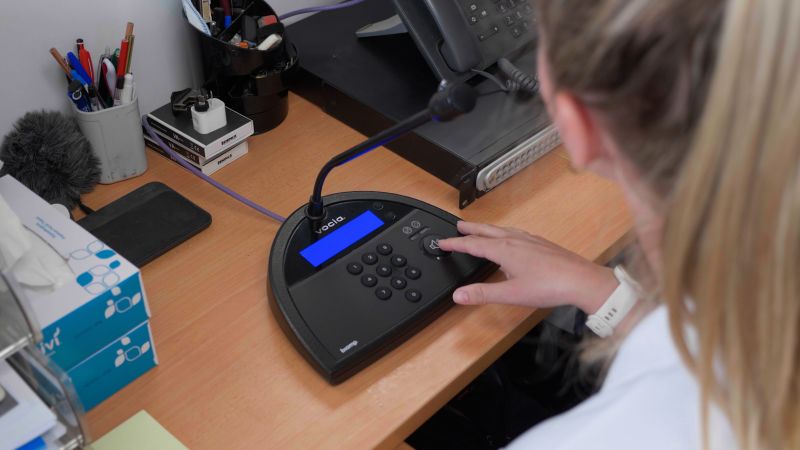
The college uses live announcements because students respond more reliably to familiar voices, especially during emergency drills. Staff make those announcements through Biamp DS-10 paging stations installed in administration areas.
It’s a deliberate choice based on experience, not a technical limitation. Pre-recorded messages are an option, but the college found that a voice students recognize gets a faster response when it counts.
How Is the System Built?
The Vocia platform is IP-based, with a central core processor at each campus sending audio over the network to endpoint devices. That design keeps each campus self-contained.
One major building on the Marian campus uses Biamp Voltera amplifiers paired with Desono in-ceiling loudspeakers. Those components handle audio distribution in that building alongside the wider Vocia network.
How Does the System Handle Outages?
The system keeps running through internet outages and recovers on its own after long power failures. Separate cores at each campus let paging operate locally even when the internet connection drops.
Power outages haven’t been a problem either. After outages lasting six to eight hours, the system has rebooted and returned to full operation without anyone stepping in.
That’s not a minor detail for a life-safety system. When the power comes back, staff don’t have to wait on a technician before bells and evacuation paging work again.
How Will the College Expand the System?
Cardijn College plans to replicate the same Vocia configuration at its future campus expansions at the Larkin and Aldinga sites. The approach reuses a design the school already knows works.
Sayce describes scalability as a key reason for sticking with the platform.
“It’s very easy to expand. Once you get your head around how it works, it’s a very straightforward product,” Sayce says.
What Can Integrators Take From the Cardijn College Deployment?
The main lesson is that redundancy keeps a multi-campus paging system dependable for years. Independent cores protect each campus from network failures, and a repeatable configuration makes new sites easier to add.
For integrators bidding on education projects, the case also shows what clients value once the install is finished. Cardijn College’s ICT director doesn’t talk about features. He talks about not having to touch the system, and that’s the outcome school clients remember.