
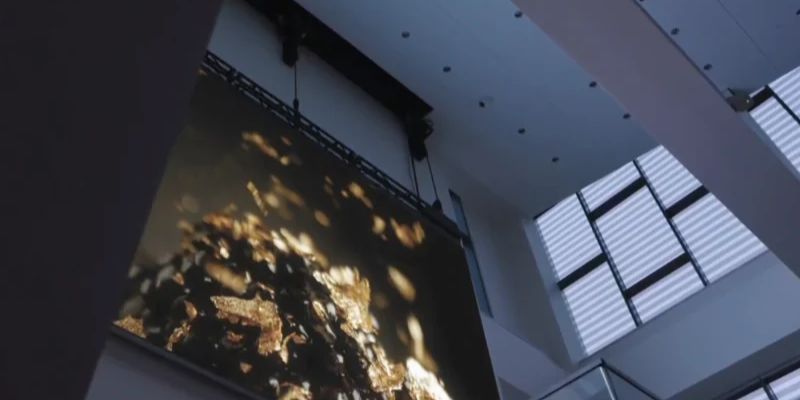
Most display walls in new academic buildings end up showing schedules, slideshows or short promotional loops. The screens get installed, the content gets forgotten and the hardware becomes background noise within weeks.
The Culinary Studies Institute at Oakland Community College took a different route. Its large-format displays carry a commissioned art piece built specifically for the space and the discipline taught inside it.
Key Takeaways:
- Global design consultancy Leftchannel created “Food Is Art,” a large-scale moving image piece for Oakland Community College’s Culinary Studies Institute in 2025.
- Design firm Ideation Orange commissioned the work, which falls under Leftchannel’s digital art and experiential design services.
- The content uses macro lenses and high-speed cinematography to turn liquids, grains and textures into abstract, sculptural motion.
- The piece runs as a long-form composition rather than a loop and plays across large screens built into the school’s architecture.
- School leadership credits the installation with inspiring students, faculty and the wider community.
What Did OCC’s Culinary Studies Institute Need From Its Digital Art?
The institute needed an artwork that did more than fill a wall. It had to reflect the school’s focus on creativity, craft and the art of cuisine.
Design firm Ideation Orange brought the project to Leftchannel, a global design consultancy, with an open brief. Leftchannel’s team saw the job as a chance to build a piece that visually belonged to the environment and spoke the same language as the culinary arts.
That goal shaped every decision that followed. Alberto Scirocco, creative director at Leftchannel, describes a consistent approach to site-specific work, one that starts with the connection between content and place.
“Our focus is always on making the story visible, finding the emotional or conceptual thread that connects a piece to the place it lives in,” Scirocco says.
Why Did Leftchannel Focus on Ingredients Instead of Chefs?
Leftchannel focused on ingredients because they’re the foundation every dish starts from. Instead of showing chefs at work or finished plates, the team built the piece around raw materials: liquids, grains and textures.
The choice gave the artwork two jobs. It had to feel ambient and architectural enough to live in the building every day, yet hold enough visual interest to take center stage when someone stops to watch.
Not a highlight reel of the kitchen. A study of what goes into it.
How Was the ‘Food Is Art’ Content Produced?
The team shot the content with macro lenses and high-speed cinematography. That combination captured the slow rhythm and fine detail of ingredients as they move, transform and combine.
At that scale and frame rate, familiar materials stop looking like food. They read as abstract, sculptural forms, giving the piece a visual language rooted in nature and craft.
Why Doesn’t the Piece Run on a Loop?
The piece doesn’t loop because Leftchannel designed it as a long-form moving composition. It works as an evolving visual meditation that shifts with the viewer’s attention rather than repeating a short clip.
That distinction matters in a building where the same students and faculty walk past the screens every day. A short loop becomes predictable fast. A long-form composition gives regular viewers a reason to keep looking.
How Does the Installation Fit the Building’s Architecture?
The installation plays across large screens integrated into the school’s architecture. Rather than reading as a separate display, the content blends into the building and reflects the energy of the space around it.
Leftchannel developed the content with that physical context in mind. The ambient pacing and abstract imagery let the screens function as part of the interior design, not as an add-on.
What Impact Has ‘Food Is Art’ Had on the School?
“Food Is Art” has become part of the school’s identity, not decoration. It connects students, faculty and visitors to the creative side of the culinary arts, using motion and imagery to mirror the transformation that happens in every kitchen.
College leadership points to the piece’s role in reinforcing what the institute teaches. Peter Provenzano Jr., chancellor of Oakland Community College, ties the artwork directly to the craft of cooking.
“The ‘Food is Art’ video displayed at OCC’s Culinary Studies Institute creatively celebrates the artistry of preparing food. It inspires our students, faculty and community with its visual interpretation of how food preparation truly is a craft to be appreciated,” Provenzano says.
What Frameworks Guided the Project?
Three Leftchannel frameworks guided the project from concept to completion:
- Experiential Storylines: defining a visual narrative that evolves with the space
- Narrative Clarity: grounding abstract visuals in emotional purpose
- Brand in Motion: aligning content, tone and rhythm with institutional identity
Each one ties the content back to the building and the people who use it. Together, they explain why the piece reads as part of the institute rather than generic screen content.
What Can Integrators Take From the Project?
The biggest lesson is that a display installation succeeds or fails on its content strategy, not just its hardware. Large screens in a lobby or corridor only hold attention when the content is built for that specific space and audience.
The OCC project shows what that looks like in practice. Site-specific footage, non-looping playback and pacing matched to the architecture turned standard display surfaces into a permanent piece of the building’s identity.
For integrators, that points to a clear opportunity. Projects that pair display design with purpose-built content partners, such as design firms and creative studios, deliver installations clients keep using long after handoff.