
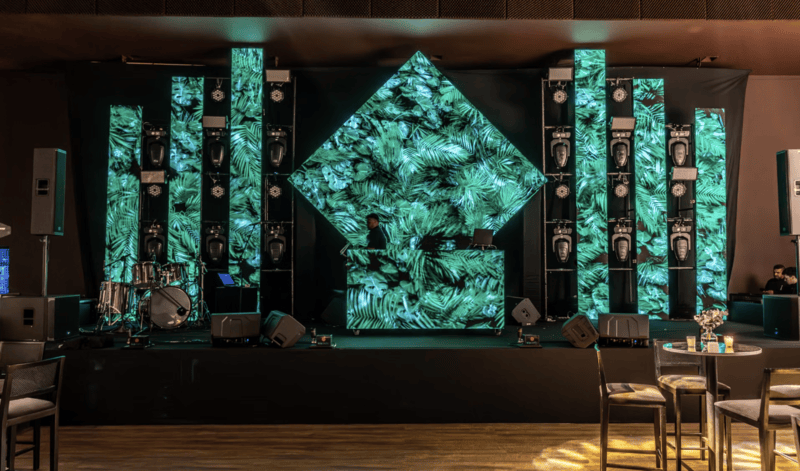
LED displays have become ubiquitous across outdoor billboards, indoor smart terminals, stage productions, and immersive virtual production environments. But as MLED technology advances toward higher pixel densities and more demanding applications, traditional PWM (Pulse Width Modulation) driving technology has become a performance bottleneck — limiting grayscale depth, capping brightness and contrast, and creating the industry-wide “low-gray, low-refresh-rate” problem that makes scanning lines visible to both the human eye and camera equipment.
NovaStar’s Infinity Solution addresses these limitations through a hybrid PWM+PAM driving architecture that creates dual-dimensional control over brightness via both pulse width and current amplitude. Combined with intelligent algorithms — including the proprietary MG algorithm and adaptive thermal compensation — and an advanced control platform, the solution delivers expanded dynamic range, finer grayscale reproduction, exceptional color fidelity (ΔE ≤ 2), and refresh rates at low grayscale levels improved by 4 to 8 times over traditional PWM.
This white paper explores how the Infinity Solution translates technical breakthroughs into real-world value across xR stages and virtual production, command and control centers, high-end commercial displays, automotive displays, and outdoor advertising — delivering superior image quality alongside up to 20% lower mean power draw.
Key Takeaways
- Traditional PWM driving faces three core limitations: constrained grayscale performance, fixed brightness/contrast ceilings, and critically low refresh rates at low grayscale levels.
- The hybrid PWM+PAM architecture boosts driving current in high-brightness regions for greater peak luminance while reducing current amplitude in low-grayscale regions for deeper blacks.
- NovaStar’s MG algorithm dynamically selects the optimal PWM/PAM combination per grayscale level, leveraging 16-bit PWM depth and 8-bit PAM depth for smoother, more natural gradients.
- The solution achieves a color difference (ΔE) of ≤ 2 — imperceptible to the human eye — with color temperature deviation stabilized within ±100K, and supports sRGB, Rec.709, DCI-P3, and Rec.2020 color gamuts.
- Refresh rates at 1 grayscale improve by 4 to 8 times compared to traditional PWM, solving the long-standing “low-gray, low-refresh-rate” challenge.
- Adaptive thermal compensation uses a thermal distribution prediction model and real-time per-pixel monitoring to eliminate color drift caused by temperature variation.
- Pixel-level dynamic energy saving delivers up to 20% mean power draw reduction, extending product lifespan and reducing cooling demands.