
THE VISUAL ERA OF 4K
We live in an era where the quality of visual communication defines the effectiveness of human connection. Whether in classrooms, conference halls, control centers, or immersive environments, audiences now expect not just brightness—but precision, realism, and seamless clarity.
The evolution from HD to 4K marks more than a step in resolution; it represents a transformation in how information is perceived and trusted.
For Panasonic, this shift is driven by decades of optical innovation—combining dual-axis pixel precision and 4K signal processing technology to deliver stunning 4K projection.
WHAT IS 4K: UNDERSTANDING THE DIFFERENCE
The term “4K” is used broadly, yet the underlying technologies vary widely in how they produce and control pixels.

The Meaning of 4K Resolution
A true 4K image contains at least 8.3 million addressable pixels (3840 × 2160)—four times that of Full HD.
At standard viewing distances, this pixel density matches the limit of human visual acuity (about one arcminute per pixel), resulting in smooth detail, natural gradients, and sharper text.
The Different Types of 4K Projection
Projection technologies achieve “4K-class” performance in different ways. The distinctions below clarify what each format delivers:
Panasonic offers both 4K UHD models featuring Quad Pixel Drive and Native 4K technology. Quad Pixel Drive reproduces 8.3 million effective pixels through high-speed, dual-axis pixel displacement, delivering highly detailed 4K imagery with smaller size and lower pricing compared to Native 4K.
THE ENGINEERING FOUNDATIONS OF 4K PROJECTION
Designing Precision at Micron Scale
Achieving true 4K projection quality is a feat of micro-engineering.
Each frame relies on millions of microscopic imaging elements such as micromirrors or liquid crystal pixels to precisely modulate light at extremely high speeds, maintaining accurate alignment and performance under thermal and mechanical stress.
Key Design Domains
- Micro-scale Pixel Control: Maintaining sub-micron precision while preserving brightness and color uniformity
- Thermal Stability: Mechanical architecture designed to sustain alignment during continuous operation
Panasonic addresses these demands through its Quad Pixel Drive technology, ensuring 4K precision is achieved with high reliability and long-term performance.
QUAD PIXEL DRIVE TECHNOLOGY: DUAL-AXIS PRECISION
Limitations of Conventional Pixel Shifting
When the native resolution is Full HD, single-axis pixel shift systems can offset each pixel diagonally, resulting in approximately 4 million effective pixels—about half the detail of true 4K. As a result, fine edges or diagonal text may appear jagged.
Panasonic’s Dual-Axis Solution
Quad Pixel Drive, Panasonic’s dual-axis technology, shifts pixels both horizontally and vertically, four times per frame at 60 Hz, requiring an internal drive frequency of 240 Hz. This enables the system to display approximately 8.3 million pixels, delivering crisp and smooth 4K image quality. Since its introduction in 2015, QUAD PIXEL DRIVE TECHNOLOGY has built more than ten years of field-proven credibility. Our proprietary dual-axis wobbling technology is backed by 10 patents, a testament to its recognized technological excellence. It features a compact design that combines a single movable lens with flexible arms. By continuously detecting the actual position of the lens-driving actuator via a position sensor and correcting any deviations caused by external factors, the feedback control system achieves highly precise drive control. Combined with a thermal management design utilizing heat conductors, this technology contributes to stable, low-power, and low-noise operation, while also delivering high-quality imagery.
QUAD PIXEL DRIVE TECHNOLOGY
Rapidly shifting pixel vertically and horizontally to produce sharp, clear, and detail-rich 4K images.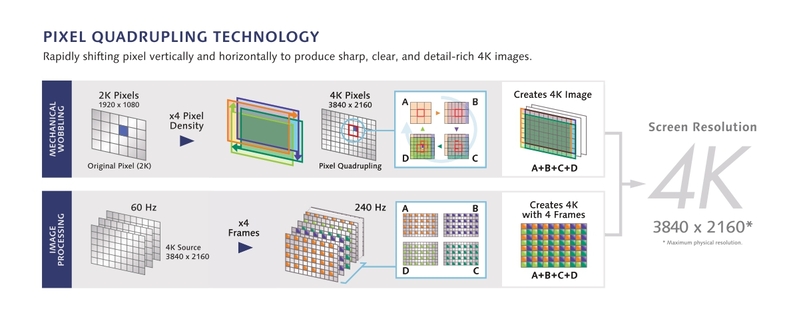
IMAGE QUALITY DIMENSIONS BEYOND RESOLUTION
The quality of 4K is defined by more than pixel count—it’s the harmony of contrast, motion, color accuracy, and uniformity.
|
Category |
Panasonic Technology |
What It Does |
Visual Impact |
|
Contrast |
Dynamic Contrast |
Controls laser output frame-by-frame based on image content |
Deeper blacks, brighter highlights, enhanced depth |
|
Color Reproduction |
Laser/Laser-Phosphor Light Source |
Provides stable, wide-gamut, high-brightness illumination |
Vivid, accurate, long-lasting color performance |
|
Color Reproduction |
Rich Color Enhancer |
Optimizes color wheel timing and modes |
Flexible settings for brightness-priority or color-priority |
|
Uniformity |
Precision Optical Calibration |
Factory-level optical alignment of lens, mirrors, and panels |
Uniform brightness, focus, and color across the entire screen |
FUTURE-PROOF DESIGN AND SCALABILITY
Panasonic’s 4K systems are designed for longevity and adaptability:
- Modular interface expansion (SDM slot)
- Firmware updates for new color standards
- Remote monitoring and predictive maintenance
Together, these capabilities transform projection into a sustainable visual platform, ensuring relevance for years ahead.
ENGINEERING FOR CLARITY
Modern 4K projection is the convergence of optical science, engineering precision, and human perception. Panasonic’s Quad Pixel Drive and micron‑level optical architecture work together to deliver crisp, smooth 4K images.