
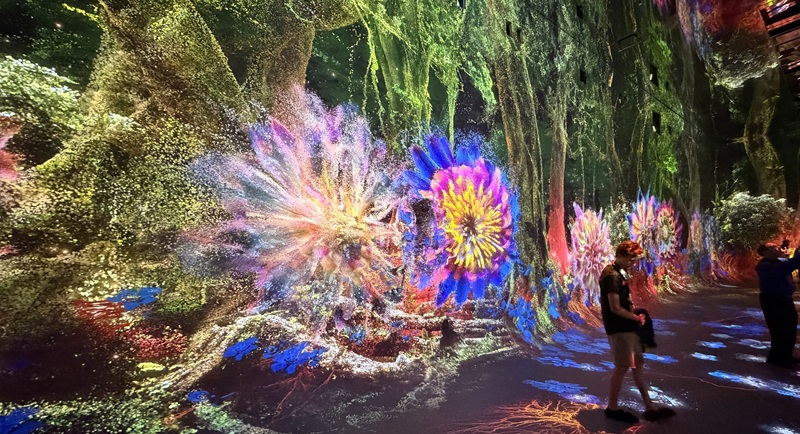
Earlier this month, I stood among a group of visitors at the entrance to DATALAND in downtown Los Angeles. It wasn’t a private tour or a press preview. Instead, this was a typical crowd of visitors, digital tickets on our phones, being led into the first gallery of Refik Anadol’s stunning new experiential museum.
Immediately upon entering the Discovery Portal, I felt transported. I was surrounded by images, inviting me to “Prepare for the scent of the forest.” A voice filled the room, introducing DATALAND as a living museum. Its exhibition, “Machine Dreams: Rainforest,” unfolds in five chapters — Discovery Portal, Data Pavilion, Latent Gallery, Infinity Room and Sanctuary — and draws on Anadol’s Large Nature Model, an AI model built to listen to the natural world.
We had the opportunity to apply wrist sensors to read our heartbeat and measure the electrical activity of our skin, thereby allowing the artwork to respond to each person who passes through. The voice made a bold promise: What happens next has never happened before and will never happen again.
It was like entering a dream state, and Epson projection helped make it happen.

A Decade in the Making
Epson’s relationship with Anadol long predates DATALAND. In fact, the two have worked together for more than 10 years, including on projects from Anadol’s time as a student at UCLA, Gavin Downey, Epson’s group product manager for large-venue projection, reports.
Downey describes Epson as Anadol’s technical partner. And it’s a thrilling partnership because Anadol is the kind of artist who keeps pushing his partners forward.
“He has ideas that are often ahead of the technical ability to make those ideas a reality,” Downey says. “So, he’s like a challenger.”
And with DATALAND’s Data Pavilion, Epson meets that challenge.
Not Yesterday’s Projection
Clearly, projection has come a long way. Today’s laser projectors bear virtually no resemblance to the older, lamp-based units I saw at InfoComm 20 years ago.
“A Tesla Roadster is a car, and a Model A is a car,” Downey analogizes. “They’re both cars, right? But are they? It sort of stretches the meaning of the word car.”
DATALAND’s two-story Data Pavilion runs on Epson EB-PQ2220B projectors: full 4K, 3LCD, 20,000-lumen laser models that are liquid-cooled. Each puts out more than eight million pixels, and 84 are deployed as part of this immersive experiential gallery.
“Hopefully, you notice like the blacks are really black,” Downey says. “The color is just really, really rich. And it all comes together: the resolution, the crispness, the depth of the color, the contrast, the clarity.”
Indeed, the images in the Data Pavilion are truly stunning. I felt as though I could reach out and touch “Avatar”-like ecological bursts, as well as lava-like sweeps of textured light. It wasn’t merely the brightness and the rich colors but, perhaps even more so, the texture and the fine detail.
The image quality reflects the work of Epson’s engineers. As Downey says, “Our engineers work tirelessly for every single aspect: color gamut, contrast, beauty. They’re working tirelessly.”
Downey is no stranger to large-format display, yet he was struck when he toured DATALAND before it opened. “I had not seen anything like that,” he enthuses.
The Infinity Room
One of my most indelible memories from the visit — its impact proven by my wrist sensor capturing my heartbeat — was entering the Infinity Room.
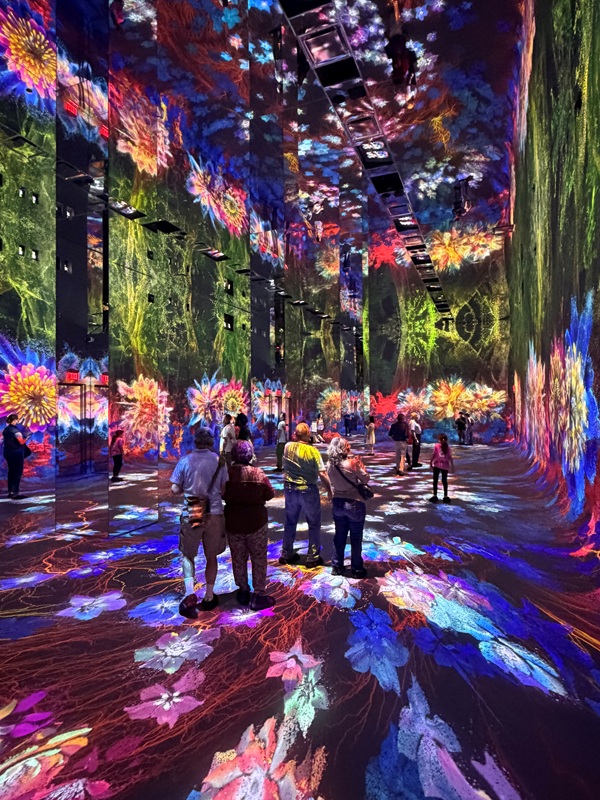
At DATALAND, this is the fourth of the exhibition’s five chapters, and the introduction promises that the edges of reality will disappear there. And indeed, they did. After initially stepping into a darkened room with just illuminated circles on the floor to guide us, we found ourselves fully transported to a faraway world of wonderment.
Perhaps the most amazing aspect was the feeling of motion as landscapes swept over and around me. Occasionally, I averted my eyes to steal a look at my fellow visitors’ faces. It was a communal feeling to see them experiencing the same emotional response.
In a word, it was awe, shared.
Emotional Resonance
Downey has seen visitors react the same way to the DATALAND experience. “I’ve been in there with folks that got pretty emotional,” he says. “It’s not like anything else.”
Courtesy / CI Staff
For Downey, that shared response calls to mind the way that many people first encountered projection: sitting in a movie theater, watching reflected light alongside family members or friends. What he loves about DATALAND, he says, “is this communal experience of what’s possible and everyone feeling the sense of awe. It harkens back to the original beauty of projection.”
The technology behind DATALAND is remarkable. But Downey notes that the specs aren’t the point. Instead, he suggests, it’s about those emotions being evoked, those feelings being felt and the memories burned into our consciousness.
“What better way to spend your time than to be in the presence of something you’re passionate about?” he asks rhetorically of technology-fueled experiences. “But what’s being done [with the technology]? I just really love it.”
Each visitor to DATALAND changes the Large Nature Model by virtue of their presence. What might be underappreciated is how much DATALAND changes them, as well. And a major catalyst for the experience — the dazzling light at the center of the Data Pavilion — is Epson projection.