From network performance and USB-C connectivity to system control, choosing the right AV-over-IP solution starts with understanding the application.
In AV-over-IP system design, more bandwidth doesn’t automatically mean a better solution. While high-performance technology continues to expand what’s possible, the most effective installations aren’t necessarily the ones with the most advanced specifications. They’re the ones designed around the needs of the application.
A university classroom, corporate training room, and command center may all rely on AV-over-IP, yet their performance, connectivity, and operational requirements can be very different.
For integrators, the challenge isn’t simply choosing the most powerful technology. It’s finding the right balance of performance, flexibility, scalability, and simplicity without overengineering the system.

Start With the Application, Not the Specifications
Before selecting AV-over-IP hardware, integrators should consider a few fundamental questions.
How many sources and displays need to be connected? Will users bring their own laptops? Does the system need USB connectivity, networked audio, or video-wall functionality? Will content remain within one room or be distributed across multiple spaces?
These considerations influence everything from network infrastructure to endpoint selection and system control.
For many commercial applications, a properly designed 1GbE network can support high-quality 4K AV distribution without requiring a 10GbE architecture. Other environments, particularly those involving uncompressed video and advanced visualization, may benefit from higher-bandwidth solutions.
The key is understanding where performance matters most and avoiding unnecessary complexity.
Choosing the Right AV-over-IP Architecture
Liberty’s DigiIP portfolio takes an application-driven approach by offering different performance levels for different system requirements.
The DigiIP 5100 Series uses JPEG 2000 technology to deliver up to 4K60 4:4:4 video over Gigabit Ethernet infrastructure. With USB routing, Dante audio, and compatible video-wall solutions, it is well suited for classrooms, conference rooms, training facilities, and multiroom commercial environments.
For applications requiring uncompressed video and advanced visualization, the DigiIP 6000 Series uses 10GbE SDVoE technology. It provides high-performance distribution for environments such as command centers, simulation facilities, and mission-critical operations.
Neither approach is universally better. Selecting the appropriate architecture depends on the application, available infrastructure, and functionality required at each endpoint.
Modern Connectivity Requires More Than Video Distribution
One consideration becoming increasingly important is how users connect their devices to an AV system.
Consider a university classroom where an instructor uses a fixed HDMI-connected computer while guest presenters arrive with USB-C laptops. Both need access to the room’s displays, and the system may also incorporate USB peripherals and networked audio.
Supporting these requirements calls for more than simply transporting video.
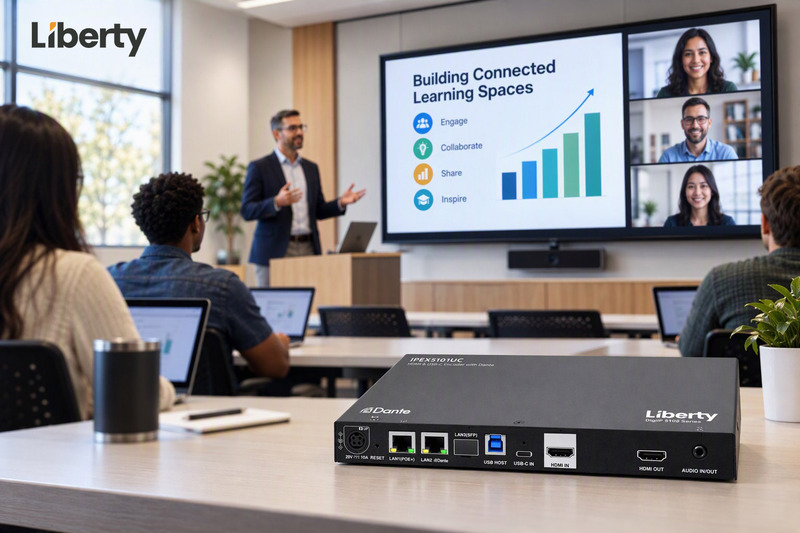
Liberty’s new IPEX5101UC, part of the DigiIP 5100 Series, addresses this need by combining HDMI and USB-C inputs in a single box-format AV-over-IP encoder.
Designed for modern collaboration and learning environments, the IPEX5101UC brings flexible source connectivity into a 1GbE AV distribution system while supporting 4K60 4:4:4 video, USB data, and Dante audio. It also supports USB-C device charging when locally powered with the appropriate power supply.
For integrators, this provides flexibility to accommodate both traditional HDMI sources and modern USB-C devices within the same AV-over-IP architecture.
Rather than treating connectivity as an afterthought, it becomes an integral part of system design.
Don’t Overlook the Control Experience
Even the most capable AV distribution system needs to be easy to operate.
A straightforward classroom installation may require little more than selecting sources, switching displays, and recalling presets. A larger enterprise deployment may require customized interfaces, automation, remote monitoring, and visibility into system performance.
Liberty addresses these different requirements with two DigiIP control options.
The Basic Controller provides straightforward system configuration and control, making it suitable for everyday AV-over-IP deployments.
For applications requiring greater functionality, Arranger offers an advanced control and management platform with customizable user interfaces, QR-based control, automation, centralized monitoring, and analytics.
Considering control requirements early in the design process helps integrators select an approach that supports both the immediate installation and the customer’s ongoing operational needs.
Build Around the Application, Not Just the Technology
Successful AV-over-IP deployments begin with three important decisions: selecting the right performance platform, identifying the appropriate source and display endpoints, and choosing a control experience that fits the environment.
When these decisions work together, integrators can deliver systems that are easier to specify, operate, and expand.
With solutions like the DigiIP 5100 Series and the new IPEX5101UC, Liberty is helping integrators bring greater flexibility to modern AV environments while keeping system design practical.
Explore Liberty’s DigiIP 5100 solutions and discover what’s possible for your next project.
To request a quote, book a demo, receive product information, or any other questions, contact us now: https://www.libertyonline.com/contact-us