
Editor’s Note: Here, Commercial Integrator’s editors highlight one of our 2026 Integration Award-winning projects. IVCi earned top project honors in the Best House of Worship category. Read on to learn why our judges deemed this project the most impressive house-of-worship project of the year!
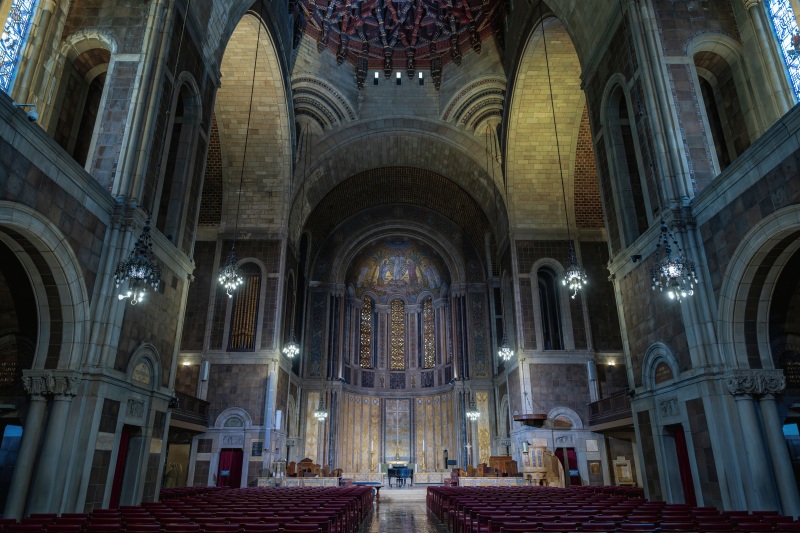
IVCi has won Best House of Worship Project for its work at St. Bartholomew’s Church, a National Historic Landmark in Midtown Manhattan with a 1,200-seat sanctuary. The integrator delivered new AV systems across six spaces and turned the church’s control room into a campuswide broadcast hub.
The hard part was making the technology disappear. Every decision had to balance modern performance with historic preservation, from loudspeakers in a highly reverberant sanctuary to cable routes through thick limestone walls.
Key Things to Know
- The project: Bartholomew’s Church (St. Bart’s) is a National Historic Landmark with a 1,200-seat sanctuary.
- The scope: IVCi project entailed integrating AV in six spaces and upgrading the control room over a yearlong timeframe with three distinct system designs.
- The challenge: The sanctuary has an unusually long reverberation time, and every installation choice had to protect the landmark’s historic character.
- The solution: seven custom color-matched EAW AC6 ADAPTive column arrays, a unified Q-SYS control platform and a new video-production suite.
- The partners: Salas O’Brien led the system design, and IVCi led the integration.
- The result: According to IVCi, St. Bart’s now has intelligible audio across the campus, expanded broadcast reach and an easy-to-manage platform.
How Did IVCi Join the Project?
IVCi joined through Salas O’Brien, an engineering and technical consulting firm that won the bid to redesign the church’s AV system. Salas O’Brien selected IVCi as its integration partner after a longstanding client referred the integrator.

What Did the IVCi Project Team Install Across the Campus?
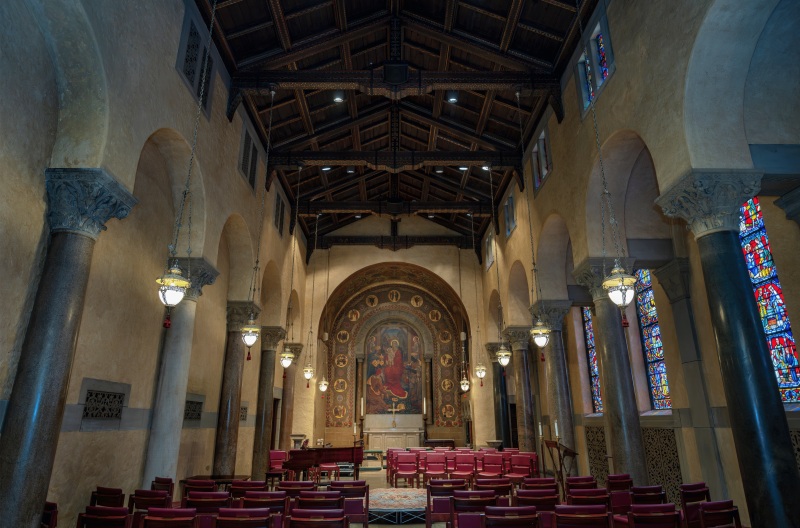
Image courtesy of Don Parenta IVCi.
IVCi installed new AV systems in six spaces: the sanctuary, chapel, great hall, restaurant, classroom and video-production suite. It also upgraded the control room to serve as the campuswide broadcast hub.
The production suite pairs an Allen & Heath digital mixing console with a Blackmagic Design video-production switcher that manages multiple camera feeds around the sanctuary. It supports multicamera switching, real-time livestream adjustments and broadcast-quality mixing for services, concerts and special programming.
How Does One Control System Simplify Operations?
A single Q-SYS ecosystem controls every room, with a Q-SYS touchpanel in each space, to reduce training burden and error risk for volunteer operators. Role-based presets cover different event types, and operators can change audio and scenes quickly without complex menus.
A Shure digital wireless-microphone system addresses another priority: minimizing interruptions during services. Clergy and lay leaders can move among the sanctuary, chapel and adjacent gathering spaces without changing transmitters or reestablishing audio connections.
How Did the Team Address the Sanctuary’s Acoustics?
The team chose seven custom color-matched EAW AC6 ADAPTive column arrays. They replaced loudspeakers installed more than 20 years ago that no longer met the needs of a sanctuary with an unusually long reverberation time.
After interviewing church staff and evaluating the legacy system, Salas O’Brien identified the ADAPTive arrays as a fit for the room. IVCi then supported live demonstrations to confirm performance and coverage before the team proceeded. According to the integrator, the arrays deliver even coverage and intelligible speech from the front rows to the balcony and visually blend into the historic finishes.
How Did the Team Protect a National Historic Landmark?
IVCi worked through an approvals process with preservation consultants, a structural engineer and other stakeholders. Every mounting point and equipment location had to respect original finishes and sightlines.
Before drilling through 36 inches of limestone, IVCi engaged a structural engineer to verify that penetrations wouldn’t damage the structure or threaten significant features, including the pipe organ, which the integrator describes as Manhattan’s largest. The team used existing chases where possible, avoided decorative moldings and limited new penetrations to preapproved locations, keeping all cabling concealed.
What Has Changed for St. Bart’s?
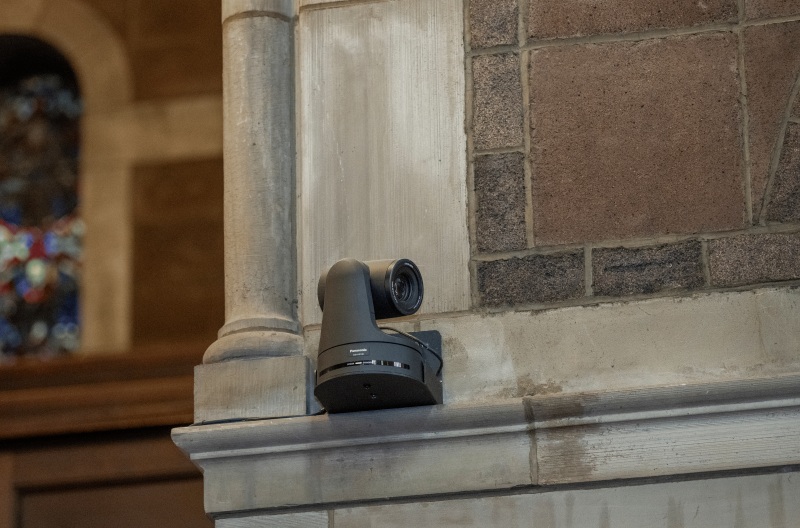
Image courtesy of Don Parenta IVCi.
According to IVCi, St. Bart’s now has intelligible audio throughout the sanctuary and campus, plus broadcast capabilities, including multiple camera feeds, that extend services and concerts to remote audiences. Clergy, staff and volunteers operate on a single platform.
“In a place like St. Bart’s, the technology shouldn’t outshine the architecture, the tradition, or the community,” says Niko Bakulich, manager, broadcast & production studio at St. Bart’s. “IVCi and Salas O’Brien helped us implement a solution that keeps the right things in the foreground. Everything runs more smoothly and everyone can stop worrying about the tech and focus on what’s important to us.”
What Can This IVCi Project Teach Integrators?
The project shows the value of proving performance before committing. IVCi supported live demonstrations of the column arrays before the team proceeded, confirming coverage in a difficult acoustic space.
It also shows how a single control platform, with presets and a touchpanel in every space, can serve volunteer operators across a multiroom campus.