Key Takeaways
- A major U.S. federal security agency needed a compact, high-security control room for continuous 24/7 operations, and standard console products couldn’t meet the brief.
- Legrand | AV, the exclusive North American reseller of LundHalsey consoles, delivered a custom Kontrol Plus configuration built around operator performance.
- Curved console geometry let a single supervisor oversee two operators, enabling two people to handle the workload of four.
- Ergonomics drove the design: articulating display arms, calculated viewing angles and automated sit-stand at the supervisor station.
- The agency’s internal team installed the system in a secure facility using a custom video guide, with no LundHalsey engineers on-site.
Courtesy / Legrand AV
The Brief Off-the-Shelf Couldn’t Answer
The agency needed a working environment where operators could perform at the highest level for hours at a time, under pressure and in a restricted space, without the fatigue that degrades performance in critical moments. Fitting monitors and keyboards into a room was never the problem. The footprint was limited, but the information density was not.
Multiple operators needed to monitor simultaneous feeds across a large display array while a supervisor kept unobstructed sightlines across the entire suite. Operators carried firearms, so console surfaces had to withstand the daily wear of weapons belts without degrading. Flat, uncluttered work surfaces were non-negotiable. In a 24/7 environment, misplaced equipment is a safety and efficiency risk.

The agency turned to Legrand | AV to develop a bespoke solution based on the Kontrol Plus console. The resulting series remains in active service today and has become a reference configuration for related environments within the agency’s broader portfolio.
“The brief was high-density, high-endurance and high-security,” says Brandon Ivey, national solutions manager, Fed/Gov/DoD, Legrand | AV. “Everything we specified had to serve the operator first, because in a 24/7 control room, the furniture is not decoration. It is infrastructure.”
Engineering Around the Operator
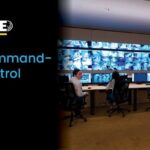
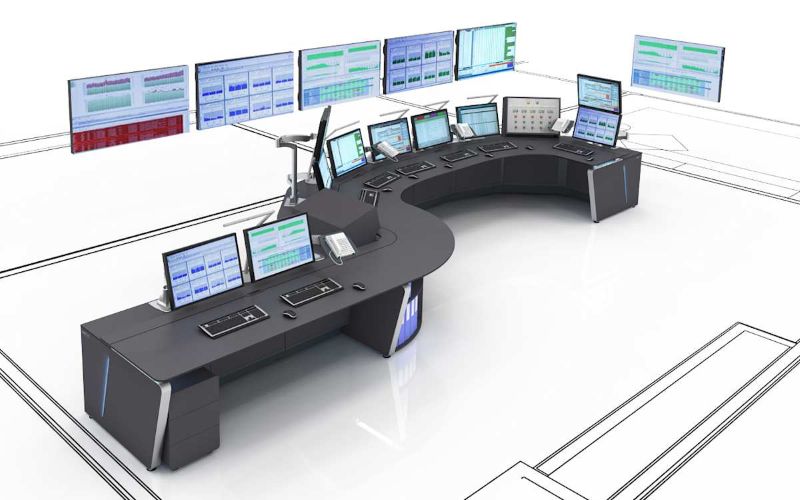
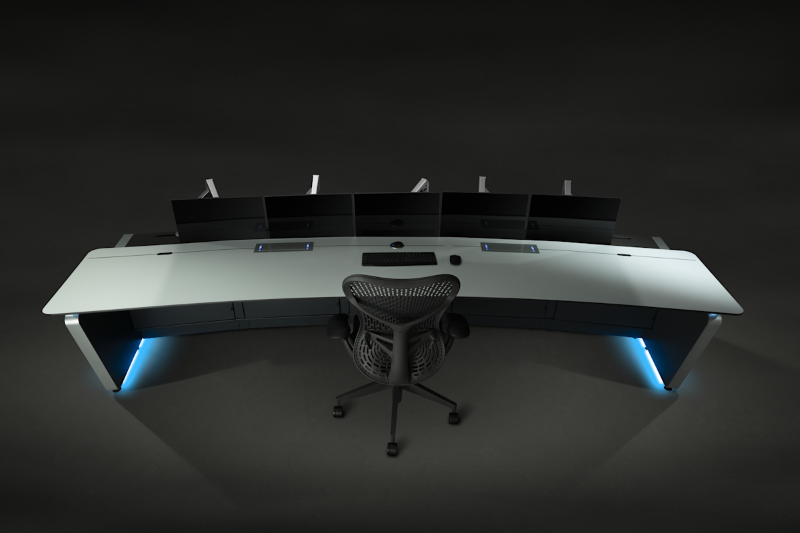
LundHalsey answered with a custom-designed curved console suite built on the infinitely customizable Kontrol Plus series and engineered for the space, the workflow and the demands of continuous operations. The configuration combined a primary operator arc, a secondary supervisor station with motorized sit-stand capability and an integrated wall-mount display array, all resolved within the room’s footprint constraints.
Design started with the operator and worked outward, a distinction that separated this project from anything a standard catalog could supply.
Courtesy / Legrand AV
Operator Wellbeing and Ergonomics
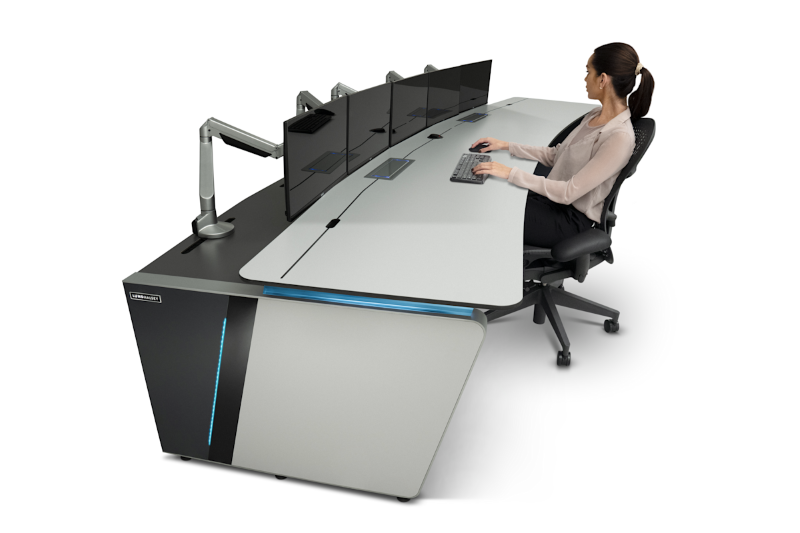
In mission-critical environments, fatigue is an operational risk, so the design treated it as an engineering problem rather than an afterthought. Every display arm was fully articulating, letting operators fine-tune screen angle, height and distance to their individual working posture. Viewing angles to the wall-mounted array were calculated precisely: 35-degrees from a three-foot standoff on the primary configuration, and 33-degrees with a 12-degree tilt on the secondary. Both keep viewing comfortable over extended shifts without neck strain or eye fatigue.
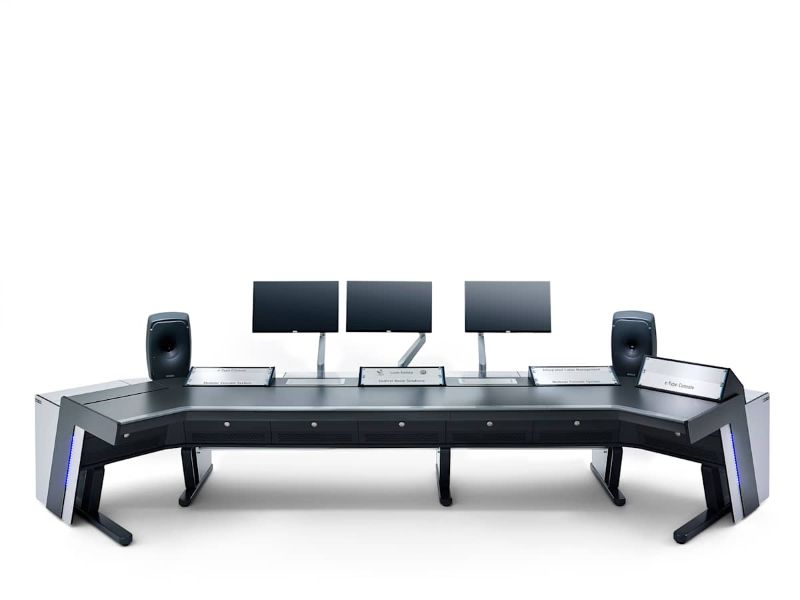
The supervisor station was specified with an automated sit-stand mechanism, programmable to adjust on a timed schedule with manual override, to promote movement and reduce musculoskeletal fatigue. Console geometry was designed to minimize handover disruption between alternating shift pairs. Dedicated flat surfaces at each position accommodated paper logs and operational documentation, reflecting how people actually work in high-security environments where digital-only workflows remain uncommon.
Surface Durability Under Working Conditions
Console surfaces were finished in black laminate, chosen for its ability to withstand the daily contact of holsters and equipment belts without showing wear. Edges and corners were engineered to eliminate snagging points. In a space where operators are physically present and active around the clock, surface longevity isn’t an aesthetic preference. It’s a maintenance and operational continuity consideration.
Courtesy / Legrand AV
Sightlines and Space Efficiency
The curved console geometry served two functions: it maximized the number of active operator positions within the available footprint, and it gave the supervisor station a clear, unobstructed view across all operator screens. The curved section was designed so a single supervisor could maintain visual oversight of two operator positions, effectively enabling two people to perform the monitoring and response workload of four, without creating supervisory blind spots.
A standalone supervisor pod with motorized sit-stand capability complemented the main arc. It provided an elevated oversight position that could be adjusted dynamically depending on the operational phase and the supervisor’s preference.
“The requirement to support two operators doing the work of four, in a space designed for a fraction of that density, is not something you solve with catalogue furniture,” Ivey says.
Installation in a Secure Facility
The agency’s internal team handled installation under a tight timeline, in a secure facility where external access is tightly controlled and LundHalsey engineers couldn’t be on-site. To make that work, LundHalsey produced a custom video assembly guide delivered via secure link, giving the team repeatable, precise reference at every stage of the build.
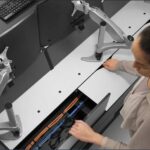
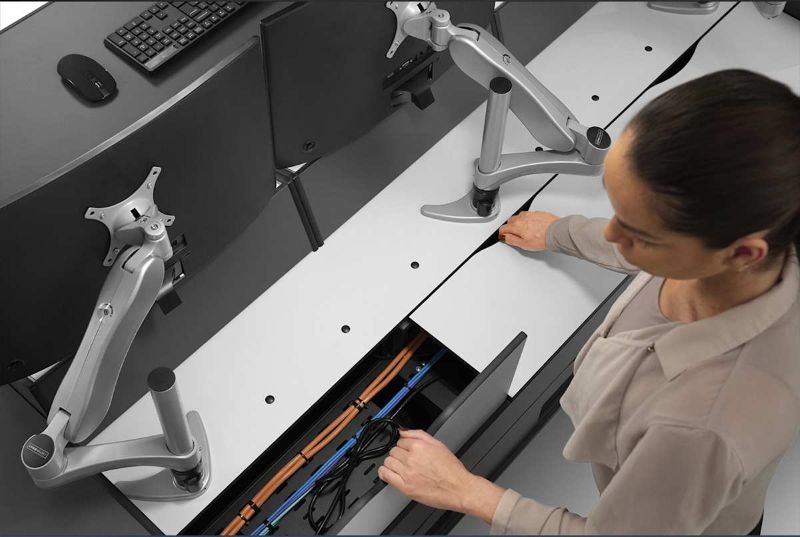
Each pod incorporated a rear pull-out drawer for a PC tower, integrated cable management provisions, a 1U 19-inch rack-mounted 6-way switched PDU for managed power distribution and a hinged lockable rear door with vent grille to keep the infrastructure secure and serviceable.
Courtesy / Legrand AV
What Mission-Critical Means for Integrators
The federal security vertical places demands on AV and furniture infrastructure that most commercial environments never encounter: continuous operation, physical durability under working conditions, ergonomic standards tied directly to human performance and installation requirements constrained by security protocols. Meeting those demands isn’t a matter of specifying better products from the same catalog. It requires design thinking that starts with the operator and works outward.
This project shows what that approach delivers in practice. A compact room supports a staffing model two people deep. Operators sustain focus through long shifts because the environment was designed to support them physically. A supervisor maintains oversight without moving. And the entire system was installed cleanly, in a secure facility, by an internal team working from a video guide delivered through a secure link.
For AV integrators and specifiers working in mission-critical government environments, the project is a working reference. The decisions that made it successful, including ergonomic display positioning, sit-stand automation, durable surface specification and custom assembly documentation, are replicable. The principle behind them is consistent: in a control room, the room is part of the mission.