
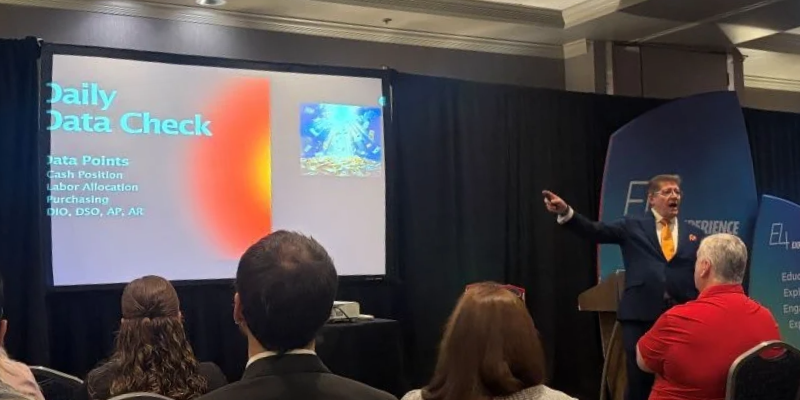
Memory prices, aging chipsets and politics all squeeze AV integrators, and none of them can be fixed from the field. The bigger risks to an integration business are the ones it can control. That was the message Tim Albright, founder of AVNation and host of the AV Week podcast, delivered in his keynote at Almo Pro AV’s E4 Experience in Boston.
“There are three areas I’m going to talk about today that we absolutely do have control over,” Albright says. He identified them as AV network security, state and local regulation, and a proposed change to the National Electrical Code (NEC) that could reshape who runs cable.
Why Is AV Network Security Now an Integrator’s Problem?
AV gear isn’t just AV gear anymore. It’s a network endpoint, and IT departments now treat it like one.
Albright traced the shift back roughly two decades. InfoComm hung a “convergence” banner over its show halls in 2004. As AV-over-IP (AVoIP) matured, IT departments often told integrators to build their own separate networks. That arrangement is disappearing. IT teams are pulling AVoIP traffic and devices onto their own production networks.

That move simplifies some work for dealers, who now interface with the IT side rather than managing a parallel network. It also hands AV a security checklist it never carried before.
“We didn’t have to worry about which ports were open and which weren’t. We have to today,” Albright says.
He also pointed to the budget. In most organizations, AV spending sits in the IT budget, which means IT sets the rules. “Today, we are on their network,” he says.
What Do IT Departments Want to Know Before AV Goes on the Network?
Expect three questions before any device touches a client’s network: what it is, whether IT can trust it and who maintains it.
According to Albright, the answers IT accepts come from four places:
- Internal IT policy: Years of experience and the department’s own best practices.
- Risk management and insurance: Cyber insurance carriers increasingly tell clients what they must do, and what they can’t do, to keep coverage.
- Regulation: Laws such as HIPAA for health information and FERPA for student records dictate how data on the network must be protected.
- Their own history: Past incidents shape what IT will allow.
That last factor explains why identical requests get different answers. Albright cited the ransomware attacks on Caesars and MGM, two Las Vegas casino operators hit with nearly identical attacks within weeks of each other. Caesars paid the attackers the ransom while MGM refused to pay and fought back.
Neither response was objectively right, Albright argues, and outsiders don’t have the information to judge. “Those decisions were made internally based on their own experiences,” he says.
The takeaway for integrators: a port request that sails through at one client may be off the table at the next. Don’t walk in with an edict. Walk in ready to explain why each port matters, and expect IT to explain its refusals in return.
“It’s a conversation,” Albright says.
How Have AV Devices Been Used in Cyberattacks?
The threat isn’t theoretical. AV hardware has already been drafted into a major attack.
Albright pointed to the 2016 distributed denial-of-service attack that knocked Twitter, Netflix and other services offline, particularly along the East Coast. In the post-incident analysis of the hijacked devices, he says, the list included DVRs, IP cameras and a networked professional AV speaker.
The speaker wasn’t used as a doorway into a network. It was used as a node, one of the thousands of compromised devices aimed at a target. “This is serious for us now,” Albright says, recalling his reaction.
He also echoed former White House CIO Theresa Payton, who served under President George W. Bush: an attempted breach isn’t a question of if, but when.
Why Do Default Passwords Still Put Integrators at Risk?
The simplest fix remains one of the most skipped. Leaving default credentials in place is faster on install day and far more dangerous afterward.
“You can find the default login and password for nearly every network device on the planet,” Albright says. Those credentials live in product manuals, Reddit threads and Facebook groups. If a technician can find them in seconds, so can an attacker.
Albright urged integrators to audit their own blind spots. Do your teams change default logins during shop builds and on-site deployments? Do they talk with IT about open ports before install, not after?
Which Certifications Help AV Teams Handle Network Security?
Integrators don’t need to turn every technician into a network engineer, but they need a baseline. Albright pointed to Cisco’s Certified Network Associate (CCNA) as a manufacturer certification that has become an industry benchmark, while acknowledging it’s a demanding exam. He also named CompTIA and BICSI as sources of network training, and noted AVIXA has started addressing the gap with a networking credential he described as a first step.
The goal, he argues, is to understand what clients ask for and to act as better stewards of their networks.
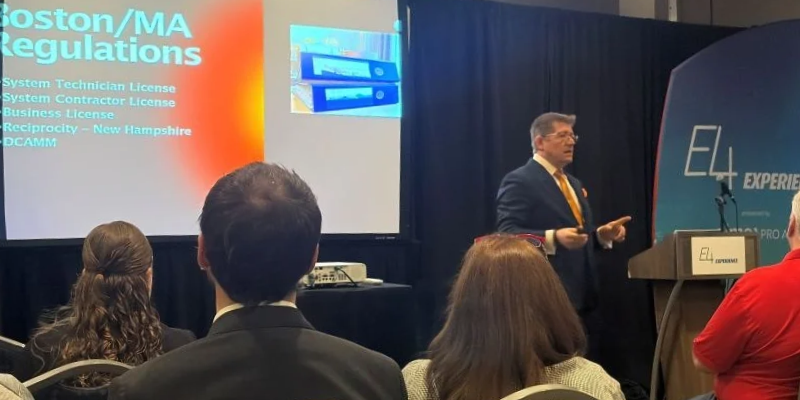
Photo by Alyssa Borelli.
What Licensing Rules Apply to AV Work in Massachusetts?
Massachusetts doesn’t license AV work the way most states do. Integrators who assume otherwise risk their bids and their schedules.
Albright, who has customized this keynote for each Almo Pro AV E4 Experience regional tour this year, highlighted several differences:
- No blanket low-voltage license. The state asks what the wiring is for, whether fire safety, security, AV or communications, and the system type determines which license applies.
- Technician and contractor licenses differ. Firms need to know which one each job requires.
- The licensed technician must be on-site. In some states, a company can hold the license. In Massachusetts, the licensed individual has to be at the job site.
- Limited reciprocity. According to Albright, New Hampshire is the only state whose license Massachusetts recognizes.
The on-site requirement hits operations hardest. “The licensed technician has to be on the site,” Albright says. “That changes how your labor is allocated on a weekly or monthly basis.”
In practice, a firm running multiple jobs at once likely needs more than one licensed technician.
How Do Boston Historic Districts Affect AV Installations?
Boston adds a layer the rest of the state doesn’t. Buildings in historic districts such as Back Bay and Beacon Hill fall under architectural review bodies that approve physical changes to those properties.
Running conduit, mounting a display, hanging a projector or installing speakers can all count as altering a building. Albright urged integrators to ask clients two questions before quoting any work in an older building.
“Is this covered by any historical society? Do we have to go talk to someone?” Albright says.
What Are Boston’s Workforce and Prevailing Wage Requirements?
Labor rules can quietly erase a project’s margin. Work in and around Boston can carry workforce requirements that set percentages of workers who must be city residents, women and people of color. That changes how integrators staff and schedule jobs.
Prevailing wage compliance is the bigger trap. Albright stressed that it isn’t simply a union versus nonunion question; it’s tied to state-set wage rates. He has seen firms assume they know the rate, or forget it entirely, then learn from their lawyer or CFO after the bid that their labor costs are wrong.
The result may not be a lost job. It can mean a job that loses money.
What Is the NEC 2029 Proposal and How Could It Affect Integrators?
The final threat reaches integrators in all 50 states. A January report on proposals for the 2029 National Electrical Code includes language stating that infrastructure cable capable of carrying power must be installed by a licensed electrician.
Category cable carries power through PoE. If the proposal survives, integrators could lose the right to run the cable their business depends on. The proposal also renames low-voltage as “limited energy,” a change Albright reads as a move to capture category cable infrastructure.
Some integrators may shrug, since pulling cable is dirty, tedious work. Albright pushed back on that reaction. “Who cares? Your technicians care,” he says. He added that clients care too, because integrators typically cost less than licensed electricians for the same cable runs.
Can Integrators Influence NEC Adoption?
Yes. The NEC isn’t automatically law. States and regions adopt it selectively, and they rarely copy it word-for-word.
“It is not an edict,” Albright says. “Every state in every region adapts and adopts different parts of this.”
That makes state-level lobbying the integrator’s lever. With the 2029 edition three years out, firms have time to contact their representatives before adoption decisions are made.
Why This Matters Beyond Integrators
Albright aimed the keynote at integrators but argued end users and manufacturers have a stake too. Anyone who has lost a favorite integrator to an acquisition or a closure knows the cost. Clients who rely on a long-term AV partner can share these risks with them.
Network security, local regulation and code changes won’t wait for supply chains to stabilize. Unlike memory prices, they’re problems integrators can start solving now.