
Editor’s Note: Here, Commercial Integrator’s editors highlight one of our 2026 Integration Award-winning projects. Mechdyne earned top project honors in the Best Immersive Experience category. Read on to learn why our judges deemed this project the most impressive immersive-experience project of the year!
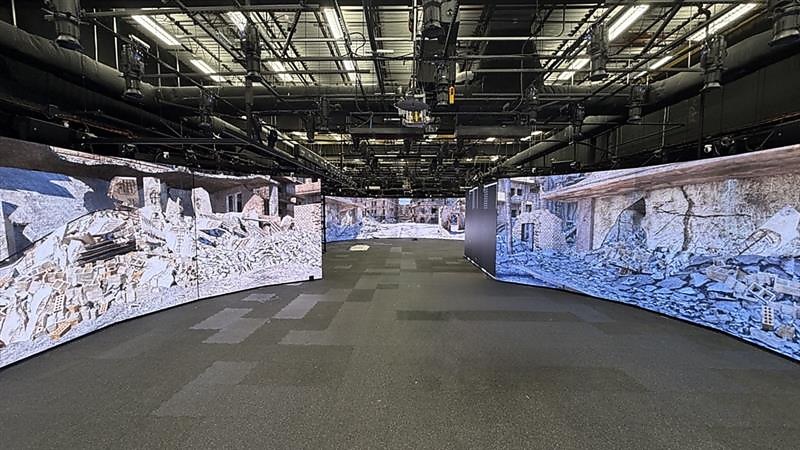
Mechdyne has won Best Immersive Experience Project for the Wide Area Virtual Environment (WAVE) at the Uniformed Services University of the Health Sciences (USU) in Bethesda, Maryland. It’s a nearly 83-million-pixel training environment for military medical teams. Inside, teams assess patients, communicate and make decisions together in real time, without headsets.
For the integrator, the key challenge was integration at scale. Visuals, tracking, motion, audio, lighting, scent and other effects all had to work together so instructors could run complex scenarios without disrupting immersion.
Key Things to Know About This Mechdyne Project
- The project: The WAVE is a team-based synthetic medical-training environment that prepares military medical teams for high-pressure scenarios.
- The scale: Forty DVLED modules deliver 82,944,000 synchronized pixels across 225 linear feet of continuous LED surface.
- The rendering: Each module has its own workstation with an NVIDIA RTX 6000 Ada GPU, forming a 40-node real-time rendering system.
- The experience: Spatial audio, motion platforms, custom lighting, atmospheric effects, patient simulators and live actors surround learners.
- The team: Seventeen Mechdyne project team members contributed to the design and installation.
- The goal: improving readiness and survivability through realistic, repeatable training.
What is the USU WAVE?
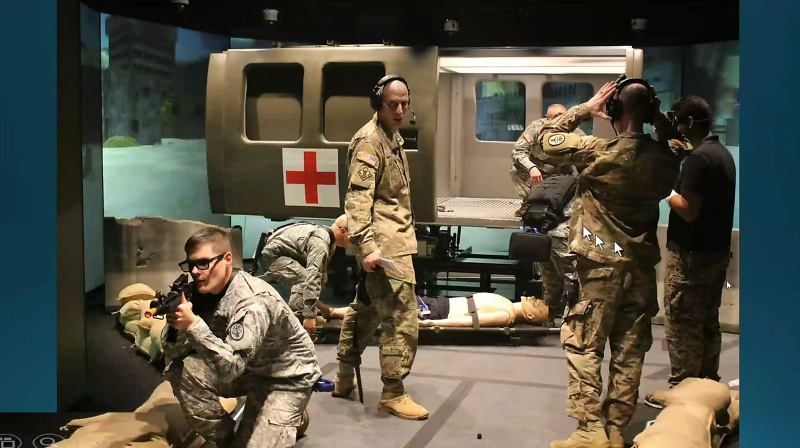
Photo courtesy of Mechdyne.
The WAVE is USU’s synthetic environment for complex medical-readiness training. It supports training in conditions that are difficult, costly or unsafe to recreate through live exercises, including urban emergencies, combat trauma, transport missions, disaster response and continuum-of-care scenarios.
According to Mechdyne, it’s one of the most advanced team-based synthetic medical-training environments operating today.
How is the Display Environment Built?
The display runs 225 linear feet of continuous LED surface in a dog-bone configuration. It’s built from 40 ClearLED wall sections, each made of 25 LED cabinets arranged five across by five high, with active surfaces nearly 10 feet tall and a 1-millimeter gap tolerance between sections.
A 16.875-foot-wide corridor connects the larger immersive zones. Six movable LED doors and one movable corridor support access, reconfiguration, prop movement and scenario flexibility.
How Does the Mechdyne Project Render Nearly 83 Million Pixels?
Each of the 40 Full HD DVLED modules has its own workstation with an NVIDIA RTX 6000 Ada GPU. Together they form a 40-node system that generates images in parallel and in real time across the full display.
According to Mechdyne, the architecture delivers the performance needed for high-resolution visuals synchronized with motion, lighting, tracked interactions and environmental effects.
Why Does the WAVE Avoid Headsets?
Military medical teams must see one another, communicate under stress and coordinate care as conditions change, so the WAVE puts them in a shared physical space instead of isolating them in headsets. Ten to 30 participants, including learners, instructors, actors and support personnel, can work together at once.
They maintain eye contact, read body language, carry equipment and move patients in the same space. According to Mechdyne, that more closely reflects how care is delivered in the field.
What Other Sensory Cues Shape the Training?
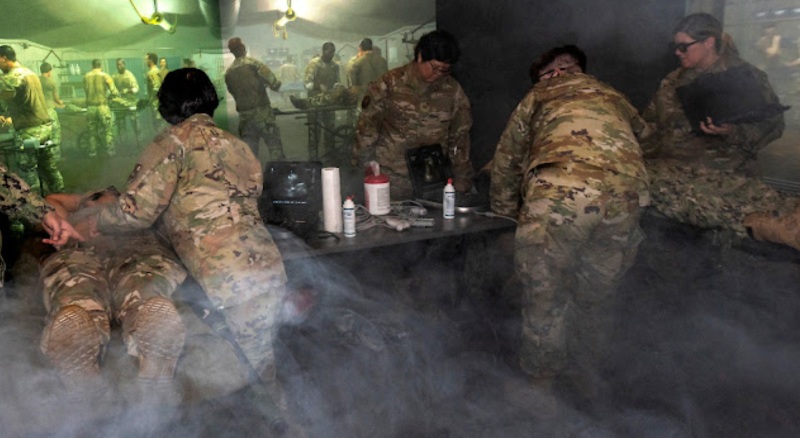
Photo courtesy of Mechdyne.
Visuals are synchronized with layers of physical and sensory cues. Spatial audio delivers sounds such as aircraft, vehicles, alarms and battlefield effects. Motion platforms carry helicopter bodies and vehicle assets to simulate transport and en route care, and custom lighting sets time of day, visibility and urgency.
Scent effects, smoke and haze, debris cannons and collapsing-wall effects introduce stress and distraction. According to Mechdyne, they do so in a safe, repeatable way. Human-patient simulators and live actors play the injured, so learners must communicate, triage, treat and adapt in real time. More than 60 ART tracking cameras follow participants, objects and interactions.
How Do Instructors Run a Scenario?
Instructors run scenarios from a master-control interface that coordinates visuals, tracking, motion, audio, lighting, scent, interactive props and scenario effects. It’s designed to let them manage complex events without disrupting immersion.
According to USU, instructors can introduce stressors safely, observe how teams adapt and use those moments in debriefing. Teams can also move through multistage scenarios along a continuum of care, from point of injury to transport to emergency treatment, and see how decisions in one phase affect the next.
What Can This Mechdyne Project Teach Integrators?
The WAVE shows how many disciplines an immersive project can require. It called for integration across visualization, AV, IT, real-time rendering, tracking, motion, control, environmental effects, physical installation and instructor operation, and 17 Mechdyne team members contributed to the effort.
It also shows that immersion doesn’t have to mean headsets. For team-based training, the WAVE builds immersion around a shared physical space where participants can see and work with one another.