
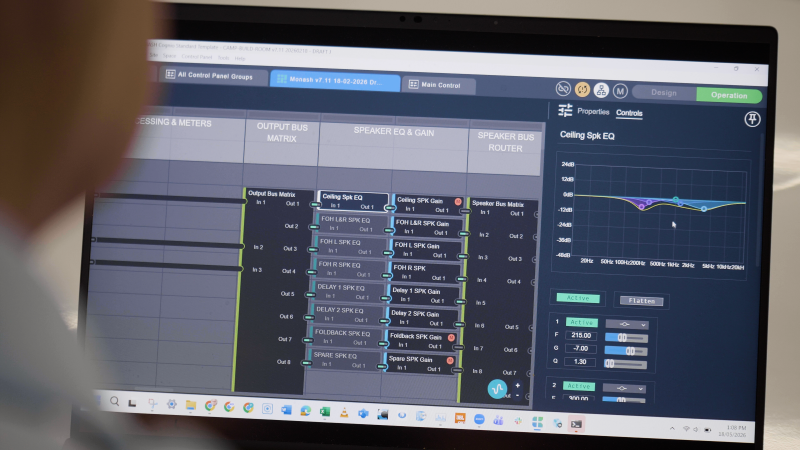
For many AV teams, sticking with a familiar architecture might feel like the safe choice. It’s proven; the team knows how to deploy it; and everyone is used to its costs and complexities. But according to Mark Graham, CEO and co-owner of Symetrix, that sense of safety obscures a growing bill that will eventually come due.
“To understand the challenge facing today’s AV solutions, we must recognize that these systems still rely on decades-old networking and processing architectures — approaches the IT industry has long since moved beyond,” Graham explains.
Those AV architecture approaches were designed around the IT infrastructure of that bygone era. Today, they’re out of sync with modern IT infrastructure and, increasingly, they’re a point of contention with the IT teams that have to manage them.
“The AV industry thinks and operates within a different paradigm from today’s IT professionals,” Graham reflects. “Our assumptions about networking and processing, what these tools can do, how they work and where their limits lie [tend to] shape and constrain the AV solutions we develop and deploy. Those assumptions leave us out of step with modern IT thinking and expectations.”

AV Architecture Can Incur ‘Technical Debt’
This mismatch between legacy architectures and modern network infrastructure creates what Graham calls “technical debt.” What makes that debt so easy to accumulate, he notes, is the pure inertia of being comfortable with the old standard. “It’s clunky [and] it’s out of sync,” Graham imagines an integrator saying, “but, yeah, we’ve been doing it a long time.”
A typical K-12 deployment is the perfect case in point. It might call for a server-grade processor and an enterprise-grade switch, as well as redundancy to support essential life-safety functionality. The costs, Graham says, end up rising exponentially.
But worse yet, the result is fragile. The system will likely work once an expert pulls it all together and locks it down. But as soon as any changes are necessary, Graham says, “it starts to become brittle, and it wants to break.” At that point, the network specialists have to come back in, alongside the AV pros.
How Much Legacy AV Architectures Demand
The fact that consultancies make their living solving problems exactly like this is evidence, Graham notes, of how much these legacy architectures demand. “It’s an unnatural tax for working in these types of systems,” he states vividly.
Setting aside day-to-day functionality, the technical debt really comes due when the owner needs to expand the system or adopt new technology. “On the old model, it’s rip and replace,” Graham says. “You don’t have an option.”
“It all comes out, and your customer has to pay to put all new in,” Graham continues. “That’s hugely expensive, and it doesn’t have to be that way on modern IT standards.”
Future-Ready AV Architecture: It’s All of the Above
So, what is future-ready architecture, and what should integrators expect from it? According to Graham, the Symetrix team has been wrestling with those questions for years. “What’s the best processing model: central, distributed or edge?” he asks rhetorically. “The answer is always, ‘It depends.’ It’s all of the above.”
In short, Graham believes that modern architecture should embrace any of those paradigms in any combination, based on what will be most resilient, most cost-effective and longest-lasting for the application.
Graham envisions room- and area-level systems that naturally work together, as well as deployments that no longer require deep network expertise. With the benefit of modern IT technologies, these systems can smoothly evolve over time, liberating clients from costly rip-and-replace cycles.

Mark Graham, CEO and co-owner of Symetrix. Image courtesy of Symetrix.
But for Graham, a factor just as important as frictionless system compatibility and near-limitless flexibility is simplicity of design and deployment. As he puts it, “If there’s only one special guru, who created the original design, that can figure out that one system that he or she designed and deployed back in a distant time frame, that’s a high-risk, high-cost, high-pain approach.”
To wit, Graham has a consultant friend who specializes in highly complex enterprise-scale systems, and he sees the consequences firsthand. “The first thing he’ll tell you, [and] the biggest challenge that takes the most time [and] costs the most money, is figuring out what the original designer did in the first place,” Graham relates.
Those investigations regularly turn up, among other issues, what are known as “orphaned devices,” devices that have no connection in the design at all. “They’re plugged in; they have a network connection; and they’re doing absolutely nothing,” Graham states.
It’s exactly the kind of complexity and associated waste (dollars and power budget) that IT teams committed to leaving behind decades ago.
Better Citizen on the Network
The technical debt that legacy AV architectures impose isn’t limited to the systems themselves. In fact, Graham points to a loss in opportunity that’s arguably even bigger.
With a modern architecture, he says, “there’s opportunity there for being a much better citizen on the network and being much more acceptable to the IT communities.” This opens doors that would remain closed to legacy architectures.
That matters now more than ever, with IT teams increasingly driving the AV decision-making. “The IT team is now who’s increasingly controlling the purse strings and making decisions,” he confirms.
Graham has watched longstanding, formerly strong relationships between integrators and school districts, houses of worship and government organizations become strained, simply because of a gulf developing between internal IT teams and AV channel partners.
The result? Failure to adapt to the IT paradigm doesn’t simply risk a single project. As Graham puts it, “You’re going to start shrinking your customer pool, and you’re going to find yourself with less influence with your existing customers.”
IT Won’t Allow It
If the case for adopting a modern architecture is so compelling, why do legacy architectures persist? Graham understands the reflexive reluctance. The perceived security of what had always previously worked is a powerful force.
Adopting the voice of an integrator, Graham says, “I’ve been doing this. I’ve made money at it. My team knows how to reliably deploy it. We minimize our callbacks and keep ourselves profitable.”
Integration business owners might also worry about sunk costs related to education and training. Adopting the voice of an integration leader, Graham says, “I flew all these guys out to XYZ brand, and they spent a week getting trained. And so now what? Am I going to throw all that investment away?” It’s a legitimate concern.
And technicians are part of the equation, as well — and, for them, it’s personal. They’ve built up their expertise over years or decades. “Now, you’re going to tell me you don’t need my great expertise,” Graham imagines one saying. “I’m not as valuable to the organization anymore.”
Grappling With the Facts
Graham doesn’t dismiss those feelings; on the contrary, he understands and validates them. But he also recognizes our industry’s need to grapple with the facts of the matter. “Things have evolved,” Graham says of legacy architectures now being recognized as overly complex, brittle and inflexible. “Our value add needs to evolve with it.”
The most compelling force may be integrators’ duty of care to their clients. “We have to value the fact that we owe our customers system solutions that are healthy and stable into the future,” Graham states.
What’s more, the superficial appeal of status-quo legacy architectures might be a mirage of sorts. “It isn’t going to stay the way it is,” Graham declares. Emphasizing the point, he adds, “It won’t; it can’t. IT won’t allow it.”
And that means that, the more integrators resist, the more vulnerable their businesses become to competitors that more readily adapt to the reimagined landscape. And with so much of our industry built on long-term relationships — some integrators serve the same school district for 15 or 20 years — that’s a precarious situation to put your business in.
“Do you want to put that at risk because you didn’t evolve when the rest of the world did?” Graham asks rhetorically. If the answer is no, then change is no longer just an option.
Symetrix’s Cognio Platform: The Brains of It

Cognio is an intelligent system, built to be the distributed brains of an installation, untethered to a single centralized processor. Image courtesy of Symetrix.
If integrators are worried that a modernized architecture inevitably entails a massive, scary leap into the great unknown, there’s reassurance in Symetrix’s Cognio platform. Cognio was designed from its inception for systems that need to evolve but that aren’t ready for another rip-and-replace cycle or big capital round.
Its name, Graham explains, illuminates its design. Cognio is an intelligent system, built to be the distributed brains of an installation, untethered to a single centralized processor.
“Cognio architecture supports the expansion of existing systems, regardless of scale or complexity, by becoming the brains [and] turning the legacy system into a controlled subsystem of a larger and now ‘evolvable’ AV solution,” Graham says.
The legacy portions of the system that were stable and working will remain that way. But, he adds, “Cognio enables smooth evolution over time as obsolete components are gradually worked out of the solution.”
Scalability: A Distinguishing Factor for Cognio
Scalability is another key distinguishing factor for Cognio — and it works in both directions. Most of the industry, Graham notes, talks about scalability only in terms of scaling up. “And we always go, ‘Yeah, that’s only one form of scaling,’” he says. “What about scaling down?”
Cognio provides power and flexibility not only for the largest systems but also, with equal finesse, for small systems, Graham confirms, including spaces in which room kits have become popular. Cognio offers a bespoke, price-competitive opportunity for those cost-sensitive environments.
Returning to the technical debt theme, Graham emphasizes that Cognio is designed for ongoing evolution and a holistic, full-system approach. “[When] you come in with a system like Cognio, built on the modern networking and processing architectures, the requirement for costly network infrastructure is greatly reduced,” Graham explains. “You don’t necessarily need enterprise-grade switches. Cognio is designed to evolve and work holistically across a large number of smart network devices, delivering powerful processing capabilities, without requiring every audio and control signal to be routed back to one central device.”
What’s more, with a modern architecture, central points of failure are eliminated, along with a scaling down of infrastructure costs and configuration complexity.
The Danger of Standing Still on AV Architecture
No one would argue that integration businesses should jump heedlessly from tested approaches to something new. But it’s important to grapple with the fact that standing still carries its own risk. That’s especially true as the AV decision-makers change and IT departments start steering. “Often, if not nearly always, the purchase decision-maker is not who it used to be,” Graham says.
For integrators, then, the wise path is neither a heedless leap nor an inertia-inspired holding pattern. Instead, Graham says the industry has reached a crucial pivot point. “We need to look at a meaningful planned evolution out of the old model,” he concludes.
The real cost of standing still — of tripling down on legacy architectures — isn’t merely a bigger bill down the road. The real cost lies in the relationships, credibility and opportunities that will slip away in the meantime.
Learn more about Cognio and Symetrix’s approach to modern AV architecture today.
Watch Commercial Integrator’s recent webinar focused on AV architecture that we produced in partnership with Symetrix.