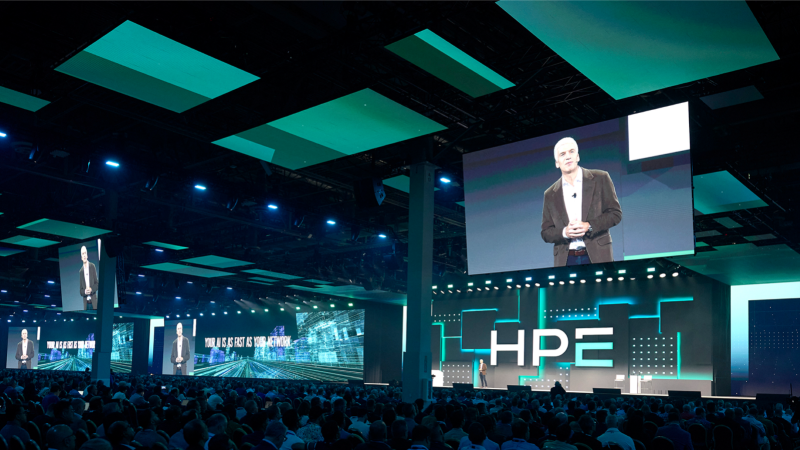
HPE Discover held its keynotes at Sphere for the previous two years. That set a high bar for any venue that followed, and it left the 2026 production team with a clear problem: surround the audience with content in a convention hall that wasn’t built to do that on its own.
The answer was LED at a scale few corporate shows attempt. The project offers a close look at what it takes to plan, process and install a display system of this size on a tight load-in schedule.
Key Things to know:
- Matrix Visual supplied the LED and technical execution for HPE Discover 2026 at The Venetian Convention and Expo Center in Las Vegas.
- The system used 3,773 active ROE Visual Graphite GP2.6 panels across eight flown walls and four overhead LED groups. That’s roughly 1,730 square meters of LED and more than 255 million pixels.
- A mix of 3,147 full and 626 half cabinets kept the planned screen geometry intact across flat, curved and overhead surfaces.
- 48 Brompton Tessera SX40 processors and 180 Tessera XD units carried 10-bit video over single-mode fiber, with runs of up to 200 meters.
- The core installation happened in a four-day load-in for an audience of more than 13,000 attendees.
What Did Matrix Visual Deliver for HPE Discover 2026?
Matrix Visual supplied the LED equipment and technical execution for HPE Discover Las Vegas 2026, turning the production’s screens concept into a buildable system. Its scope covered technical design, CAD and wiring plans, equipment prep, installation, show support and more.
The company also supplied the hardware behind the screens. That included ROE Visual Graphite panels, Brompton processing, fiber and data distribution, LED support hardware, power distribution and LED crew.

Matrix Visual is based in Chatsworth, California. It operates from Orange County, Las Vegas and Nashville, serving corporate productions, trade shows, concerts and festivals nationwide.
Why Did HPE Discover Need an Immersive LED Design?
HPE challenged its agency to create an immersive experience unlike anything attendees had seen in the venue before. After two years at Sphere, the 2026 event had to wrap the audience in messaging without a purpose-built immersive venue.
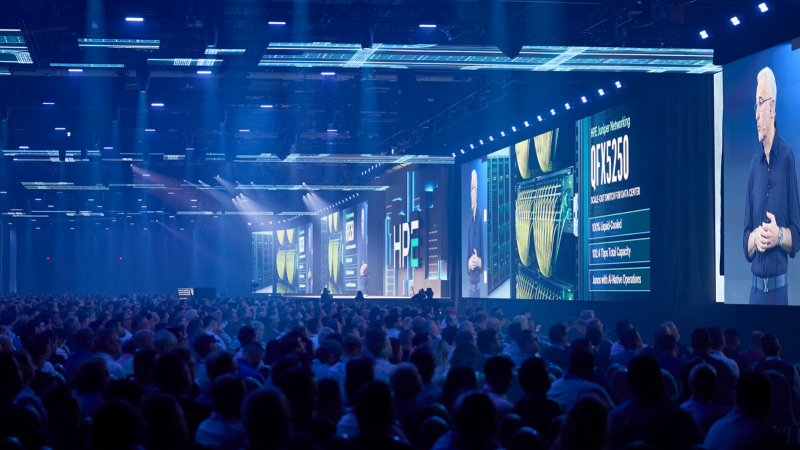
August Jackson, the lead agency, designed the screens around that goal. Instead of one dominant stage display, the design spread LED across the room. Attendees could follow the speaker from several vantage points while brand content ran overhead.
Courtesy / ROE Visual
Who Was on the Creative and Production Team?
The project brought together an agency, two LED partners, several content studios and a media server provider. August Jackson led the project and tapped Ten Eighty Media and Matrix Visual to build the LED system together.
The rest of the team split creative and technical work:
- August Jackson: Scott Riley served as lead screens producer, supporting the screens strategy and media architecture. The agency’s animation team also contributed.
- No Filter Creative: Led visual development for presentation content and the overall screens look.
- Sibling Rivalry: Produced video assets for the screen specification.
- Randy Gonzalez: Provided animation for the secondary vertical and horizontal screens.
- LMG: Supplied and supported the Disguise media server system.
Matrix’s job was translating creative requirements into LED sections that could actually be hung, powered and fed with signal. That handoff, from design intent to buildable hardware, is where large shows succeed or stall.
How Large Was the LED Deployment?
The deployment totaled 3,773 active ROE Visual Graphite panels, roughly 1,730 square meters of LED and more than 255 million pixels. For context, that’s about 18,600 square feet of display and roughly 30 times the pixel count of a single 4K screen.
The largest surfaces were four 30-meter walls, two flat and two curved. Each ran at a native resolution of 11,520 by 2,304 pixels. They carried iMAG, or image magnification, of presenters alongside keynote content and HPE brand graphics.
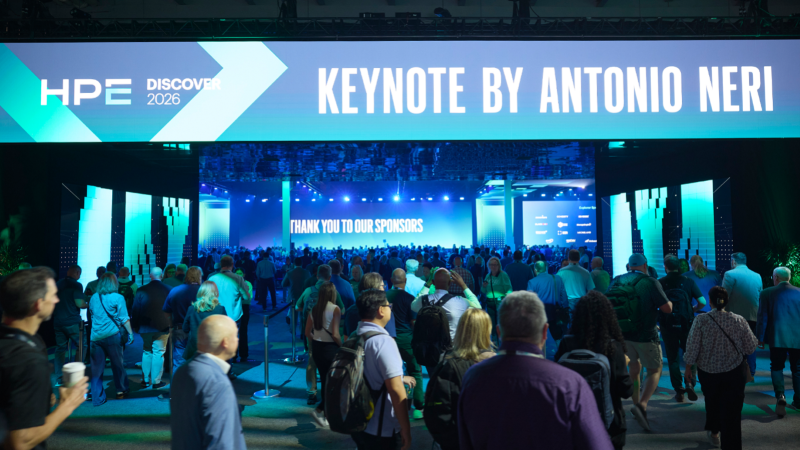
Four vertical walls measuring 5 meters by 6.5 meters and four overhead LED groups extended the design through the space. The result gave the audience multiple places to watch the speaker and kept the brand visible above the seating area.
Courtesy / ROE Visual
How Did Matrix Hold Screen Geometry Across 3,773 Panels?
Matrix held the planned screen geometry by mixing full and half cabinets throughout the build. Graphite GP2.6 comes in full 500 by 1,000 mm cabinets and half 500 by 500 mm cabinets, and the crew used 3,147 full and 626 half cabinets in active use.
Roughly one in six cabinets was a half unit. That flexibility let the team hit exact dimensions on flown, curved and overhead surfaces without compromising the drawn design.
Rigging varied by surface. Graphite headers hung the standard walls, curved steel pipe formed the two curved walls and a separate system of pipe, clamps and standoffs carried the overhead build.
McMurtry makes clear that the panels were only half the job. The real work was keeping thousands of components organized.
“At this scale, preparation is just as important as the panels,” says Zack McMurtry, lead LED tech and video engineer at Matrix Visual. “Using full and half Graphite cabinets helped us maintain the planned screen geometry across the flown walls and overhead elements. Keeping the cabinet allocation, hardware and signal distribution organized was a major part of the job, and it took close coordination between Matrix, Ten Eighty Media and the creative and media teams to bring those pieces together.”
What Processing and Signal Infrastructure Drove the Screens?
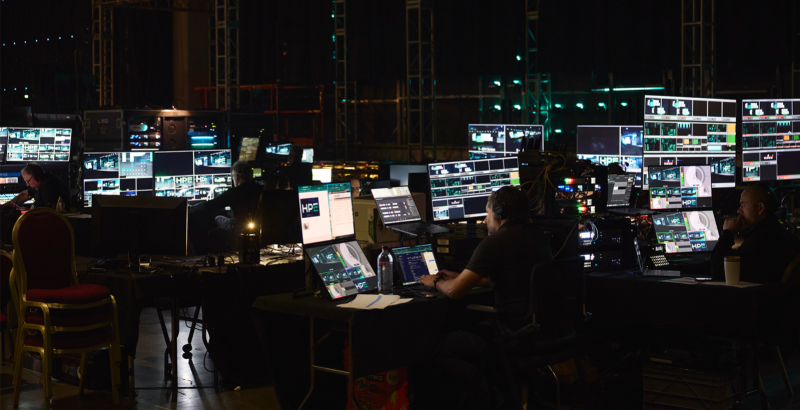
Forty-eight Brompton Tessera SX40 LED processors and 180 Tessera XD data distribution units drove the screens, carrying 10-bit video over a single-mode fiber network. Main fiber runs of up to 200 meters linked the processing positions to the distributed LED surfaces.
That distance matters. Standard copper Ethernet tops out at 100 meters, so fiber was the practical way to reach screens spread across a convention hall from centralized processing.
Network racks, fiber patch bays, power conditioning and battery backup supported the infrastructure. Content played from a Disguise media server system, supplied and supported by LMG, which fed the Brompton processing.
How Did the Team Keep Every Surface Consistent?
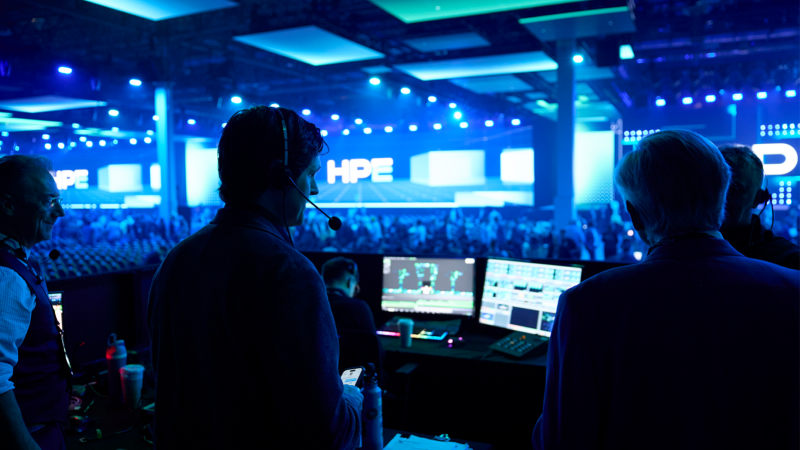
The team kept every surface consistent through tightly synchronized processing across dozens of LED sections. With screens placed throughout the room, any mismatch in color, brightness or timing between surfaces would have been obvious to the audience.
Callaway points to that consistency as the defining technical demand of the show.
“HPE Discover is exactly the kind of show Tessera is built for,” says Adam Callaway, global lead of technical solutions at Brompton Technology. “With that many LED surfaces spread across the room, every screen had to look consistent with the next, and Matrix’s team did an outstanding job keeping the visuals in sync. Brompton processing and ROE Visual are a proven combination, and seeing them perform together at this scale is a real testament to both. We’re proud to have been part of such an ambitious show.”
Baum stresses the margin for error at the media server level.
“When you’re driving 255 million pixels for a major enterprise event, there is zero room for error,” says Dan Baum, vice president of sales for the Americas at Disguise. “For a global brand, an annual conference is a defining moment, and the technology behind it has to deliver without compromise. HPE Discover demonstrated once again that Disguise is built to power the world’s most ambitious corporate installations, giving creative teams the freedom to push boundaries with full confidence in the technology.”
Courtesy / ROE Visual
How Did Matrix Plan the Load-In and Strike?
Matrix front-loaded the work, completing technical planning and equipment prep before a core four-day load-in. Leads from Matrix and Ten Eighty Media then coordinated installation, show support and strike alongside the creative, content and server teams.
Four days isn’t much time to hang nearly 4,000 panels and commission a fiber network. The schedule only works when cabinet allocation, wiring plans and hardware are sorted before trucks arrive.
How Did the Industry React to the Build?
The build drew attention across the industry during the same week as InfoComm in Las Vegas. Montero notes that even ROE Visual underestimated the scale until it saw the finished result.
“I was in Las Vegas the same week for InfoComm, and people were already talking about the design and execution at HPE Discover,” says Frank Montero, managing director at ROE Visual. “Even knowing how ambitious the project was, the scale still caught me off guard when the photos came in. Nearly 4,000 Graphite panels working as one show is a credit to Matrix’s planning and crew, and we’re grateful Graphite was the product they chose to build it with.”
Courtesy / ROE Visual
What Should Integrators Take From This Deployment?
Integrators planning large-scale event LED should treat preparation as the main deliverable, not the hardware. The HPE Discover build shows where the work actually happens:
- Plan cabinet mix early. Combining full and half cabinets lets you hit drawn dimensions on flat, curved and overhead surfaces. Lock that allocation before load-in, not on site.
- Design signal distribution around distance. Once surfaces spread beyond 100 meters from processing, single-mode fiber becomes the practical choice. Build in patch bays and clear labeling from the start.
- Protect the infrastructure. Power conditioning and battery backup keep a processing failure from taking down a keynote.
- Match rigging to each surface. Headers, curved pipe and overhead clamp systems each solve a different problem. One method won’t cover every element.
- Define the handoff with creative teams. Your job is translating design intent into buildable sections. Clear coordination with agencies, content studios and server teams prevents late-stage surprises.
- Respect the load-in window. A four-day install for nearly 4,000 panels only works when CAD, wiring plans and equipment prep are finished in advance.