Many rooms headed for a Dante upgrade still have working amplifiers, microphones and DSPs in the rack. Replacing that hardware just to get onto the network adds cost most clients don’t want to pay.
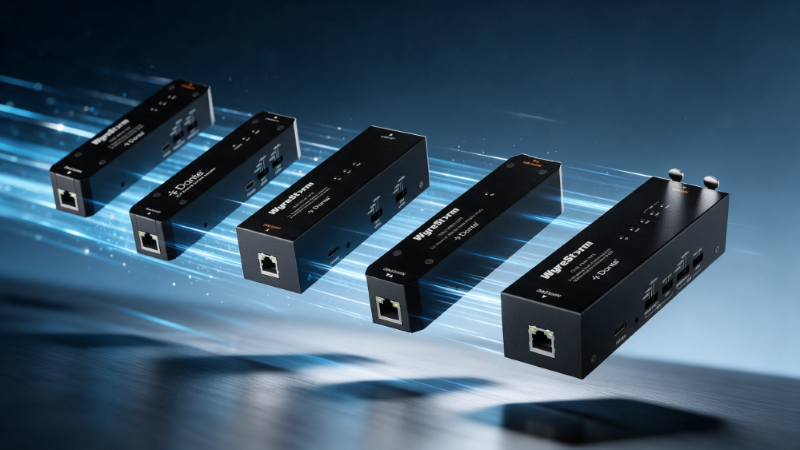
WyreStorm Technologies is targeting that gap with five new Dante/AES67 audio adapters. The lineup converts analog, USB and XLR audio to and from networked audio, so existing equipment can stay in service.
Key Things to Know
- WyreStorm launched five Dante/AES67 adapters: the CON-DNT-ANLG, CON-ANLG-DNT, CON-USBC-DNT, CON-DNT-XLR and CON-XLR-DNT.
- The adapters connect analog, USB and XLR equipment to Dante networks in both directions.
- The XLR input adapter supports 48V phantom power and PoE for microphones and lecterns.
- All five products are available now through WyreStorm’s authorized distribution and reseller network.
What Did WyreStorm Launch?
WyreStorm launched five Dante/AES67 audio adapters that convert between networked audio and traditional analog, USB and XLR connections. The lineup includes:
- CON-DNT-ANLG: 2-Channel Dante/AES67 to Analog Audio Output Adapter
- CON-ANLG-DNT: 2-Channel Analog Audio Input to Dante/AES67 Output Adapter
- CON-USBC-DNT: 2×2 Channel USB-to-Dante/AES67 Audio Adapter
- CON-DNT-XLR: 2-Channel Dante/AES67 Audio Input to XLR Output Adapter
- CON-XLR-DNT: 2-Channel XLR Analog Audio to Dante/AES67 Output Adapter
The family covers both directions. You can bring legacy sources onto the network and send networked audio back out to traditional gear.

What Problem Do the Adapters Solve?
The adapters let you connect existing analog, USB and XLR equipment to a Dante system without replacing hardware that still works. That’s a common situation on retrofit and phased projects, where the budget covers the network but not a full equipment refresh.
Joseph Gagliardi, product manager at WyreStorm, describes the launch as a response to how most projects actually go. Full system redesigns aren’t the norm.
“Not every project needs a complete system redesign. Often, integrators simply need a reliable way to bring existing analog, USB or XLR audio into a Dante network, or take networked audio back out to traditional equipment, without adding unnecessary complexity,” Gagliardi says. “That’s really what this launch is about: practical products that make mixed audio environments easier to integrate, expand and support.”
How Do the Analog Adapters Work?
The CON-ANLG-DNT puts analog sources onto a Dante network, and the CON-DNT-ANLG takes Dante audio back to analog. Each handles two channels.
The CON-ANLG-DNT accepts balanced or unbalanced inputs and delivers 24-bit audio at sample rates up to 96 kHz. Adjustable input sensitivity lets it work with a wide range of source equipment.
The CON-DNT-ANLG outputs balanced or unbalanced analog audio for amplifiers, powered speakers, recording devices and analog DSPs. Used as a pair, the two adapters keep a room’s analog gear in play after the move to networked audio.
What Does the USB-to-Dante Adapter Do?
The CON-USBC-DNT connects USB audio devices to Dante networks, with two channels in each direction. Laptops, soft codecs, conferencing appliances and media PCs can send and receive networked audio through it.
It runs on PoE or USB-C power and doesn’t require USB drivers. That matters in meeting rooms where users bring their own laptops and nobody wants to install software before a call.
WyreStorm points to corporate meeting rooms, conference spaces, education spaces and fixed AV installations as the main use cases.
How Do the XLR Adapters Handle Microphones and Line-Level Sources?
The CON-XLR-DNT converts XLR microphone and professional line-level audio directly onto the Dante network. It offers independent input sensitivity controls, 48V phantom power and PoE.
That combination fits microphones, podiums, lecterns, racks and installed-audio applications. One network cable can power the adapter, and the adapter powers a condenser mic.
The CON-DNT-XLR handles the reverse path, converting Dante audio back to XLR for traditional pro sound equipment. It supports 24-bit audio at 44.1, 48 and 96 kHz with selectable output gain.
Where Do These Adapters Fit Best?
The adapters fit best in mixed-technology projects where Dante is coming in but legacy equipment isn’t going out. WyreStorm cites corporate, education, hospitality, enterprise and professional audio work as target markets.
For you, the practical value is flexibility at the edges of the system. You can add Dante where it’s needed, one entry or exit point at a time, rather than specifying a full replacement.
Where Can Integrators Buy the New Adapters?
All five adapters are available now through WyreStorm’s authorized distribution and reseller network.
What Does This Mean for Integrators?
The launch gives you more ways to sell a Dante upgrade without forcing a rip-and-replace conversation. Not a full redesign, just the conversion points the project needs.
That can shorten the path to a yes on budget-sensitive jobs. It also keeps a client’s existing investment in amplifiers, microphones and DSPs working longer, which is often the easier sell.
The bigger shift is in how you scope retrofits. Start with what’s already in the rack, then decide where each adapter closes the gap to the network.