Most facilities don’t need the same video quality in every room. A boardroom videowall or a surgical display needs uncompressed 4K with no lag. A lobby screen or overflow room across campus usually doesn’t. Until now, serving both from one source often meant buying two encoders.
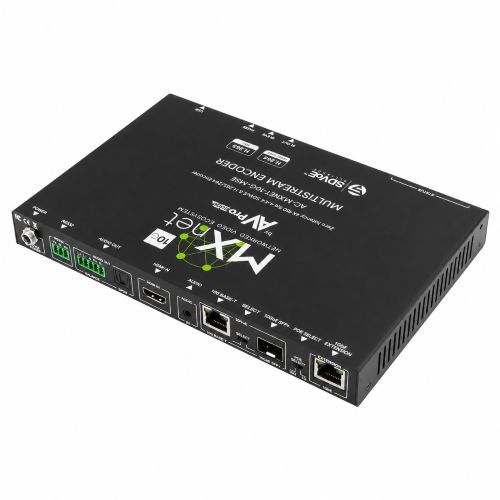
AVPro Edge is targeting that problem with the AC-MXNET-10G-MSE, a multi-stream encoder that outputs both stream types at the same time. The MXnet 10G-MSE is available now.
Key Things to Know
- The MXnet 10G-MSE sends a 4K SDVoE stream and a 1080p H.265 stream onto the network simultaneously.
- The SDVoE stream is uncompressed up to 4K/30fps and lightly compressed at 1.3:1 above 30fps.
- It supports HDR10, HLG and Dolby Vision on the SDVoE stream, but not on the H.265 stream.
- Integrators can route USB and control signals over the network for peripheral control or KVM matrix systems.
- AVPro Edge backs the encoder with a ten-year advanced replacement warranty.
What Is the AVPro Edge MXnet 10G-MSE?
The MXnet 10G-MSE is a 10G multi-stream encoder built for hybrid AV-over-IP (AVoIP) video distribution. It’s part of AVPro Edge’s MXnet ecosystem and produces two different video streams from a single endpoint.
That lets you design a system that mixes high-performance 10G zones with lower-bandwidth streaming zones without adding a second encoder at each source.

How Does the Dual-Stream Approach Work?
The 10G-MSE sends a primary SDVoE stream to MXnet 10G-TCVR decoders and a secondary H.26x stream to MXnet USP decoders at the same time. The SDVoE stream carries visually lossless 4K video, while the secondary stream delivers 1080p H.265 for low-bandwidth distribution.
The H.265 stream works with AVPro Flow, so you can push that feed to MXnet USP endpoints across a building or campus. The practical result is one source, one encoder and two levels of performance.
AVPro Edge says the approach cuts hardware count, lowers installation cost and simplifies long-term maintenance, since you aren’t duplicating sources, encoders or infrastructure.
How Much Compression Does the SDVoE Stream Use?
The SDVoE stream uses no compression up to 4K/30fps 4:4:4 8-bit. Above 30fps, it applies very light compression at a 1.3:1 ratio, which AVPro Edge says produces a signal almost identical to the source.
The encoder handles up to 4K/60fps 4:4:4 8-bit YCbCr or RGB content. For users, that means detail-critical content like spreadsheets, medical imaging or fine text holds up on primary displays.
Is the 10G-MSE Really Zero Latency?
Yes, 10G endpoints distribute AV content with zero latency when running in genlock mode. That makes the SDVoE side suited to time-sensitive work like surgical monitoring, live event switching and interactive presentations.
Keep the genlock requirement in mind during commissioning. The zero-latency claim depends on that mode being active.
Which HDR Formats Does the Encoder Support?
The encoder supports 10-bit and 12-bit deep color formats, including HDR10, HLG and Dolby Vision, on the SDVoE stream. Those formats don’t carry over to the H.265 stream.
That’s worth flagging with clients early. If a secondary display needs HDR content, it should sit on the 10G side of the system, not the USP side.
Can the 10G-MSE Route USB and Control Signals?
Yes, 10G endpoints include control signal I/O that integrators can route over the network through the MXnet API. You can use it to control peripherals or build KVM matrix systems.
That adds value in control rooms, labs and operations centers, where users need keyboard and mouse access to sources from multiple workstations.
Which Markets Is the 10G-MSE Designed For?
AVPro Edge designed the 10G-MSE for commercial projects in corporate and workplace, higher education, medical, hospitality and live events. These are settings where a few spaces need premium performance and many others just need a reliable picture.
A typical layout puts 4K SDVoE on projectors, videowalls and surgical monitors. The 1080p H.265 stream then feeds lobbies, hallways, breakout spaces and buildings across a campus.
What Warranty Covers the 10G-MSE?
AVPro Edge covers the 10G-MSE with a ten-year advanced replacement warranty. Advanced replacement means the company ships a replacement unit before the failed one comes back, which shortens downtime on client sites.
For integrators, a longer warranty also reduces service risk on projects with multi-year support agreements.
What Does This Mean for Integrators Designing AV-over-IP Systems?
The 10G-MSE removes the need to pick one AVoIP platform for an entire facility or double up encoders to serve both. You can match performance to each space from a single endpoint.
That changes how you scope large jobs. Start by identifying which displays truly need uncompressed, zero-latency 4K, then route everything else over H.265. Fewer encoders and less 10G infrastructure in secondary areas can make the bid more competitive without giving up quality where the client will notice it.